
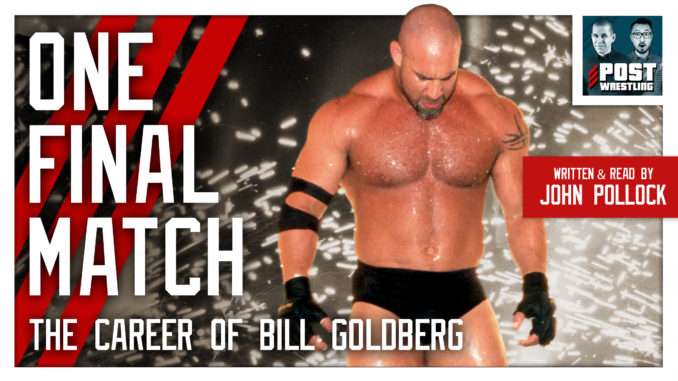
WWE’s latest prime time broadcast on NBC is centered on the retirement of 58-year-old Bill Goldberg and brings a range of opinions on his legacy.
For most of the past decade, Goldberg has been on standby as a reliable attraction from the romanticized Monday Night War era. It was an easy add-on, primarily for cards in Saudi Arabia, where Goldberg took the assignment seriously, getting his body in shape and putting in a short but hopefully explosive performance. The results were hit-and-miss, but with a three-year absence since his last match, now was believed to be the time to execute his retirement and generate one final audience off the Goldberg mystique.
After shooting an angle at last year’s Bad Blood show in Atlanta, it was established that Goldberg’s “TBA return” would be with Gunther. The answer was the same city where the angle was shot, where Goldberg holds deep roots, and airing on network television, as it engages in a battle for the wrestling fan’s attention with AEW All In Texas.
WWE opted to double down beyond just presenting Goldberg’s retirement, but added the World Heavyweight Championship to the match after Gunther regained the belt last month. It has muddied the waters with WWE de-emphasizing the retirement with a larger focus on Goldberg seeking revenge on Gunther and not being able to explain what would happen if Goldberg won. Further complications include WWE having less than a month before its two-night SummerSlam at MetLife Stadium and already beginning to tease an issue between Gunther and CM Punk for a future title match while Seth Rollins remains hovering with the Money in the Bank briefcase.
Saturday’s test is to see if Goldberg can command an audience for what most expect to be his legitimate retirement match, as the veteran has gone to extenuating lengths to be physically prepared. The show’s support includes matches involving Seth Rollins and LA Knight, and Drew McIntyre facing Randy Orton.
It will be WWE’s fourth edition of the latest iteration of Saturday Night’s Main Event since its return last December. The benchmark to hit is this past May’s special, highlighted by a rare John Cena match on television, and a steel cage bout between Drew McIntyre and Damian Priest, averaging 1,969,000 viewers and 0.54 in the 18-49 demographic. It was their largest audience of the three airings and a thirty-two percent viewership increase from January.
The career of Goldberg is a fascinating one, and if it ended after the fall of WCW, he may have been a blip on the radar among modern audiences. The ex-NFL player found a second calling and hit World Championship Wrestling like a tornado in the fall of 1997 and was the hottest thing in wrestling by the next summer. The MMA-inspired look and presentation were propelled by a tried-and-true concept of short and explosive matches akin to Magnum T.A. and Ultimate Warrior rolled up together.
Fans salivated when his familiar drumbeat began and Goldberg’s entrance became as memorable as the match to follow, heightened by his walk from the back, snorting pyro through his nose, as anticipation grew for the bell to ring and a countdown to the next jackhammer and notch on the growing win streak (outside of the 1,800 fans that saw the undefeated star lose to Chad Fortune in a dark match at a Saturday Night taping in July 1997).
Signs began popping up at arenas, keeping count of the streak. Suddenly, WCW had a phenomenon on its hands by early 1998, and Goldberg was becoming an accidental superstar who was every bit Steve Austin’s equal during a year when both companies were on fire. It escalated toward Goldberg winning the U.S. Championship from Raven and climbing the ladder to wrestle the major stars in the company, some of whom would take more convincing to be destroyed in under five minutes.
It was a simple formula, but it took buy-in from the opponent to see the bigger picture and what Goldberg meant for the company, which needed a fresh babyface star and translated to business moving in the right direction.
The seminal moment of Goldberg’s rise occurred on July 6, 1998, at the Georgia Dome for a hastily promoted WCW Championship match with Hollywood Hogan. With a month of promotion, it is hard to imagine this match wouldn’t have shattered WCW’s pay-per-view record and allowed the promotion to cross the $1 million threshold at the gate. But in a ratings battle, it was the ultimate bullet in the chamber to fire against its competitor, and with the match officially announced four nights before on Thunder, it was on.
The special edition of Monday Nitro drew 41,412 and a gate of $906,330 ($1,787,000 in today’s dollars) at the Georgia Dome and provided one of the most electric atmospheres for a WCW title match, ever. In eight minutes and eleven seconds, Goldberg pinned Hogan and was flanked by members of the Atlanta Falcons as WCW anointed its new star, and while the company was spiraling behind the scenes, it felt like it had solid command of the wheel on this night with a 31-year-old star to build the next era around. We know how that turned out.
The performance on TNT, combined with the audience watching Raw is War on the USA Network, was staggering:
The Hogan vs. Goldberg title change was the first quarter-hour in the history of pro wrestling on cable to reach five million homes, drawing 5,054,000 homes (in excess of seven million total viewers) or a 6.91 rating and 11.8 share, breaking the all-time record of 4,774,000 homes (6.53 rating and 10.7 share) set by the match where Hogan won the title from Randy Savage after a one-day reign on 4/20. The combined audience of both shows in the final quarter hour hit another all-time peak with 7,873,000 homes or a combined 10.75 rating and 18.3 share. (Wrestling Observer Newsletter)
The next six months were a dizzying set of misfires by the company, which have been dissected and discussed ad nauseam. Instead of becoming the clear-cut top star, Goldberg was wrestling Curt Hennig six nights later at the Bash at the Beach while Hogan took center stage with Dennis Rodman against Diamond Dallas Page & Karl Malone. One month later, it was Hogan & Rodman against DDP & Jay Leno while Goldberg was in a non-descript battle royal on the undercard of Road Wild. Then, the Ultimate Warrior came to WCW and took more focus away as Goldberg was clawing for the position he had been promoted to months earlier.
While WCW’s creative was tanking, the live event business was not showing those signs, yet.
The tail end of 1998 was nothing short of extraordinary, with the business that WCW generated over four weeks.
On December 7, it drew 32,067 and a gate of $755,995 to the Astrodome for an episode of Monday Nitro
Two weeks later, it was 29,000 and $914,389 for Nitro at the TWA Dome in St. Louis. This was the “go-home” Nitro before Starrcade, which attracted 460,000 buys at $29.95 for Goldberg’s defense against Kevin Nash.
The run concluded at the Georgia Dome on January 4 with 38,809 and $930,735, and only six months after Goldberg’s win in the same stadium.
But for the arguments that creative is subjective, the returns at all these venues in 1999 told the tale of where WCW was heading and turning off large percentages of its fan base.
WCW came back to the TWA Dome in May 1999 for the Slamboree pay-per-view and still drew a healthy 20,516, but the gate figure dropped by forty-six percent from December.
May 31 at the Astrodome, attendance fell in half to 15,004 and a gate decrease of forty-two percent.
The Georgia Dome decline was one covered the heaviest. The audience on January 4 bore witness to the “Finger Poke of Doom” with Hogan pinning Nash to win the WCW title after a bait-and-switch with Goldberg throughout the night. They came back in July 1999 with 25,388 and a gate of $594,745, or a thirty-six percent decline. It was also the company’s last card at the Dome.
The boom period was over, and the peak of Goldberg had expired, but he remained the biggest star for the #2 promotion in the world after WWE took a commanding lead in 1999 and beyond. The end of Goldberg’s winning streak was poorly executed, and its follow-up was even worse. Through millions of ideas being thrown against the wall, they would change his music, turn him heel, was injured for months after an errant stunt where the star put his arm through the glass window of a limousine as his mystique was challenged every week.
By late 2000, with all fresh ideas left for abandonment, they “re-started” Goldberg’s winning streak, where he would be forced to retire if he lost. The “streak” ended at the Sin pay-per-view in January 2001, teaming with Buddy Lee Parker against Lex Luger & Buff Bagwell when Goldberg was sprayed by mace before the loss, and became a trivia note as Goldberg’s last match in WCW.
Two months later, WCW was out of business.
Through a guaranteed contract at WCW and WWE, unwilling to upset its payment structure, there was no urgency for Goldberg to move to WWE. He had a lucrative back-up, taking occasional matches with All Japan Pro Wrestling, but was otherwise divorced from pro wrestling unless an offer was compelling.
WWE’s business sank after the purchase of WCW’s assets with a botched invasion story, a lukewarm reception to the company’s own version of the N.W.O., and an invasion redux using its internal television programs as the warring brands, Raw and SmackDown.
In 2003, WWE’s business needed a shot in the arm and was exacerbated by the 1-2 punch of losing Steve Austin and the full-time services of The Rock after WrestleMania 19. In a different outcome, Goldberg would have been the savior to at least be used as a band-aid until the next big star was discovered.
Goldberg was only thirty-six years old and had more than enough juice for a substantive run, but the issues that plagued the invasion and the N.W.O. reared its head again. Rather than take from the formula that was a proven success in 1997-98, WWE needed its own “evolution” in the Goldberg character ranging from new music, less reliance on the squash formula that built the mystique and a belief that he needed to work longer matches to meet the bar of WWE main events.
After negotiating a lucrative contract with limited dates, it painted a target on Goldberg’s back for having the audacity to work anything less than a full-time schedule. The creative staff famously orchestrated a skit where Goldust placed a wig on Goldberg, symbolic of the company’s total disregard and misunderstanding of what made Goldberg such a unique star for its defunct competitor.
There were glimmers of promise, including a well-laid-out Elimination Chamber match at SummerSlam in Phoenix where Goldberg tore through the participants before falling to Triple H’s sledgehammer. It deflated the crowd, but the argument was made of holding off Goldberg’s crowning as champion for one more pay-per-view cycle, beating Triple H at Unforgiven for a forgettable two months as champion. The belt was back on Triple H by year’s end, and Goldberg was eyeing the expiry date of his one-year deal, one where the company was all too ready to bid farewell.
An embarrassing WrestleMania match with Brock Lesnar was Goldberg’s swan song as the New York audience was aware both men were on the outs with WWE and took over the match. Bitter feelings on each side remained with Goldberg, intent on never working for WWE again, and he was not shy in the press to vocalize those sentiments.
Over the next decade, Goldberg did film work and attached himself to the growth sport of MMA as a commentator for PRIDE, WFA, Elite XC, K-1, and Glory kickboxing, and operating his own gym in San Diego, even flirting with the idea of taking a kickboxing fight.
He had the distinction of being on the call for Brock Lesnar’s first pro bout in June 2007 at the K-1 Dynamite card in Los Angeles as the former WWE star stopped Olympic judo silver medalist Min-soo Kim in the first round. Goldberg would never be found innocent of calling it down the middle, as his guttural “roar” was a popular sound byte as Lesnar dismantled his opponent in sixty-nine seconds.
A reunion with WWE seemed improbable, but through a third-party business arrangement, the door was opened.
2K had not only assumed the company’s video game license but also became an unofficial broker for talents on the outs to find an “in”.
After years of exile, Randy Savage would be plastered across the promotion of the WWE All Stars game in 2011, two years later it was Ultimate Warrior coming in through 2K as a entrée for a Hall of Fame induction, and in 2014, it was 2K (not Vince McMahon) that reached an agreement with Sting and led to his first (and only) run with the top promotion.
The next target was Bill Goldberg as 2K secured his name and likeness for its latest release in 2016, and the formula was in play for yet another improbable return. The story wrote itself as Goldberg had defeated Brock Lesnar at WrestleMania XX, and its monster needed fresh opponents in the worst way.
Paul Heyman played a key role in the updated presentation of Goldberg, where there were no wigs and no compromises. They wanted to present Goldberg in the authentic form and book to his strengths rather than mortgage his potential. It wasn’t 2003, and it was a lot tougher for Goldberg to look the part of the ass-kicking machine as he approached his fiftieth birthday.
Goldberg showed up on television and cut a hell of a promo, leading to the rematch with Lesnar in Toronto at the Survivor Series. In one of the bolder booking decisions in a conservatively minded WWE, they didn’t leave anything to chance. Rather than do the “one and done” where Lesnar gets his win back, they saw the legs Goldberg could have, and the decision was made to put the legend over in the strongest way imaginable for maximum interest in a rematch.
WWE presented an eighty-five-second main event where Goldberg pinned Lesnar clean with a Jackhammer and stunned the audience at the Air Canada Centre and those watching at home. It was ballsy and bold, attributes sorely lacking thirteen years prior when Goldberg desperately needed this attention.
They took the rematch to WrestleMania 33 in Orlando, going further by opting to have Goldberg unseat Kevin Owens as the Universal Champion and put the belt on the line with Lesnar, similar to the scenario this weekend with Gunther.
The two had a high-octane, all-action match in under five minutes, which was leagues above their 2004 embarrassment. The two exorcised those demons, and the loss at Survivor Series amplified Lesnar’s win.
It was believed that it was the end of the line for Goldberg, who got his proper sendoff in WWE to rectify the previous run, and was inducted into the WWE Hall of Fame the next year. But several factors led to Goldberg being called on for future matches.
In 2018, WWE entered a ten-year contract with the General Entertainment Authority of Saudi Arabia, with shows netting the company approximately $50 million per visit and relying on big names. Goldberg became an easy attraction to fill out these shows, wrestling in Saudi Arabia four times over the next four years.
For the amount Goldberg was making, it only made sense for him to be used in high-profile matches, which led to some resistance to his constant presence in quickly promoted title matches over the ensuing years. McMahon pulled the trigger on another Goldberg title win in February 2020, beating The Fiend to heighten a pencilled-in match with Roman Reigns for WrestleMania 36.
The global pandemic changed those plans as Reigns opted to stay at home and Braun Strowman took the empty spot, beating Goldberg inside of an empty Performance Center. Goldberg returned the next year for failed title challenges against Drew McIntyre and Bobby Lashley, and finally had the delayed match with Reigns in February 2022 – his last until this Saturday.
It’s hard to envision Goldberg doing another match after Saturday, but the caveat is always there, this being professional wrestling and all.
The legacy is an interesting one, and while never gaining support for a Wrestling Observer Hall of Fame induction, it doesn’t diminish the importance of someone who came along during a major boom period and extended it for WCW rather than riding its coattails.
Today, Goldberg either elicits a surge of nostalgia or an eye roll at the latest return; it comes down to whether you lived through his 1997-99 run. It is too short for a Hall of Fame career to stand on, and ultimately, his side was on the losing end of history. If his contemporary was Steve Austin, his own run on top was realistically three to four years from his anointment in 1998 to the heel run in 2001, and retirement two years later but there is no argument how instrumental Austin was to the saving of WWE from its mid ‘90s doldrums and leading it to heights. The fact is, Austin saved his company, while Goldberg’s exploits could not overcome WCW’s demise, and frankly, no one performer could.
The case study for Goldberg’s “What if?” is 2003, and if the WWE booking of 2016 had been transported to that era, what level of star could he have become with the industry leader? It was an exceptionally lean period in that post-Attitude Era, and even in limited doses, a Goldberg approximating his WCW peak could have at least been the bridge needed to get to the next set of stars.
If this is his final match, he’s an intriguing figure who entered the rarified air of a true “difference maker” during WCW’s zenith, exited during prime earning years, and returned for a capstone on his career.
While Goldberg’s age and WWE’s booking were never in alignment, the test is this Saturday for the 58-year-old to get a proper sendoff as one of wrestling’s biggest stars of the past generation, and whether he can attract a sizable audience for the final time.
Attendance and gate records, per the Wrestling Observer Newsletter
