
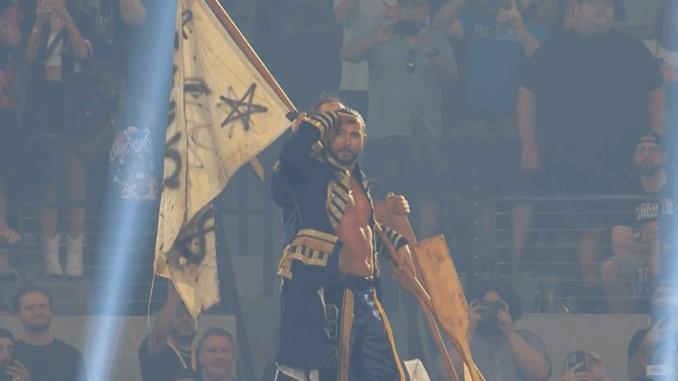
“We find ourselves engaged in conflict born of desire, power, and tyrannical control, and for this, we cannot stand. We will not tolerate the greed of men who wish to tarnish this sacred ground. We are better than those who dare encroach and claim what was founded based on the pursuit of liberty of the mind, body, soul, and the best professional wrestling in the world. We declare there is no room for the evil desires of others if we wish to protect the inestimable privileges for which we have been so long contending, which we have pledged ourselves never to abandon … We must fight. I repeat, we must fight.”
– The Young Bucks
When the dust settled after professional wrestling’s latest battle, the top promotions staged over twenty hours of content as they fought for your uninterrupted attention.
The second weekend of July isn’t one with a rich history of major pro wrestling events; it just happened to be the date where AEW booked Globe Life Field for its annual All In event in Texas. The idea was to air in prime time on pay-per-view following past iterations of the event held at Wembley Stadium in England. Company head Tony Khan would share that Coldplay’s booking of Wembley in August made it logistically impossible for a return, especially when the show has been booked around the August Bank Holiday weekend.
AEW made the announcement eleven months in advance, with tickets going on sale last December, allowing fans ample time to make travel arrangements and spend nearly a year building toward its apex show on the calendar. While it’s promotion “101” to get the word out early and loud, it also allowed plenty of time for a response strategy and WWE to release its plans for the weekend.
First, there was the news of Saturday Night’s Main Event being slotted directly against All In Texas and giving wrestling fans a free alternative to the pay-per-view. AEW had to place ego aside, and moved the show up by several hours, running in the afternoon to avoid direct competition for its biggest pay-per-view and the risk of leaving possible pay-per-view purchases on the table for WWE to cost them.
WWE was not done yet, adding its NXT Great American Bash show on Saturday, which would air directly against All In Texas and not allowing AEW any more wiggle room. Also added was the return of the Evolution concept for a Sunday night airing as WWE placed its stamp on the weekend with three shows to win over the attention economy and dilute AEW’s ability to have the weekend to themselves.
It is one of those examples where the wishes and actions of management run counter to the talent set out to fight these battles. For any talent inside a WWE locker room, it is to their benefit to have a strong competitor both for leverage and for their longevity. Most performers understand that, but it is a wrestling war, and it’s easy to default to the athlete mentality of wanting to “win”.
The weekend forces an analysis of AEW from the start of this promotion to its culmination and the impact it’s had on the company. When tickets went on sale in December, a sparsely attended event outside of Globe Life Field made this feel as far removed from its version of “WrestleMania” as possible. It wasn’t an isolated event, as fan sentiment for the once thriving alternative had sputtered, and worse of all, it had lost the image of being the cool product to a diverse fan set.
Over the past several months, when the direction became locked in and apparent on television, momentum started to manifest. The once derided Death Riders’ story suddenly wasn’t maligned, perhaps with an end in sight and the right star in Hangman Page set for a big moment after winning the Owen Hart Cup.
AEW has not turned back time to 2021 levels, nor are its weekly ticket sales fully reflecting an on-screen product that is routinely being praised for its booking and overall quality. But it isn’t the cold product it felt like last year, and the patience of disciplined booking, a major title change, and even the reveal of the physical belt resulted in one of AEW’s greatest shows in its history.
The jury is out on the success of the show because the determining factor is how this performed on pay-per-view and whether the competition made a dent.
From a live event and fan appreciation point of view, it felt like a major victory for AEW. Ticket sales hovered in the 14-15,000 range for months before slowly ticking upward as the card came into focus with Hangman Page’s chase for the belt, the first Okada vs. Omega match on U.S. soil, and the biggest women’s match that AEW has promoted.
The final tally from WrestleTix was just over 25,000 tickets distributed, and Tony Khan estimated the final number in the building could be closer to 30,000. Last Tuesday, the gate was hovering below $3 million, and with the final week of ticket movement, it is likely they hit the threshold and easily surpassed their all-time North American gate record. Both numbers are achievements and should be blasted out by the company; however, like last year’s Wembley show, they never touted the attendance on the broadcast or provided an updated gate number at the press conference.
Cagematch has the show rated 9.09 among its voters, with the Texas Deathmatch at 9.64 (#26 among all matches on the database).
The next focus is maintaining momentum after the big show and replicating what Cody Rhodes’ title win at WrestleMania 40 achieved for WWE, where the boom period didn’t culminate with the title win; rather, it was a wave they continue to ride today.
WWE’s assessment of the weekend will be polarized as they threw a lot against the wall, arguably too much, where much criticism was levied at the lack of promotion dedicated to Evolution, leaving the show feeling like a weapon in a wrestling war rather than a celebratory show. This was enhanced with the reporting by Bodyslam.net that the show was initially scheduled for its own weekend in Uncasville, Connecticut.
The show also fell on a weekend where Evolution wasn’t even the biggest all-women’s card on the streamer, as Netflix hosted the trilogy bout between Katie Taylor and Amanda Serrano and took up most of its promotional resources over the past week.
The positives from the weekend included Bill Goldberg’s retirement, which came off as well as one could hope for, involving a 58-year-old with obvious physical limitations and an aura to maintain. It was accentuated by a great speech after the broadcast, and was done in the right city of Atlanta.
While the build-up was criticized, the women’s show saw a lot of determined performers who saw this as much more than a monthly event, and were fighting for attention.
The week began with fewer than 5,000 tickets out at the State Farm Arena and announcements of seat upgrades, preparing for a lower turnout. By show time, the number had passed 8,300, and it looked perfectly fine on the broadcast. The paid ticket figure is unknown, but it was clear that this wasn’t the right weekend or city for two shows, much less three. WWE had to contend with a Beyonce concert on Sunday at Mercedes-Benz Stadium, MLB taking over the city for All-Star Week, and frankly, neither Saturday Night’s Main Event nor Evolution had the one big match or attraction to sell out the venue.
For those who watched Evolution, it was a very good show, highlighted by IYO SKY vs. Rhea Ripley with the surprise cash-in and title change involving Naomi, and a stellar opener involving Becky Lynch, Bayley, and Lyra Valkyria.
NXT seemed like collateral damage in this strategy, with a show that was as close to the analogy of a tree falling in the forest, but no one there to determine if it made a sound.
The ”flood the zone” strategy has led to an impossible situation for NXT as its last two premium live events have been put in that position to run against AEW, and will do so again on August 24, albeit not directly head-to-head, but on the same day.
They booked the smaller Center Stage for Atlanta with tickets still available the week of, which has nothing to do with AEW, running in another part of the country.
It created a weekend where one could either buy the AEW pay-per-view and spend most of their day on that one show, or watch anywhere from two to four-and-a-half hours at relatively and only requiring access to NBC or a Peacock subscription and getting their wrestling “fill” that way.
Most people are not tackling all this wrestling programming, and that’s the point; even ardent fans are forced to pick and choose, and it’s less about the head-to-head aspect and more about the finite factor, people’s time.
There is always an audience that will consume as much as the firehose will deliver, and in theory, the fan should win in scenarios where each company is trying to outdo the other and present the best cards possible.
Despite a major weekend for AEW, to discount the level WWE is operating under would be naïve. Creative directions have been under more critical eyes this year, Netflix viewership is being studied with WWE’s worldwide appeal, and countless masters to serve have led to a strain on the weekly consumer. But this company’s arena business is on fire, and they’re guaranteed revenue streams place them in a nearly impenetrable position. In three weeks, they’ll see well over 80,000 across two nights at SummerSlam.
Conclusions cannot be drawn over one weekend like this past one, but if this is the long game strategy, there will be weekends when AEW is not presenting its biggest card of the year, and other weekends where it won’t just be a rank-and-file NXT show airing against AEW. If the stakes continue to grow, at the same rate as the hours produced, there is the question of supply outpacing demand. The audience will decipher what shows are “major” and the others that are supplementary and become skippable, which historically is a bad habit for fans to pick up.
The game plan was presented in its clearest form this weekend, and fans are becoming savvier with each successive shot fired. Competition can be excellent for the consumer, but for those trying to enjoy both products, the tactics being employed are not for the fan to “enjoy all wrestling”, but instead, to choose a side and win the day.
