
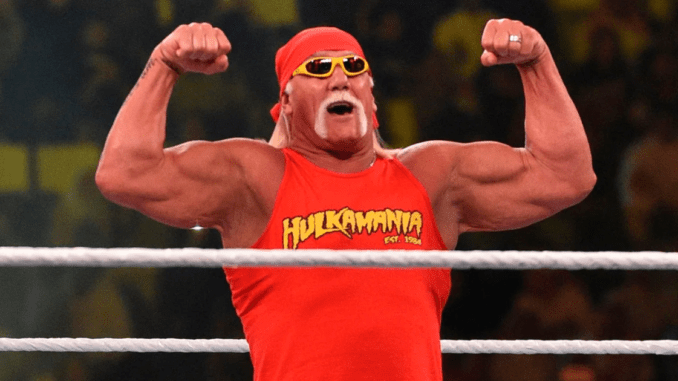
Terry Bollea, who became one of the biggest stars in wrestling history as “Hulk Hogan”, has died at 71.
TMZ broke the news that medical personnel were sent to Bollea’s home on Thursday, where the outlet reports that the operators handling the call believed it involved a cardiac arrest.
Hogan had been in rough health for months and had a neck procedure this past May. He had been absent from public appearances, including this past week’s announcement of Real American Freestyle joining Fox Nation.
Former friend Bubba the Love Sponge (Todd Clem) had been sharing various information on the status of Bollea’s health, painting a dire picture despite its downplaying by Hogan’s family members.
Stemming from the rumors, Bollea’s wife, Sky, issued a statement earlier this month to clarify the status of her husband’s health:
No, he’s definitely not in a coma! His heart is strong, and there was never any lack of oxygen or brain damage… none of those rumors are true.
He’s been recovering from a major four-level Anterior Cervical Discectomy and Fusion (ACDF), which is an intense surgery with a long and layered healing process. If you look it up, you’ll see what the last six weeks have involved… not just for his spine, but also for his vocal cords, and the eating/breathing tubes that are clamped over during surgery. We’ve been in and out of the hospital to support that recovery. So truly, there’s no need for the drama or panic some people try to stir up. He’s healing, and we’re taking it one day at a time with love, strength, and patience.
One day ago, Jimmy Hart seemingly responded to the same health rumors and posted that, “Hulk is doing great, doing phenomenal! Last night at karaoke with Nick was absolutely fantastic, baby!!!”
The name Hulk Hogan is, arguably, the most synonymous with professional wrestling itself, comparable to El Santo, Antonio Inoki, Rikidozan, Steve Austin, and The Rock, depending on your age and where you lived.
Bollea was a musician and became a wrestling fan in Florida, attending shows in Tampa, where he claimed that Dusty Rhodes was among his influences.
The story of Terry Bollea and Hulk Hogan has been mythologized to such a degree that separating fact from fiction was nearly impossible for the performer, who told so many tall tales throughout the years that it became part and parcel of his persona — many of which will be repeated in the major media stories to follow this week, no doubt.
We will have a much more sizable biography of his life and career in the days to come, but obviously, there was no bigger star in professional wrestling from 1983 until the rise of Steve Austin in 1998.
He first arrived in the WWWF in 1979, working as a heel with mouthpiece Freddie Blassie, before being repurposed as “Hulk Hogan” to appeal to the Irish audience in the Northeast.
Hogan got his first taste of Japan in 1980 and became a major star in New Japan Pro Wrestling, often crediting Antonio Inoki and Verne Gagne for teaching him aspects of working.
He became the AWA’s top star, but putting the title on Hogan became problematic, as he was not doing jobs during this period in order to maintain his aura for his Japanese commitments. Hogan was a major difference maker for AWA on the shows he worked, compared to the ones he was not available for.
In November 1983, he quietly struck a deal with Vince McMahon and walked out of the AWA, debuting for the WWF the next month and being crowned its champion on January 23, 1984.
The national expansion put Hogan’s face across NBC, CBS for Hulk Hogan’s Rock N’ Wrestling, and syndication across the country, spearheading the WWF’s move into pay-per-view.
Hogan was the promotion’s top national draw for memorable programs with Paul Orndorff, Kamala, Randy Savage, and Big Bossman.
Although a retread of past programs where they worked together at the Louisiana Superdome, Shea Stadium, and even in Alabama, the feud between Hogan and Andre the Giant saw its largest audience in 1987. The long-awaited heel turn by Andre as he went for Hogan’s title was the lightning rod that filled the Pontiac Silverdome in March 1987.
The after-effects of Hogan vs. Andre were felt as the WWF launched the Survivor Series in November 1987 with the two on opposite teams, a rematch on NBC in February 1988 that drew gangbuster numbers, another rematch at WrestleMania 4, and the first SummerSlam pay-per-view with Hogan & Savage vs. Andre the Giant & Ted DiBiase in the main event.
After an attempt to replace Hogan with Ultimate Warrior at WrestleMania 6 amounted to a failed transition of power, Hogan reclaimed the belt one year later and rode out the wave of Hulkamania until WrestleMania 8 in 1992. He left the WWF for a year and was mired in the company’s steroid scandal, with Hogan implicated as one of the figures receiving steroids from Dr. George Zahorian, who had gone on trial in 1991.
Hogan was seen as the prosecution’s star witness in the 1994 steroid distribution trial, but when he got on the stand, he would not flip on McMahon and ended up providing favorable testimony for his former employer. Despite that, McMahon still held a grudge over Hogan’s involvement, a sentiment which was later brought up during a promo segment the two shared during their 2003 on-screen feud.
Hogan’s swansong in the WWF occurred in 1993 after he dropped the title to Yokozuna and finished up with several live event dates.
After wrestling select matches with New Japan Pro Wrestling, he joined WCW in 1994.
He received a lucrative contract and yielded early results on pay-per-view, but his true impact occurred in 1996 as WCW’s live event business was taken to the next level with the creation of the New World Order and Hogan’s heel turn.
For the next two years, WCW was on fire with Hogan as the lead heel who dominated the championship picture.
The N.W.O. era was highlighted by the company soaring to financial heights in 1997 and 1998, with Hogan helping to draw two of the company’s strongest pay-per-view numbers in its history: In December 1997, Sting challenged Hogan for the WCW title. It was a commercial success but a critical failure in its execution. The two rebounded with another strong business result for their February 1998 rematch at SuperBrawl.
The N.W.O. fizzled throughout 1998 and, after Hogan’s disappearance from television, he returned in January 1999 for an impromptu title match with Kevin Nash, winning in the famous “Finger Poke of Doom” contest at the Georgia Dome.
WCW fell out of favor with audiences throughout 1999 and hit a tailspin by 2000 before shutting its doors in March 2001.
Hogan was embroiled in a lawsuit with Turner over the handling of a promo delivered by Vince Russo at the Bash at the Beach event in the summer of 2000, which ended up being Hogan’s final appearance for WCW.
There were constant reports of Hogan trying to launch a company on his own, which led to the short-lived XWF project in late 2001. Shortly after, Hogan returned to the WWE and had one of his biggest matches of that era against The Rock at WrestleMania X8 in Toronto.
This period allowed Hogan to work with Kurt Angle, Chris Jericho, and Brock Lesnar. He won the tag titles with Edge in a run that exceeded expectations.
In subsequent years, he worked with Vince McMahon at WrestleMania 19, was inducted into the company’s Hall of Fame in 2005, drew an impressive figure with Shawn Michaels at SummerSlam the same year, and wrestled Randy Orton at the following year’s event.
In 2009, he joined TNA Wrestling as the promotion tried to recreate the Monday Night War. It was an ill-fated attempt that only lasted a few months before TNA returned Impact to its prior Thursday night timeslot. Hogan would wrestle Sting one more time at the 2011 edition of Bound for Glory and remained in the company until 2013.
In 2014, he came back to the WWE as an ambassador and was celebrated as one of the greatest legends in the promotion’s history.
In the summer of 2015, the worst scandal of his career erupted when a tape was released of Hogan uttering the N-word multiple times in reference to his daughter’s then-boyfriend. The damning footage forced WWE to cease ties with Hogan and resulted in a massive stain on his legacy that has remained unresolved with a large portion of the audience. This was confirmed as recently as January of this year, with a loud negative reaction to his live appearance at the debut edition of Raw on Netflix at the Intuit Dome.
Over the past year, he tied himself to the Republican Party and spoke on behalf of Donald Trump at the Republican National Convention last summer.
His latest projects included the launch of Real American Beer and becoming the promotional face of Real American Freestyle.
Bollea was married three times and leaves behind his widow, Sky, and his children, Brooke and Nick.
We will have a more extensive write-up on his career in the coming days, along with a special podcast on Thursday.
