
Part 1 – The Early Years
Part 2 – WWF Goes National
February 5, 1988
Odds are, if you were home that night, you had NBC turned on as Hulk Hogan defended his championship against Andre the Giant in their WrestleMania rematch.
The objective was to get the championship off Hogan after four years, protecting the top star in losing, and launching the promotion for WrestleMania IV around the state of the championship.
From a booking standpoint, it was one of the most brilliant ideas of its time and lodged in every fan’s memory. Ted DiBiase had sent Andre as his henchman to obtain the prized title and deliver it to The Million Dollar Man. DiBiase’s insurance policy was Earl Hebner, the evil twin brother of lead official Dave Hebner.
Earl had quietly left Jim Crockett Promotions and would make his grand arrival in this match with the story that DiBiase had concocted a scheme involving plastic surgery to create a decoy to replace Dave and count to three despite Hogan’s shoulder being lifted from the mat. It was a stunning result as most fans had never seen a world where anyone but Hogan had been their champion.
Andre’s attempt to hand over the belt was thwarted, and Jack Tunney held up the title to be decided in a 14-man tournament as the centerpiece of the fourth edition of WrestleMania in Atlantic City, New Jersey.
The NBC special was a gigantic success, with Nielsen reporting an average viewing audience of 26,640,000.
In many retrospectives, you will hear the often-cited figure of “33 million viewers,” and there’s a reason for that. Often, television estimates were immediately released using the standard estimate of 2.4 viewers per home before the final numbers were released. Nielsen’s numbers were based on their figures of the NBC special having 1.95 viewers per home, to get to the slightly lower average audience.
It is virtually impossible to imagine any wrestling match being viewed to that volume ever again. At the peak of the Attitude Era, Steve Austin and The Undertaker attracted an audience of 10.7 million in 1999, and the only relevant comparisons would be the biggest matches in Japanese history on broadcast television, which could eclipse the Hogan and Andre match.
The transition from Hulk Hogan to Randy Savage occurred at WrestleMania as Hogan and Andre ousted one another in the second round of the tournament, clearing the path for a new babyface star to take the crown and run with the championship.
The long-term was Savage as a heel, and WrestleMania 4 would kick off a year-long story to the eventual showdown with Hogan. It kicked into gear at the inaugural SummerSlam event in August as The Mega Powers of Savage & Hogan beat The Mega Bucks’ DiBiase & Andre, once again leaning on Hogan and Andre to launch another event.
In the post-match celebration, a visible glare by Savage toward his partner, revealing his jealousy and possessiveness of his wife Elizabeth, was the seed that would bear fruit over the next nine months.
With the support of NBC to hatch the breakup of The Mega Powers, the main event of WrestleMania 5 was set for a return date in Atlantic City and a major grudge match in the headline position. Savage and Hogan would combine to generate approximately 650,000 buys on pay-per-view, a figure that WrestleMania wouldn’t top until 1998.
For the second year in a row, WrestleMania was also competing against a free cable special by Jim Crockett Promotions (recently purchased by Turner) as its Clash of the Champions special was broadcast from the Louisiana Superdome with Ricky Steamboat defending the NWA Worlds Heavyweight Championship against Ric Flair. It was a poorly promoted special, leading to the exodus of booker George Scott, and only attracted 5,300 fans to the NFL stadium and a 4.3 rating on TBS.
Hogan was back on top, reclaiming the championship from a red-hot Randy Savage. After WrestleMania, they took the program around the country with Savage becoming one of Hogan’s all-time great opponents.
In June 1989, “No Holds Barred” was released. The film was the first vehicle built around Hogan and nemesis Zeus (Tiny Lister) as the WWF partnered with New Line Cinema.
It was not a box office hit, but it did introduce impressionable wrestling fans to the term “Dookie” five years before Green Day.
WWF did manage to cash in on Zeus with one of its great promotional build-ups for a character to wrestle in the main event of the second SummerSlam in August. Zeus would team with Savage against Hogan and Brutus Beefcake and relied on production techniques such as Zeus placing himself on steel steps to overshadow the diminutive Hogan and get across his vaunted nerve hold.
It was a stroke of promotional genius, taking a non-wrestler and presenting him as the ultimate threat, leading to a sellout at The Meadowlands and 575,000 buys on pay-per-view. Whether they felt they got all they could out of Zeus, the decision was made for Hogan to pin Zeus clean with the leg drop in the tag, followed by a singles match later that year when they presented “No Holds Barred: The Match / The Movie”.
The new decade arrived, and Hogan was now 36 years old but had been on top for six years, and McMahon was eyeing the future. His candidate was Jim Hellwig a.k.a. The Ultimate Warrior, who had come from World Class and protected in short and explosive matches fueled by out-of-control promos that were most intense and meandering but charismatic, nonetheless.
The transfer of power was set for April 1 at the brand new SkyDome in Toronto, a hotbed for both WWF and Hulk Hogan. This time, there would be no evil twin referee, or a Dusty finish, or any type of shenanigans. Hogan was going to lose clean, and the WWF was going full steam ahead with Warrior as its new top star.
It’s one of the unique aspects of professional wrestling where what is good for the team isn’t always good for the performer. Every star has themselves to protect because their value as a star is only as strong as their perception to the audience; no one was more keenly aware than Hogan of protecting that image at all costs.
The performance at WrestleMania 6 was a display of Hogan’s innate sensibilities of carrying out the promoter’s wishes, but keeping the audience wanting more of Hogan. After Warrior’s pin, it is Hogan that laments the loss, holds his title in despair, and hands over his prized possession to the rightful winner, walking off into the sunset as Gorilla Monsoon proclaims, “Hulkamania will live forever”.
Hogan lost the match, but he won the game, and that is the industry in a nutshell. For the fansexitinge SkyDome, the story of the night was that Hogan lost instead of Warrior winning. Within months, WWF realized the same.
Hogan pivoted in the summer and engaged in a program with John Tenta a.k.a. Earthquake, which ended up overshadowing the main event of Ultimate Warrior and Rick Rude at SummerSlam in Philadelphia and drawing a comparable number of buys to WrestleMania.
A Warrior vs. Hogan rematch was never produced, and the Warrior’s title run ended in January 1991 with Sgt. Slaughter was used as the bridge to get the belt back to Hogan at WrestleMania 7 at the L.A. Sports Arena.
It was an awkward step back because the audience had been sold on Ultimate Warrior as the evolution of the WWF and a company moving toward the future; now it was going back, and the Hulkamania surge was waning.
A controversial decision to attach the lead heel, Sgt. Slaughter with Saddam Hussein as an Iraqi sympathiser during Operation Desert Storm left a bad feeling among fans, advertisers, and broadcasters.
The glory days on NBC were ending. After the April 27, 1991, edition of Saturday Night’s Main Event attracted 9.35 million viewers, it was dropped by the broadcaster and would send the franchise to Fox for a short spell before it too dropped the property.
The sheen on WWF was deteriorating and was only going to be challenged in the years ahead as Hogan and the company underwent numerous scandals and terrible press.
In 1991, Dr. George Zahorian, a Pennsylvania State Athletic Commission doctor assigned to WWF shows, was indicted and put on trial for illegal dispensing of anabolic steroids.
The trial brought media attention because it was believed that the iconic Hulk Hogan would need to testify. However, lawyer Jerry McDevitt was able to convince the judge that Hogan’s testimony would do damage to his character and image, and through that legal maneuvering, Hogan was excused from testifying, although he was named in testimony by Zahorian and repeated by his lawyer in the closing arguments.
Zahorian was found guilty and spent the next three years in prison and was ordered to pay a fine of $12,700. But the residual effects were felt by Hogan, whose name was linked to steroid use and was akin to a scarlet letter among athletes in the era, and this magical wonder drug.
Steroids were hardly a new phenomenon and can be traced back decades in usage, even in pro wrestling, but were greatly popularized in the modern era of physiques with no larger avatar than Hogan.
Clandestine terms like “the look” and passing the “airport test” all became euphemisms for size, often obtained through extreme means and an unofficial rite of passage if you wanted to succeed in the WWF. There was no need for a list of requirements listed on the door; all one had to do was look down the bench at the competing physiques to understand the rules and what equipment was necessary to succeed.
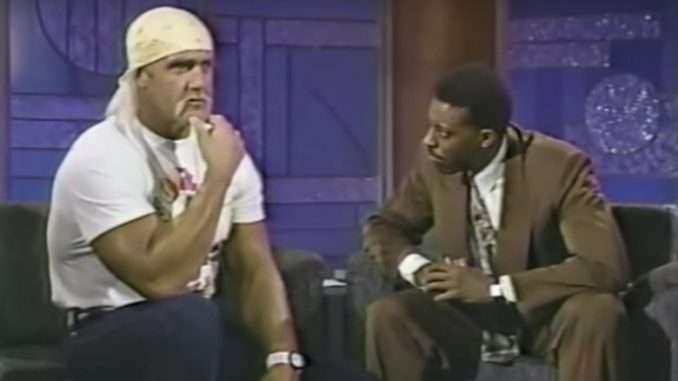
The heat on Hogan reached enough of a peak that he agreed to go on The Arsenio Hall Show on July 16, the same day WWF had invited members of the media for a symposium to introduce its plans to invest in a comprehensive drug testing policy. The famous interview saw Hogan admit to the use of steroids…three times…for injury rehabilitation purposes. Like the loss to the Ultimate Warrior, he would admit defeat but try to keep the audience rooting for its hero and not compromising his image and the business that image supports.
It was a letdown and an eyeroll for many in the industry who knew the score with Hogan, but none were more aghast than Hogan’s previous idol, Superstar Billy Graham (Eldridge Wayne Coleman). It was on Arsenio where Hogan denigrated Graham, who knew Hogan was lying and set out on a vengeful media tour to discredit Hogan and draw further attention to the steroid allegations. Years later, Hogan would have to admit under oath that he lied on Arsenio and first came into contact with steroids in the ‘70s.
The headlines were no longer about the burgeoning business or Vince McMahon as the “Walt Disney of Professional Wrestling”; instead, it was steroids and drugs, as business declined, and the worst was yet to come.
By 1992, the eye test revealed the impact on Hogan as his physique was rapidly decreasing, and reading the room, all sides believed it was best for Hogan to leave the stage. That was the setup for WrestleMania 8. A retirement tease orchestrated by McMahon and Hogan, with the idea that his match with Sid Justice could be his last.
The walls were crumbling in Titan land as a massive sex scandal erupted, placing steroids and accusations of sexual abuse among minors at the forefront of the WWF’s image. With the resignations of Pat Patterson, Terry Garvin, and Mel Phillips, McMahon was on the defensive, forced to confront these heinous allegations of ring boys being abused under his watch while his top star was under the gun and heading for cover.
In 1992, WrestleMania was used as a transition from Hogan to the returning Ultimate Warrior, who had been suspended for no-showing dates the previous summer. The idea was that WrestleMania 8 would end the Hogan chapter and restart the Warrior version. By year’s end, Warrior was gone, a terrible fit for a company trying to exercise a semblance of a competent drug testing policy.
After lying low for the next year on the pro wrestling front, Hogan was called to return for the next year’s WrestleMania in Las Vegas. As noted in the recent WrestleMania IX: Becoming a Spectacle that WWE released, the company had only sold 2,000 tickets for the event in Las Vegas after eight days. It needed a shot in the arm (only figuratively), and plans for a long-term run with Bret Hart as champion were mortgaged in favor of nostalgia and turning back the clock for one more Hogan run.
Once Hogan was added to the card for a tag match with Brutus Beefcake against Money Inc., the promotion of the event shifted toward Hogan’s match as the drawing event above Bret Hart and Yokozuna’s title match.
The negative press was enough that WWF felt the need to tackle it during a sit-down interview where Hogan referred to the “Tabloid Terrorism” he was a victim of and while admitting to “mistakes”, didn’t opt to be specific and just stating that lies were reported about him and took aim at the media for their role in his image being harmed.
Two days before WrestleMania, McMahon informed Hart of the new direction and Hogan would leave Caesar’s Palace with the title. Hart didn’t just take it as a vote of non-confidence, but McMahon going against his word of Hart having a “Bruno Sammartino-like” reign that would last years, not months. It wasn’t just about ego, but also financial, as Hart shared in his book HITMAN, as champion, his pay “tripled” to $6-7,000 per week on top.
It was years removed from their days working in Georgia Championship Wrestling, and now, Hart was not as apt to cede territory back to the star of yesterday, and a political rivalry was hatched. Hart believed that he would get his big match with Hogan at that year’s SummerSlam, including a fact in his book that the two had a photoshoot in May where they orchestrated a “tug-of-war” with the title. Instead, Hogan would drop the title to Yokozuna in June, perform on several live event dates, and his short-lived return was over. The underlying issues would not be resolved before Hogan’s departure and were placed on the back burner, and rear their ugly head when Hart and Hogan would find themselves in WCW years later.
Unlike 1992, this was Hogan’s exit from WWF as he turned 40 that year, and that was a derisive number in McMahon’s calculus for his top star. McMahon felt he could take the formula used for Hogan and apply it to Lex Luger as the next All-American babyface, but it failed, and as history shows, the next superstar was likely going to be a polar opposite from the previous one.
Hogan had an alternative option beyond the WWF in his former outfit of New Japan Pro Wrestling. Hogan had struck a lucrative deal that called for a reported $150,000 per match, struck before his exit at WWF. His four-match deal began with Keiji Muto at the Fukuoka Dome in May 1993 while Hogan was still WWF champion and caught heat for diminishing his championship in favor of the real prize, the IWGP Heavyweight Championship.
He returned in September for a pair of matches, including a rematch with Muta in Osaka, and made one more trip to defeat Tatsumi Fujinami on January 4, 1994, at the Tokyo Dome.
His focus was geared toward acting, and his latest project, “Thunder in Paradis,” was greenlit for 22 episodes in 1994 with Hogan in the lead role. The legacy of the show is not its one season of existence but a meeting, reportedly set up by Ric Flair, to get newly installed WCW Executive Producer Eric Bischoff in front of Hogan.
It was the launch of Hogan’s next act, and for the first time, Vince McMahon’s top star would now become his opposition and leading to the next popularity wave for the industry.
Part 4 will cover Hulk Hogan’s arrival in WCW and his role in the steroid trial, the N.W.O., and the downfall of the promotion
