
Part 1 – The Early Years
Part 2 – WWF Goes National
Part 3 – Tabloid Terrorism and WWF Exit
Part 4 – The WCW Years
Part 5 – The Return to WWE
By late 2009, Hulk Hogan’s personal life had been turned upside down as he reeled from the impact of a divorce, his son had undergone prison time for his role in a car wreck that left John Graziano with permanent brain damage, and the Hogan brand had become attached to tabloid celebrity culture.
Physically, Hogan was a shell of his former self, and while the outside world was poking fun at the Hogan name, the wrestling industry still held him in reverence, as memories die hard.
With partners, Hogan staged a tour of Australia in November 2009, working with longtime friend and foe Ric Flair on each night of the four-city tour. Hulkamania: Let the Battle Begin was an attempt to deliver Hogan to a country he had not wrestled in since 1986, and was enough of a draw to get a local television deal for the events.
The tour was marred by Hogan suffering a hip injury on the first night, but he gutted his way through four matches with Flair over the week-long stay. Attendance was paltry, and it became a “one and done” attempt.
Before taking off for Australia, a press conference was held at the Theatre at Madison Square Garden as TNA president Dixie Carter introduced Hogan and Eric Bischoff as the newest additions to the company.
TNA had grown out of a weekly pay-per-view format in 2002, narrowly escaping death within its first months, finding television partnerships on Fox Sports Net, and landing a big spot on Spike TV in October 2005. Company co-founder Jeff Jarrett has stated that TNA reached profitability in 2007 after expanding its weekly Impact Wrestling program to two hours in prime time on Spike and had its most profitable year in 2009.
They opted to put all their chips on the table by spending on the services of Hogan, as Dixie Carter took a central role. Jarrett was placed in a powerless position as minority owner, providing his role as strictly a talent during the 2010 period.
On January 4, 2010, TNA ran a three-hour edition of Impact promoted around Hogan’s first appearance in the Impact Zone and going head-to-head with the return of Bret Hart to WWE on Monday Night Raw.
It was the most-watched episode of TNA in its history, averaging 2,190,000 viewers and peaking at 3,360,000 viewers for a segment involving Hogan, Bischoff, and their former N.W.O. compatriots.
TNA revamped its image overnight, ditching its six-sided ring for the traditional four sides, adding the likes of Jeff Hardy, Ric Flair, Val Venis, and The Nasty Boys to the mix, and getting rid of Christopher Daniels fresh off a set of main event matches on pay-per-view.
In March, they made the permanent move to Monday nights and were slaughtered against WWE, opting to revert to its Thursday night slot before the summer and waving the white flag.
Hogan was promoted as its biggest star but was so physically limited that he would only wrestle four times over four years, his first being a tag with Abyss against Flair & AJ Styles that lasted just over two minutes.
TNA thought it was WCW in 1994, and Hogan would open the company to a larger audience, more marketing opportunities, new sponsors, and compete with WWE. The reality was that the brand mortgaged its identity to become a facsimile of a version of pro wrestling they had experienced and lived through, while incurring tremendous expenses with talent additions, touring the country, and failing to grow the audience.
The Hogan saga with Gawker would begin while at TNA, when the irreverent site would post a clip of a sex tape involving Heather Cole, the now ex-wife of Todd Clem a.k.a. Bubba the Love Sponge. The act was filmed in 2007, unbeknownst to Hogan, after his marriage to Linda had broken down, and with the approval and encouragement of Bubba.
Later, a portion of one tape shows Bubba speaking to Heather afterward, suggesting that the tape could be their retirement, referring to the value of catching Hogan on tape. All the while, Hogan and Bubba would espouse a friendship that had been widely known for years. Bubba would state that the DVD was stolen from his office and was labelled “Hogan”.
While rumors persisted of potentially damaging content involving a second tape, the first Gawker story in October 2012 was essentially contained to this famous pro wrestler caught having sex on tape, which would prove embarrassing but not enough to sink his cache with the wrestling audience or business partners.
Hogan was forced to address the controversy head-on as he was scheduled for major media for TNA’s Bound for Glory show that month, and it was the topic everyone wanted to address.
Hogan initially sued the Clems for invasion of privacy, and a settlement was quickly reached. Hogan’s biggest target was Gawker and kicked off a years-long legal battle, where Hogan was not deterred when a federal court found that Gawker did not violate any copyright laws by posting the clip. Instead, it went to the Florida state court, which would lead to the site’s sinking and create a major chilling effect for future journalists, based on the jury’s decision.
Hogan sued the site for $100 million, claiming loss of privacy and emotional pain. But it was only the tip of the iceberg.
After four years, Hogan memorably left TNA, filming one final scene in the Impact Zone as Dixie Carter clung to his leg, begging the star not to leave TNA.
It was TNA, and not WWE, where Hogan would wrestle his final match as he teamed with James Storm & Sting against Kurt Angle, Bully Ray, and Bobby Roode on its Maximum Impact Tour in Manchester, England.
The physical price Hogan would pay for his vocation was a laundry list of back surgeries and various ailments that left him struggling to walk by the latter years of his life, and disqualifying the notion of “one more match”.
With enough time and a new streaming network to promote, Hogan was welcomed back to the WWE in 2014 as a brand ambassador and making cameo appearances, including the start of WrestleMania 30 with Steve Austin and Dwayne “The Rock” Johnson.
It seemed that Hogan had come out of the sex tape scandal without too much of a stain, was back working in WWE, and by the summer of 2015, he was appearing weekly as a judge on the Tough Enough series on the USA Network.
The other shoe finally dropped in July 2015 when the National Enquirer and Radar Online reported on the transcript of a tape involving Hogan going on a racist and homophobic tirade after having sex with Clem. Later, the audio was published on the Death and Taxes outlet.
It would be the story that sunk his reputation among so many former fans:
She [Brooke Hogan, who would have been either 17 or 18 at the time] is making some real bad decisions now. My daughter Brooke jumped sides on me. I spent two to three million on her music career. I’ve done everything like a jackass for her. The one option Brooke had, Brooke’s career besides me is (to) sell beach records.
He also said to Heather Clem, when talking about a black billionaire who was helping fund his daughter’s musical career:
I don’t know if Brooke was f***ing the black guy’s son (Brooke had a boyfriend named Stacks at the time who was the son of a famous record producer). I mean, I don’t have double standards. I mean, I am a racist, to a point, f***ing n***** , but then when it comes to nice people and shit, and whatever.
I mean, I’d rather if she was going to f*** some n*****, I’d rather have her marry an 8-foot-tall n***** worth a hundred million dollars, like a basketball player.
He also said:
F***ing N*****…he had Jamie Foxx coming in on the 22nd track. I didn’t even tell Brooke about it. F*** her. Brooke and (the name he mentioned was not released) met in Miami. Brooke f**** up a $10 million deal I had with the Saudis. Brooke says, `F*** you dad.’ She’s never said that. She flipped a bird at me.
On that tape, he also said, “I have this huge F***ing house in Miami (the house purchased for one of the seasons of “Hogan Knows Best”). My family never comes home. They went to L.A. F*** ‘em.”
His homophobic rant was when talking to Heather Clem about how VH-1 producers of the “Hogan Knows Best” reality show that was doing its filming season at the time, wanted to do a segment where they would go back to the house he grew up in.
VH-1 wanted me to do a big thing and go back to the house I grew up in. So we knock on the door, and a big f– lives there now.
He added, “This half-gay was enamored with Linda.”
The tirade was aimed at Cecile Barker of SoBe Entertainment and his son, Yannique De Lisle Barker, who Hogan believed was dating Brooke. The language is enough to wince at, but hearing the disdain in his voice and inflection took it to another level and was impossible to unhear.
WWE immediately cut ties with the radioactive star, and he was essentially erased from any mentions on screen, replaced by The Miz on Tough Enough, and the promotion created as much distance as possible.
Hogan’s damage control included an apology issued to People Magazine:
Eight years ago, I used offensive language during a conversation. It was unacceptable for me to have used that offensive language; there is no excuse for it, and I apologize for having done it. This is not who I am. I believe very strongly that every person in the world is important and should not be treated differently based on race, gender, orientation, religious beliefs or otherwise.
I am disappointed with myself that I used language that is offensive and inconsistent with my own beliefs.
It was a reckoning for fans and colleagues alike, many of whom were experiencing the death of their real-life superhero in a way they would never have to confront their feelings toward a Marvel or DC character.
In the world of celebrity, second, third, and fourth chances are at many stars’ disposal if they opt to take them. Hogan was a unique example because so much of his persona was baked into the art of a “con,” whether it was embellishing facts and figures, creating mythology out of pure fiction for maximum effect, or ludicrous statements that undercut the basic logic capacity of his audience.
Hogan was a lot of things, but sincerity was not a familiar trait, and now, in his darkest moment, sincerity was desperately needed, and it was coming from a man who could never convey it.
Years later, as is always the case, WWE softened its stance, and when it was safe to venture back into the Hogan waters, they did and brought him back in 2018. The disgraced star did himself no favors during a famous locker room meeting with the talent to address the elephant in the room, but reports emerged that the tone was not one of regret but painting himself as being caught on tape and warning the talent of the dangers in the digital age.
Titus O’Neil shared his reaction in 2018 on Busted Open Radio:
At the end of the day, the company made a decision. I support the decision. I actually support having one of the most iconic figures in WWE history in Hulk Hogan be in the WWE Hall of Fame. What I don’t support is the apology that was given in regards to the words and the actions he exhibited years ago. To me when you have true remorse for being sorry about doing something, It’s pretty simple. You don’t have to be prepped to say certain things and you certainly don’t want to make excuse.
Earlier this year, when Hogan was booed out of the Intuit Dome, Mark Henry spoke with TMZ and said, “He never wanted to go forward and fix it. That’s what happens when you think everything is gonna go away. It’s not gonna go away. He thinks it’s gonna go away. That it’s not gonna be that dark cloud over his career. I offered to say hey, ‘Let’s do a tour of the Black colleges and law schools, and explain what happened.’ He didn’t want to do that.”
Fans were forced to either separate Hulk Hogan from Terry Bollea or acknowledge that their childhood hero wasn’t what he presented on screen, and it became a major anchor to Hogan’s legacy up to and including his death last week.
While on the outs at WWE, Hogan continued his lawsuit, and it climaxed with the trial in 2016, with a jury awarding Hogan $140 million and eventually, settling on a figure of $31 million with Gawker unable to post the necessary bond to pursue the appeal process, and the site declared bankruptcy under the burden of the judgment.
Like a wrestling angle, there was a “Wizard of Oz” financing Hogan’s legal battle, revealed as billionaire Peter Thiel, who long held a grudge at Gawker, spurred by the site’s outing of the tech giant as homosexual.
Today, journalists across the U.S. are living with the realities of reporting on powerful figures with “lawfare” at their disposal, whether it is Iowa pollster J. Ann Seltzer, ABC, George Stephanopoulos, or the Wall Street Journal. There are legacy media outlets that can afford to defend themselves or afford eight-figure settlements, but plenty more that cannot. It has a chilling effect when a journalist is faced with this level of legal ramifications and opts to avoid reporting on such a story to begin with.
Gawker was far from without fault, and many can merit the newsworthiness of a sex tape where one of the individuals is filmed without their consent, but a worldwide celebrity unleashing racist and homophobic slurs would qualify.
Like the Donald Sterling case in the NBA, you can both agree his privacy was violated while also not absolving the individual from what was said.
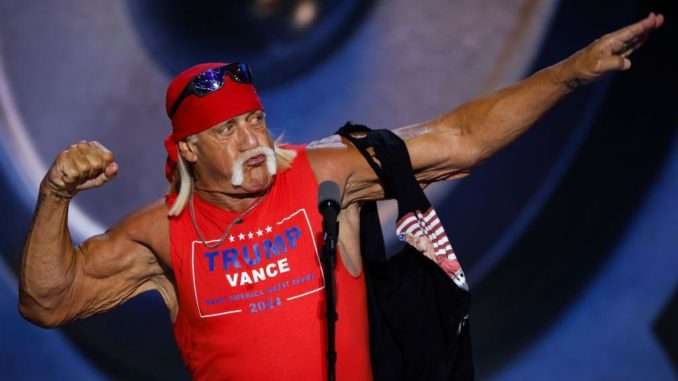
In the past year, he attached himself to the Republican Party and became its avatar at the RNC last year. This was an audience that embraced Hogan – warts and all – and owed no apologies to, and in his passing, has been the side of the aisle that has rigorously celebrated the good and minimized his mistakes.
Hogan’s legacy was never the same after this incident, and in a digital age, it is far more difficult to escape controversies where the results are shared and accessible within seconds.
For someone who lived for the pop and adulation, his final moment in front of a WWE audience was being booed out of the arena, a collective vote among the current base that it was ready to move beyond Hogan as a central figure in this new “Netflix era” the show was launching.
Then it ended on July 24th, 2025.
Amid rumors and speculation from Bubba the Love Sponge that Hogan’s health was dire, those around Hogan’s orbit kept the news private, and yet another instance of what was fact and what was fiction.
His death has forced his audience to decipher the question of who this man was. It was impossible to know if the red light was on, and in the digital media age, there was always a red light and always an audience, and therefore, someone to sell to.
It was appropriate that his death only divided people further, tasked with the chore of “picking a side” to honor or dismiss his passing. Like Hogan, the answer was never an easy one, and encompassing Hogan’s life is not easy.
While we can mourn the memory of a man who brought entertainment to many, provided great services through his charity work, and grew his industry. But he was a man with many faults, and there are consequences for those actions.
Over time, Terry Bollea and Hulk Hogan became virtually indistinguishable, and separating the two was nearly impossible. For some, they must do so to preserve the “make-believe” rather than confront reality.
We can throw out words like “complicated,” but that’s just the problem; for many, there is nothing complicated about this at all.
Some lived by the words of Hulk Hogan, while others’ fandom died because of the ones uttered by Terry Bollea.
We’ll never know where Hulk Hogan ended and Terry Bollea began, and in the end, it doesn’t really matter.
