
By: Félix Gouty
The last Sunday of August 2025 was a special day for pro-wrestling in France. Six hours before more than 30,000 fans entered Europe’s largest indoor stadium, Paris-La Défense Arena, to witness WWE’s last PLE on Peacock, Clash in Paris, around 250 packed in a small wedding venue nearby bid farewell to one of French pro-wrestling’s proudest sons. “Don’t forget me,” said the emotional young man in a mask known as Aigle Blanc (or White Eagle) in the squared circle. “One way or another, we’ll see each other again, and in the meantime, please keep supporting this new generation full of sickos of the ring!” Thus ending a weekend where this generation of French performers indeed shone bright.
As historic a show as it was for this part of the world, last year’s WWE card in Décines-Charpieu, WWE Backlash France, only attracted one independent show to gravitate around it. This past weekend, the Paris metropolitan area hosted four such shows: Drag Attack’s Divas in Paris on Friday night, right as WWE broadcasted Smackdown live from last venture’s LDLC Arena (which, by the way, was free from any independent event this time around); Khao Wrestling’s Retour aux Sources (Back to basics) and later French Touch, a crossover between BZW and APC, on Saturday; and lastly, in the morning before Clash in Paris, APC’s The Last Dance. On any recent WrestleMania weekend scale, this list may seem short, but to French workers and fans, this was the country’s first attempt at emulating the same diversity, enthusiasm, and success.
Proudly independent
Eager to deliver, Kuro is 26 years old and already carries three belts (APC and CACC’s main championships in France and one-half of OTT tag team titles in Ireland). “I’ve wrestled during this year’s Wrestlemania weekend in Las Vegas [for Progress and BZW], and it feels weird to encounter the same mood here,” he confessed to POST Wrestling on Saturday afternoon. “We all definitely feel the pressure to show how talented we are to as many fans as possible. I feel like we have two objectives this weekend: to deliver each time without hurting ourselves and to make it work so we can replicate such a special occasion next time WWE comes by – or even on our own.”
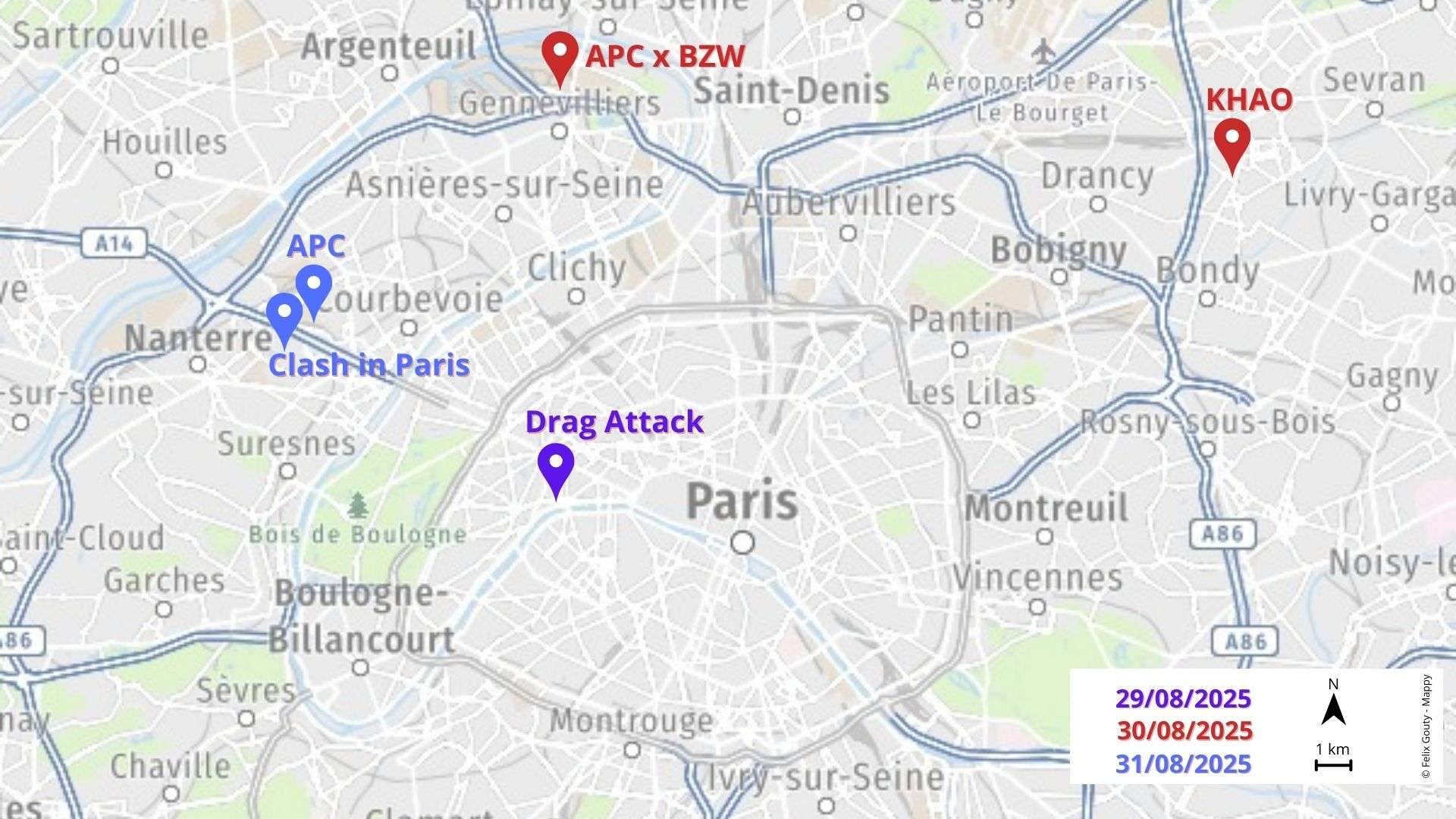
Like many of its local colleagues this weekend, Kuro began his four consecutive bookings with Drag Attack. Launched in October 2024, the promotion was the only one providing a show within Paris itself. Renting the Yoyo night-club on Friday night, Divas in Paris couldn’t ask for a more adequate place. Situated under the Palais de Tokyo (Tokyo Palace), Paris’ foremost museum on modern and contemporary art, located near the Eiffel Tower, the event was meant as a prelude to an all-night Haus of Gaga concert. The perfect match for Drag Attack’s offering, combining music performances by drag queen artists with wrestling bouts, proudly empowering talents and narratives from the LGBTQ community and its allies.
Inspired by the success of TV shows such as Drag Race and structures like A Matter of Pride in the US, its promoter and star, Jazze Parry, an openly trans wrestler with just four years of experience, surely brings the most unique proposition the French wrestling has ever seen. “I fight against the wrestling norm, including WWE’s political vision of it,” (author’s translation) she proclaimed in an interview in May. To illustrate this sentiment, a video of Jazze addressing the audience opens every show, telling the spectators what to do and, most importantly, what not to do with the performers, whilst also setting the slapstick tone and sexual humor of the night. “At the same time, we try to free ourselves of any toxicity backstage and offer awareness by bringing in people from associations like SOS Homophobia,” Parry mentioned as well. “I think what I like the most about Drag Attack shows is to see regular wrestlers perform in a much more inclusive context than usual,” said Camille, an exhibition curator specialized in looking at contemporary art through the lens of pro-wrestling. “We can visibly see how free and inventive they can be, and the genuine fun they get from it.”
On that particular night, “conventional” wrestlers from the wrestling scene tangled with stars like The Boy Diva, a drag wrestler from New-York City, or Nixi XS from St. Louis, and played happily along with their own homoeroticism in a room mixing the regular wrestling crowd with nightlife party animals, totalling as many women, trans or non-binary as cis men. Even after numerous technical difficulties and the drag star on the call, Uta Valentine, inciting an intense “Macron Démission” (“Macron, resign!”) chant from the 200-plus attendees. Drag Attack also made a point to bring two former WWE stars to attract as many of the fans, mainly in town for Clash in Paris: Ariane Andrew (formerly Cameron) and a visibly moved Melina Perez. Wrestling (and winning) in the main event, the former WWE titleholder was in fine form, shedding her “Diva” stigma for her first match back in the country in more than fifteen years against Jazze Parry and JGU, a Shayna Baszler no-nonsense type of performer who would end up with a new title belt before the weekend finished.
L’émotion est grande. C’est l’une des catcheuses qui a bercé notre enfance et une légende de la discipline.@RealMelina fait son entrée à Paris chez @dragattackparis. ✨
La vie est belle. pic.twitter.com/Ngb0GimxUp
— Lucas Charpiot (@LucasCharpiot) August 29, 2025
Out with the old, in with the new
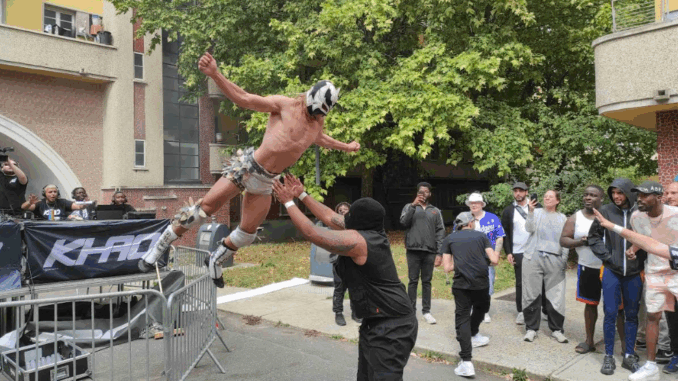
A total change of scenery occurred twelve hours later, in Le Blanc-Mesnil, part of the North-East outskirts of Paris. But the feeling of new doors of empowerment being kicked open remained. The location was the open air of the Cité 212’s courtyard, a small building ensemble from the 1930s constructed near a town square now dominated by giant yellow municipality panels warning against cigarette contraband and right behind the Bourget airport and museum with its Ariane rocket replica. There, Khao Wrestling’s ring was surrounded by furniture from which only hardcore wrestling fans would get a kick out of: a chair, a broom, and a fan all wrapped up in barbed wire, old wooden white doors, construction signs, and neon light bulbs. Tools that were all employed by two Northern Frenchmen, Jack Sans Nom (Jack With No Name) and TLB, in a street fight that also included the use of a flame-thrower, a dive off a balcony onto concrete, and a missed Swanton Bomb on top of a closed dumpster – all filmed by a drone. Meant as an open-access, free show for around 50 to 100 wrestling fans as well as gradually more curious inhabitants of the Cité 212, Retour aux Sources had an electric atmosphere from start to finish.
Like Divas in Paris, every ounce of it had a deep sense of youth and pride, but this time, aimed at representing a generation coming from the mostly poor minorities and former immigrant suburbs of the Paris metropolitan area. “We want to bring pro-wrestling back to the working-class, updating it with modern rap and urban cultures to do so,” a photographer and one of Khao’s promoters, nicknamed Rebstock, told POST Wrestling. “I was very moved to see a hijab-wearing woman witnessing the action next to Black kids and a girl of Indian descent, all coming from the neighborhood.” Khao – which was started in February 2025 by a group of friends in or around the wrestling scene, surrounded itself with collectives consisting of members of the local community, like Espoir de Jeunes (Youth Hope) and Réussir pour Réussir (Succeed to succeed), selling home-made food to spectators. Many staffers of Khao come right from Le Blanc-Mesnil, so a show was always in the works, whether WWE came near it or not, said Rebstock. “Clash in Paris precipitated us booking a show there and helped bring eyes to it. But we don’t want to depend on WWE and its talents or former talents. We pride ourselves on our independence and on delivering another kind of wrestling, one that people from our communities can identify with.”
Ne faites pas ça chez vous !
Laissez @TLB_wrestler s’en occuper ?#KHAO #RAS #retourauxsources pic.twitter.com/n9fzX9Wkom
— KHAO (@khao_wrestling) August 31, 2025
A hardened aficionado of the European continental circuit, who prefers to be referred simply as “El Gringo” so as not to disturb his professional life, made the trip from the Northern corner of the Hexagon just to see the happenings provided by the independent scene. “I love following every new and innovative talent and offerings that can further keep us away from the old and carny ways of presenting wrestling here,” he told POST Wrestling. Encountered at Saturday and Sunday shows with his gentle smile and a long metalhead beard partially covering a local wrestler shirt and an AEW sweater, the middle-aged man came to the French capital to support up-and-coming prodigies such as Kuro, TLB, or Cory Zero and the ecosystem that is rapidly growing around them. Associations like CocoriCatch, started by retirees to help their active colleagues with making and selling merchandise at events, or Trucs de Catch (Wrestling Things), a community of small wrestling influencers and content creators focused on the French scene. “When I began following the scene less than ten years ago, those little structures did not exist. Since the Covid-19 pandemic ended, they are nurturing the fanbase, keeping it young, passionate, and active with or without WWE’s attention,” said Gringo, who didn’t even plan to attend Clash in Paris.
Meanwhile, in Khao’s ring, Chahira, a young female wrestler of Maghrebian heritage, accompanied her real-life friend and former NXT UK star, Amale, to her first match back in the country in a year. She was pitted against Thiago Montero, a despicable macho of Portuguese descent, in an intergender bout originally booked for a May card. Back in early September 2024, Amale alleged “extremely abusive and brazen behavior” from her then-real-life partner, Tristan Archer, one of the top stars of the French and German circuits. Both of them have since been “suspended” from appearing in several French promotions and have only wrestled outside of the Hexagon (once for Archer in Cyprus and twenty times for Amale) as a civil case is still ongoing on the matter. Feeling supported by the Khao staff, Amale – alongside Chahira – brought a passionate fight against Montero, who played some kind of surrogate to her allegedly abusive ex-boyfriend. The emotion carried through to a closing angle full of carefully projected bitterness where, exalted by her own violence, Amale forced her friendly second to hit Montero with a chair against her better moral judgement. But Montero ducked and, as a result, Chahira hit Amale instead. Enraged against this perceived betrayal, the wounded and defeated Amale violently rejected Chahira, seemingly (in kayfabe) ending their friendship – while a national TV crew, filming a documentary around Chahira, witnessed it all.
Breaking its own records
Then, in Gennevilliers’ municipal auditorium, some eight miles west of Khao’s afternoon offering, the top two companies of French wrestling came together to make history on their own. Some 1,200 fans from all over France and as far as Spain and Germany attended French Touch, a crossover event between l’Association des Professionnels du Catch or APC (Wrestling Professionals Association) and Banger-Zone Wrestling (BZW). The former is both a promotion and a school operated since 2003 by the Constantinos wrestling family in one of the last remaining working-class boroughs in Nanterre, in the shadows of the skyscrapers that make up La Défense, the economic epicenter of the Paris metropolitan area and the host to Clash in Paris. The majority of the local wrestlers who performed throughout the weekend, from Aigle Blanc to Kuro or even Chahira, are products of its teachings.
The latter, which started in 2019 in Belgium before running more frequently beyond the border in Lille in Northern France, is perhaps the most ambitious promotion of the two, having launched its own streaming platform (BZW+), selling special meet & greet pre-shows, and having been the first to book its own card during this year’s WrestleMania weekend in Las Vegas. BZW was also the one to stage the only independent event close to Backlash France, collaborating with another French structure called Rixe. In late January, when WWE announced its return, APC was quick to promote its own Battle for Paris shows (the Sunday one has remained, being renamed The Last Dance) before BZW saw the opportunity for a partnership instead of a competition two months later.
BZW ostensibly brought its expertise in handling all aspects of promoting the big event, giving it the feel of a RevPro supercard, streaming it live on BZW+, while APC brought its litany of talents. But to attract what now seems to be the biggest crowd for a French wrestling event since the local boom of the late 2000s, the two promotions had to bring some international stars – namely, former Progress kingpin Cara Noir, GCW mainstay Joey Janela, as well as AEW’s rising star Megan Bayne. But none were bigger, both figuratively and literally, than Bobby Lashley, giddy from the moment he entered the main event with the obligatory “We hurt people” chant. Not working as much as its French counterparts, the always jaw-dropping Aigle Blanc and the other half of OTT’s tag team champions, Mecca (who benefited from a Goldberg-style entrance), Lashley was unsurprisingly victorious, pinning the departing Aigle Blanc before finding himself face-to-face with a tall and imposing local veteran, A-Buck, teasing a possible return down the line.
Among the other highlights of the night were the David-versus-Goliath battle between Megan Bayne and the frail but fierce Celine, also a product of APC’s school, as well as a terrific performance in the semi-main-event for BZW’s top prize, opposing Cara Noir to Joseph Fenech Junior, the dastardly and violent alter-ego of Senza Volto, another French masked high-flyer. However, the audience itself was undoubtedly the star of the show, demonstrating a copious amount of love to all performers and engaging in numerous chants, mostly in French, like the now-famous “Il est vraiment phénoménal,” this time directed at Aigle Blanc’s second-to-last performance on French soil.
Laure and Raphaël, who only went to French Touch, actively chose “not to give one cent to WWE,” in response to the company’s dealings with Saudi Arabia and the ongoing Janel Grant lawsuit. Their mindset echoed the numerous – even though playful – chants of “On a plus de thunes” (“We don’t have any more money”) throughout the weekend, referencing the heavy pricing of WWE’s shows. Previously, longtime fans of the scene, the couple would rather watch the French talents at their best and witness Aigle Blanc perform one last time. After that particular show ended, they confessed their amazement at how much the scene grew, how well its young wrestlers performed, and how much the fans were into their acts and chanting for them against their better-known US or UK guest counterparts.
The Eagle leaves the nest
As for his last appearance (until next time), Aigle Blanc chose its home. By noon on Sunday, inside a packed 250-seating Studio, Jenny sold out well in advance, the emotion was palpable on many of the longtime fans – like El Gringo from earlier – and performers’ faces waiting for the closing affair (guest-introduced by Mark Henry, in town for his European DJ tour). A feeling not unlike The Final Chapter in Chicago Ridge, CM Punk’s final show in Ring of Honor back in 2005. With its impeccable white-painted walls, mirrors, and chandeliers hanging from the ceiling, the wedding venue nicknamed “the French temple of wrestling” has seen many promising French performers begin and end their careers during the past twenty years. Studio Jenny has frequently been compared to Reseda’s American Legion Hall Post 335 by local aficionados, even hosting Pro-Wrestling Guerrilla’s stop in France during its two-card one-and-only European venture in 2007. So, in a sense, since his debut in July 2014, Aigle Blanc has bumped in the same ring as luminaries like Bryan Danielson, El Generico, Kevin Steen, and Chris Hero before him. But more importantly, as the leading pupil of APC and the top prospect of the French wrestling for so many years now, the 26-year-old prodigy has himself shared the ring with some of the greats of its generation, from Will Ospreay to Mustafa Ali’s first post-WWE match, Bandido, Nic Nemeth or Pete Dunne (whom he all referenced physically in the ring on Sunday).
But at The Last Dance on Sunday, like Punk before him, he chose to face his friends to say goodbye. With his variation of Shingo Takagi’s Last of the Dragon, he won a thrilling 20-minute 8-man tag team bout that wouldn’t be out of place on an episode of AEW Dynamite or Collision – or rather, an all-star Battle of Los Angeles style spot-fest, considering the referee’s tope con giro. Without ever mentioning or even hinting at the WWE, which reportedly signed him and his Belgian counterpart, Mike D’Vecchio, in May after their solid run in All-Japan Pro-Wrestling, Aigle Blanc, in his words, “came to give everything back” to the place that offered him his career before facing the uncertainty of his new opportunity.
And by doing so, he shone a light on all of its (also) young and talented adversaries, beginning with its top student, Kuro, who symbolically saved him at every turn in this last bout together. But even so, before the match, his designated successor insisted on not wanting to assume the mantle of his beloved mentor. “I want to differentiate myself, make my own path,” he said. On eventually following Aigle Blanc’s footsteps towards WWE, and while not rejecting it as he cannot deny its influence on him (and the fact he got to be one of the “medical personnel” to carry out Roman Reigns on Sunday night), Kuro maintained that “Kenny Omega and Kazuchika Okada’s first encounter made me want to be a wrestler and as one, I now want to be able to tell a story purely in the ring. My next goal is to one day perform for New Japan Pro-Wrestling or NOAH.” As WWE comes closer to, once again, claiming France as part of its ever-expanding territory (notably, with its programming migrating from French cable TV to Netflix in January 2026), it seems French pro-wrestling itself and independent wrestling as a whole still can write history their way by themselves and on their terms.