
By Brandon Thurston and Jack Wannan
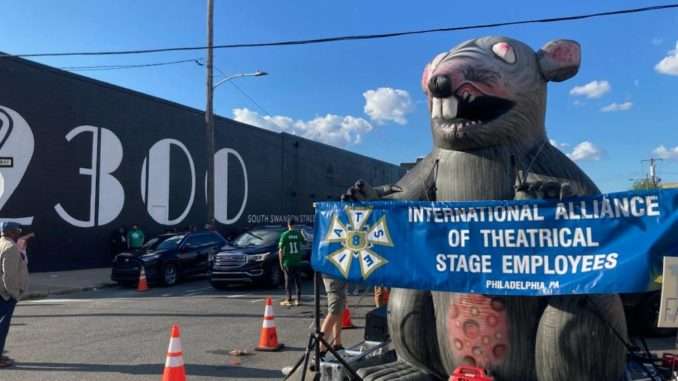
Picketing at the 2300 Arena has carried into a second week, as a local stagehand union attempts to capture the attention of fans in the area for AEW’s ongoing residency.
Members of the International Alliance of Theatrical Stage Employees’ (IATSE) Local 8 chapter continue to picket in front of the venue known to wrestling fans as the ECW Arena, claiming that the location’s CEO, Roger Artigiani, doesn’t compensate his stagehands the union standard.
IATSE Local 8 members — whose office is just across the street from the 2300 Arena — are paid $40 an hour for their work, or $54.40, when adding up extra benefits like welfare contributions, pension, annuity, and training. The group claims that, while they don’t have issues with non-union workers being hired for events, those who get paid below that amount undercut the value of stagehands in the market.
Last week, the venue’s CEO said stagehands were already being paid equivalent to the union’s standard. Phil Effinger, Business Agent for IATSE Local 8, now seems to accept that, citing information from a stagehand working the residency who’s been in contact with the union.
Members have picketed before AEW and ROH events, as well as a demonstration on Labor Day.
Dispute is mostly with venue, but AEW isn’t off the hook, union member says
IATSE Local 8 gained attention last week by targeting AEW in its protests, claiming in a social media post that the promotion had “chosen not to employ skilled stagehands,” while generating hundreds of millions of dollars in revenues, including from its TV shows like those being produced out of the 2300 Arena.
AEW later denied its involvement with the dispute, telling POST Wrestling in a statement last week that “[a]ny current demonstrations being held are between 2300 Arena and IATSE Local 8.”
When asked about the protests on a media call last Thursday, AEW CEO Tony Khan declined to comment.
The 2300 Arena’s Artigiani told POST Wrestling that the dispute is a problem between the venue and the union.
Local 8 has clarified that, although it believes AEW deserves scrutiny working with the 2300 Arena, which is a non-union venue, most of the union’s criticism is directed toward the venue’s management.
“While the dispute is largely between us and the 2300 Arena, we do find it unfortunate that AEW chose for this run to go to a non-union venue,” said Effinger. “We’ve had a long, fruitful relationship with AEW, and in the past, they have elected to come to some of our other venues in Philly, such as the Liacouras Center, to host their productions, and we have a great time, and we really enjoy working with them.”
A large amount of the appeal of hosting shows at the 2300 Arena is, of course, its long history in wrestling. The venue was ECW’s home and is the site of the “Hardcore Hall of Fame,” which Taz is expected to be inducted into this week.
Effinger acknowledged that the 2300 Arena has a “significant place in wrestling history,” but asked that AEW could “respect the relationship with us” by either heading to a union venue or asking the 2300 Arena to pay stagehands the prevailing rate.
The building’s history is a large reason why AEW returned, and is also why WWE’s NXT brand visited the spot for a one-night TV special in November 2024.
“There have been productions in the past that were more of a one-off thing where we have been able to work it out with 2300 Arena to pay the prevailing rate,” Effinger said.
He didn’t have knowledge about whether that included when NXT ran there last fall.
Effinger added, “Folks might see a little more [action from IATSE] out there for this AEW residency than they may have in the past. I’ve seen a lot on social media where folks think we’re playing favorites and things like that.”
He said the union’s strategy varies widely based on the type of event and the length of the event. AEW’s residency will last through seven shows, ending on September 11.
Grappling with the ‘prevailing wage’
When the protests first started, IATSE 8 and the 2300 Arena were locked into a he-said-she-said standstill. The union demanded proof that stagehands were paid the all-in wage of $54.40 an hour, and Artigiani wasn’t budging on providing such documentation.
However, IATSE 8’s Effinger said things have since changed. The group communicated with a stagehand worker during the residency, who told the union the workers were being paid the prevailing wage. Effinger believes this was likely due to the pressure they placed on the venue.
Now, the union’s focus has shifted to securing wages for stagehands at the venue going forward.
“Our hope is that we can sign a contract that covers the work beyond AEW,” Effinger said.
“Because once AEW leaves, our fear is that Roger will just go back to paying substandard wages to his stagehands at any productions in the future.”
Another part of their dispute is the concern that stagehands in the venue might be treated as independent contractors, a misclassification in IATSE’s view. This is something Effinger says the union is “currently working on verifying.”
IATSE says it’s not trying to unionize the stagehands currently working at the 2300 Arena.
“What we’re looking for is a contract that covers the workers that are already there and the work that they do,” Effinger said. “We don’t want to replace anyone. In fact, it is against our constitution bylaws to replace anybody as a result of an organizing drive, because those workers who are already there are entitled to keep that work.”
IATSE 8 pushes for long-term deal
Artigiani considers the 2300 Arena a “Mom & Pop” type venue, claiming they can go weeks without an event. When the location is hosting a show, it’s rarely on the scale of an AEW production, nor does it often last more than a day.
“I don’t see a company like [AEW] coming back to us,” Artigiani said. “I’d be very surprised if they do. Not because of what we do here, our hospitality, our ability to put on these shows. It’s just that our footprint isn’t really made for this. We don’t have the space. [AEW has] a lot of equipment, a lot of stuff.”
Upcoming events on the site’s schedule range from local combat sports events, like boxing, Muay Thai, and professional wrestling, to Sagra 25, the latter of which is a celebration of Italian wine and food.
Some of these events, Effinger claimed, aren’t what IATSE wants to cause issues over.
“He does a lot of community events, birthdays, things like that,” he said about the 2300 Arena. “We’re not interested in disrupting any of those smaller events. But when an organization comes into town and plans on doing not only a residency but a nationwide broadcast that will be bringing in millions of dollars, as far as we’re concerned, enough is enough.”
Effinger hoped that the union could reach a long-term agreement with the 2300 Arena that would make the building commit to paying its stagehands $54.40 an hour. Effinger said the union is open to “carve-outs” that would allow smaller events to operate independently from the deal.
“We are understanding of smaller productions, and things like that, but we do have to balance that with our interest that workers are being paid [fairly].”
However, it seems unlikely that the two sides will come to an agreement. Trouble between them is likely to continue outside the 2300 Arena in the coming days, as IATSE 8 union members continue to picket, chant, and display a large inflatable rat, which they have decided, not so subtly, to name “Roger.”