
WWE’s “All Out” Assault on AEW Intensifies
For the first time in nearly four decades, two wrestling companies will stage the equivalent of pay-per-view events against one another.
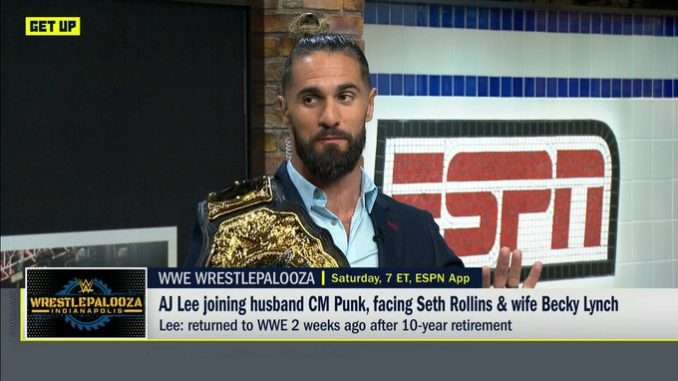
WWE will launch its ESPN era with Wrestlepalooza on the new ESPN Unlimited app, setting fans back $30 unless they have a friendly carrier with the new service included (for now) as AEW All Out airs on its regular outlets and introduces HBO Max to the fold.
The notion of WWE placing a main roster event against an AEW pay-per-view felt inevitable after pitting NXT’s monthly shows against AEW in May, July, and August and including a doubleheader with Saturday Night’s Main Event on July 11 against All In Texas.
It’s as significant an obstacle that AEW has faced since the return of Brock Lesnar and AJ Lee, Cody Rhodes’ first PLE since SummerSlam, a reunion of The Usos, and under the spotlight of ESPN and its enormous promotional machine.
AEW is on the defensive, making a calculated move to abort a prime-time head-to-head battle and attempting to gain an advantage with an afternoon start time in Toronto. They also return to pay-per-view without their big guns, Will Ospreay, Swerve Strickland, and Kenny Omega.
For those in need of a history lesson, it was in November 1987 when Jim Crockett Promotions had its year centered around Starrcade, opting to take it out of its home in Greensboro and run the card in Chicago to diversify. WWF, hot off the success of WrestleMania 3, met the moment by adding to its pay-per-view menu with Survivor Series, to be held the same day as JCP’s big show.
Carriers thought this could be a benefit to its consumers with a day-long wrestling extravaganza on the Thanksgiving holiday. It was quickly discovered that the WWF was not interested in broadening the wrestling scope but handicapping its competitors by putting an ultimatum down that anyone carrying Starrcade wouldn’t have access to the Survivor Series or next year’s WrestleMania.
All but five carriers caved to the demand, and it wreaked havoc on Starrcade, which was counting on the show’s success to fulfill its talent contracts by year’s end. Within one year, the company was sold to Turner Broadcasting.
There would be follow-up battles as TBS hosted Clash of the Champions against WrestleMania 4 and 5 over the next two years, with the 1989 battle initially designed to be a pay-per-view showdown as the WWF was battling the carriers over its fees. An agreement was reached, and WCW was allowed to continue with its show, but on cable against WrestleMania 5.
Despite the heated nature of the Monday Night War, there was never a dual pay-per-view night, mainly because the providers didn’t see any incentive to force their audience to pick one show over the other. By the late ‘90s and into 2000, each of the three companies (WWF, WCW, and ECW) received its Sunday on the calendar each month without fear of a conflict.
The nature of head-to-head contests seems counterproductive, but the results don’t always turn out that way.
In 1988, the inaugural Clash of the Champions on TBS, featuring Ric Flair vs. Sting, drew a 5.8 rating and peaked with 7.8 in the final fifteen minutes of the 45:00 draw, while its counter, WrestleMania 4, saw approximately 585,000 homes purchase the event from Atlantic City, per the Wrestling Observer Newsletter.
In 1995, the fear was that WCW would split the audience by launching Monday Nitro opposite Monday Night Raw, and instead, it propelled both sides to swell, creating new fans and each entering its zenith in the ensuing years.
In 2008, Affliction staged its first MMA pay-per-view with a stacked card featuring Fedor Emelianenko against former UFC heavyweight champion Tim Sylvia. The UFC countered by adding a free special on Spike TV with Anderson Silva moving up to light heavyweight, and the head-to-head showdown became the story. The UFC drew an astounding 3.8 million viewers for the main event between Silva and James Irvin and beat Major League Baseball that day.
Did it hurt Affliction? The pay-per-view did an estimated 100,000 buys, the first non-UFC card in MMA history to draw that amount, and only rivaled by Bellator 120 in May 2014 for a competitor on pay-per-view.
In 2025, the chess board is made of different players and technology without any restrictions or jugulars to be spared.
ESPN landed the U.S. rights for WWE’s premium live events and worked out a deal to circumvent the final months of WWE’s deal with Peacock, allowing it to launch on the new service early.
The worldwide leader has all the incentive to push WWE throughout the week and flood its airwaves with promotion to juice its service and direct fans to ESPN Unlimited.
Whether there is friction among a fanbase accustomed to paying a fraction of the cost for WWE events since 2014 remains to be seen. The confusion was only intensified on Monday when Joe Tessitore stated that “anyone with ESPN” would have access to the app, which isn’t the case.
Many fans tuning in on Saturday will find out they’ll need to shell out an extra $30 even if they subscribe to ESPN on their cable provider. Currently, Comcast and YouTube TV subscribers are the largest ones impacted, representing approximately twenty million cable subscribers.
Not to be ignored is that most of the promotion for Wrestlepalooza and ESPN Unlimited is directed toward watching “on ESPN,” and no doubt, some will assume this means the linear channel. This was somewhat mitigated on Monday when Tessitore stressed it was an “enhanced ESPN app”.
Despite the uncharted territory of a WWE event on a brand-new service, it is unquestionably the “big show” of the day, with all its attractions, and it is treated as a major show rather than just another show.
AEW’s All Out will be its first pay-per-view from Canada in over two years, with a show loaded by stipulation matches consisting of coffins, tables, thumbtacks, and ladders, and the (close enough in proximity) hometown return of Adam Copeland and Christian Cage.
Copeland and Cage going for the AEW tag titles in Toronto seemed like the strongest argument to finally have the tag titles headline a pay-per-view, but they played a different card with Brodido winning the titles, and leaving this tag bout as a straight-up grudge match with the novelty of Cope and Cage wrestling in Toronto.
The local angle appears to have worked with over 10,000 tickets distributed to the Scotiabank Arena, but it’s a complete unknown how this show performs on pay-per-view against Wrestlepalooza.
Yes, there will be fans that treat Saturday as a wrestling marathon, but the margins become slim when that prospect requires a buy-in of anywhere from eight to eleven hours of your time, and ranging from $50-$80.
Some have argued that AEW should have bit down on its mouthguard and gone head-to-head to see what the damage would entail. If AEW retains eighty to ninety percent of its pay-per-view buys, is it that serious a threat? Even if it costs AEW 10,000 buys, that means half a million dollars in revenue between the promotion and the provider.
The other side of the coin is if the damage is significantly worse, and it’s a blueprint for future tactics by WWE.
While dates for the WWE’s PLE calendar are set for 2025, it’s hard to imagine this head-to-head battle will be a “one and done”.
A bad pay-per-view isn’t going to cripple AEW, and with its U.S. television rights secure for multiple years, this is a short-sighted move viewed inside of a vacuum, but also could be chapter one of a lengthy strategy to impact AEW in the years to come and slowly suck the oxygen.
Which brings one to the question of “why?” and before laughing about the notion of WWE stifling its competitor, it does beg the question of what the incentive structure is among its talent?
To a person, you would be hard-pressed to find a member of either locker room pushing for the dissolution of its competitor. In a business with minimal leverage, the last six years have provided the only real version of their careers. It is inarguable that the floor for talent contracts has risen directly because of AEW’s placement in the market and willingness to spend.
The UFC has been a test case of a promotion without a peer, incorporating restrictive contracts and lacking incentive to retain or utilize its top stars. Years ago, when pay-per-view was its master, the UFC could never shrug its shoulders when Conor McGregor was begging for a fight, or let Jon Jones sit for an indefinite period, or ignore Georges St-Pierre’s desire to fight Khabib Nurmagomedov.
WWE needed to lure Cody Rhodes back, WWE had to make amends with CM Punk, and WWE ended its eighteen-month exile and brought Brock Lesnar in time for this show.
It is very easy for a performer in WWE to have tunnel vision, just go to work, and not think of the big picture. But at the top of TKO Towers, all they do is think about the big picture, and if they had their crystal ball, would a five-year prospectus include one with a thriving competitor, if they could snap their fingers?
It runs totally counter to the objectives and well-being of the boots on the ground in the company, but it’s a schism that is largely ignored because it’s not a problem that will present itself today or tomorrow.
In 2000, WCW was a mess, but no one was bracing for what was in store in the early months of 2001. It led to a grim industry years after the promotion’s demise and a one-horse race in North America.
WWE is being more cooperative than ever with outside promotions and has provided its blessing to those groups to thrive and succeed, but it begs the question of the end goal of these tactics.
A professional wrestling landscape where WWE has competitors under its umbrella, whether formally (AAA) or informally (TNA), and a weakened AEW will dramatically handicap any benefits that talent have received over the past six years.
The head-to-head battle on Saturday should not just be viewed in the prism of a one-night fight, but instead, the first in a multi-pronged effort to weaken the legs AEW stands on.
It’s impossible to predict where the cable and streaming industries stand by 2027 or 2028 when AEW will dive into its next set of negotiations. On the surface, it would seem WWE is offering up a menu of alternatives to AEW and bolstering them over the next several years while delivering body blows to AEW, where possible, to weaken their core.
In an industry with any type of organization among its labor, the parties meeting at the table would never agree to this battle to the death and torching a competitor for the other’s gain. It’s the secret sauce of TKO’s success, bypassing any labor disruption, share of its revenues, or compromise with the very talent that is the product you sell.
Instead, not a peep will be made by a WWE performer displaying any hesitancy toward an all-out assault, which Saturday represents an escalation of.
However, you untangle the strategy, it’s not a positive for the industry, and it’s not of value to the performers, but that’s rarely the case in a business that operates in favor of the dominant group. The wrestlers are along for the ride and hoping to profit, but only at the discretion of the hierarchy.
