
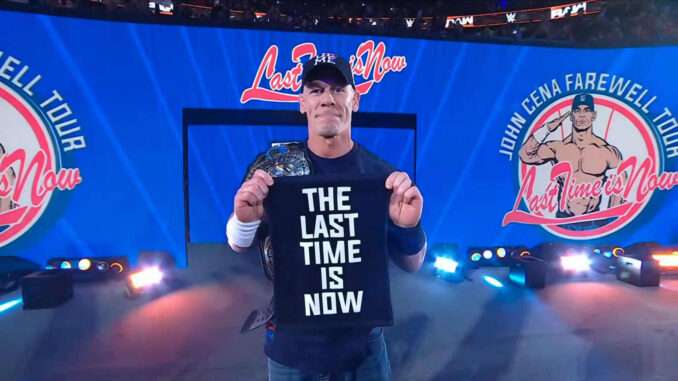
A new federal lawsuit filed this week in New York against WWE, TKO, John Cena, and others, objects to the use of a sample to create one of wrestling’s most recognizable entrance themes: Cena’s “The Time Is Now.”
The dispute centers around the iconic horn arrangements that introduce and play throughout the theme.
The complaint, reviewed by POST Wrestling, was submitted to the court just over a week before Cena is scheduled to wrestle what’s promoted as his retirement match on Saturday Night’s Main Event in Washington, D.C., airing December 13 on Peacock.
Filed on Tuesday in the Southern District of New York, the lawsuit claims that the horn-driven intro and outro used in Cena’s theme music were copied from a 1974 cover recording arranged by Canadian bandleader, the late Pete Schofield. The complaint was submitted by Schofield’s daughter, Kim Schofield, who says she now owns the copyrights to the record and the music she says is an original arrangement.
The complaint lays out a complex dispute over intellectual property rights.
Schofield’s late father’s recording was itself a cover of a Bobby Russell song, but the younger Schofield asserts that the horn intro and outro added were original, and those are the parts she claims were sampled for the Cena theme.
The case may hinge on whether those horn sections are protectable elements of the Schofield arrangement or an unlicensed derivative work of Russell’s song.
Schofield alleges that in 2017, she reached a written settlement with WWE and received a one-time payment of $50,000. However, she now claims WWE withheld key information during negotiations to induce her to sign the agreement.
Update: Schofield contacted us on Friday evening, after the publication of this article, seeking to clarify that she did not issue a cease and desist demand to WWE. She also said that the timing of the lawsuit was not influenced by Cena’s upcoming retirement.
In addition to WWE, TKO, and Cena, also named as defendants are music producer “Jake One” Jacob Brian Dutton, music publisher Pix-Russ Music, and Cynthia Jo Russell. Dutton is the producer who mixed Cena’s theme. Pix-Russ Music holds rights to the Russell recording, along with Russell’s widow, Cynthia.
According to the complaint, the sampled material in Cena’s theme comes from Pete Schofield’s instrumental 1974 cover of “The Night the Lights Went Out in Georgia,” which added horn parts not present in the original song composed by Russell, and memorably recorded by Vicki Lawrence as a hit single in 1973, and later re-recorded by Reba McEntire.
The lawsuit asserts that the horn elements in the intro and outro of the Schofield version, which make up the backbone of the Cena theme, are not present in the Russell version and were sampled by Dutton in 2003 to produce the base of what became one of the most recognizable wrestling theme songs.
Kim Schofield says her family didn’t know about the sampling until 2015, when a reporter writing a story about Cena’s theme contacted her.
Dutton’s own account confirms that he sourced the Schofield recording when he produced Cena’s theme. In a 2021 YouTube video, he shows the Schofield album cover while explaining how he looped its intro and outro to build the beat.
Dutton says in the video that he was paid $60,000 upfront for his work on the song. A more recent ESPN article from just last week, focusing on the theme song, says Dutton was paid $30,000 “for three beats.”
Dutton did not respond to a request for comment.
The family settled with WWE in 2017 for $50,000. Schofield now asks the court to void that agreement, saying WWE withheld information about the long-term use of the sample and an upcoming national ad campaign
According to the lawsuit, WWE finalized its agreement with Schofield just two days before a Toyota television ad featuring Cena’s theme premiered. The family, who live in Canada, say they were never told about the campaign and only learned of it later, as the ad didn’t air there.
WWE allegedly told the Schofields the song had limited value and dismissed their request for writing credit as “greedy” and “opportunistic,” according to the filing.
WWE and TKO did not immediately respond to a request for comment for this story.
Schofield, who represents herself in the case, says she hired an IP attorney on contingency, but that after months of exchanges with TKO and its counsel, the attorney withdrew from the case in April 2025. She is also representing herself in a separate lawsuit, filed in September, against Sony Music, Epic Records, and others over what she says is an unlicensed use of the same horn arrangement in a recent track by artist Dumar 1K.
The Schofield family doesn’t claim ownership of the original Bobby Russell composition. Instead, they assert that specifically, the intro and outro are the Schofields’ original copyrightable work.
In 2024 and 2025, Kim Schofield registered two copyrights with the U.S. Copyright Office: one for the key musical arrangement elements (the intro and outro sampled in Cena’s theme), and another for the full 1974 sound recording. We verified that both registrations appear on the Copyright Office’s website.
The Russell estate and its music publisher, Pix-Russ, have challenged the registrations, according to Schofield’s account, arguing that the Schofield arrangement is an unauthorized derivative work. The complaint counters that the Russell side accepted royalties for horn parts, which Schofield says were original to her father.
A request for comment to Pix-Russ was not returned. We were not able to locate contact information for Russell’s widow, Cynthia.
In addition to asking the court to invalidate the settlement with WWE, Schofield is also seeking to recover damages in excess of $150,000. The lawsuit also claims WWE violated the terms of the 2017 contract by releasing a 2019 version of “The Time Is Now” theme under a different title, “The Champ Is Here,” which the complaint says included a newly recorded imitation of the horn portion. Schofield says that’s a type of reuse that the settlement prohibited.
Schofield did not respond to a request for a copy of the 2017 settlement, which has not been filed with the court.
The complaint further alleges WWE failed to provide proper credit to “PS Records,” as the settlement purportedly required.
The defendants have not yet filed a response to the complaint, and court records don’t show that any of them have formally received the lawsuit. Under federal court rules, defendants typically have 21 days to respond after they’ve been officially served the complaint. If they agree to waive that formal delivery, the deadline to respond is extended to 60 days from when the request was sent.
