
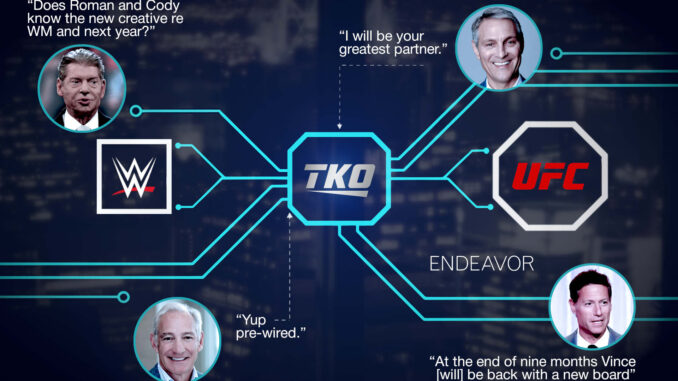
When Vince McMahon announced his retirement from WWE in July 2022 amid allegations of sexual misconduct, a top executive at Endeavor was already telling colleagues that very day that McMahon’s departure would be temporary, he would return, and that a company transaction of WWE could then be imminent, forecasting the eventual merger with Endeavor’s UFC.
In a text message sent within hours of McMahon’s public statement, Mark Shapiro — then Endeavor No. 2 to Ari Emanuel, and now TKO President — outlined a scenario that later unfolded with remarkable accuracy.
“Nick and Stephanie are going to take over the WWE for the next nine months,” Shapiro wrote, referring to Nick Khan and Stephanie McMahon, who became co-CEOs that day. “Vince [will] be back with a new board or he will take the company private or he will sell it/coming to us.”
“The race is on,” Shapiro added. “The courtship is on.”
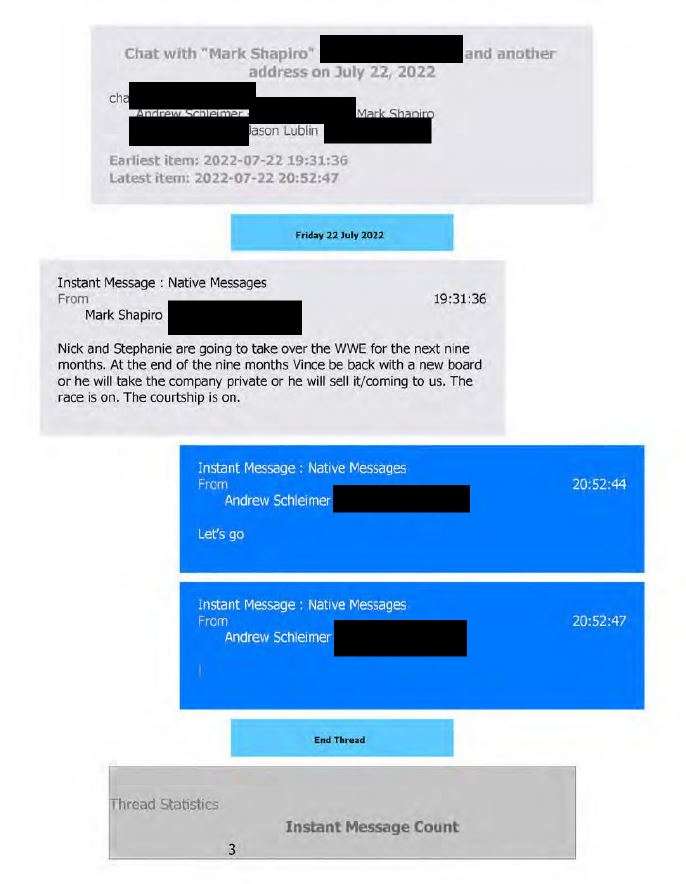
Shapiro sent the message to Andrew Schleimer, now the Chief Financial Officer of TKO, and to Jason Lublin, who was Endeavor’s CFO at the time.
McMahon returned to WWE in January 2023 — less than six months later, rather than nine. He did so by reinstating himself onto the board of directors, using his superior voting power as controlling shareholder. McMahon removed several directors; some resigned, and he added two others besides himself. Immediately upon his return, WWE announced it was exploring “strategic alternatives,” meaning the company was for sale. Three months after that, WWE agreed to merge with Endeavor’s UFC business, creating the parent holding company now known as TKO.
The 2022 text message from Shapiro is among newly disclosed records in the ongoing WWE shareholder lawsuit in Delaware Chancery Court. In that case, plaintiffs allege McMahon violated his fiduciary duties by orchestrating a sale process designed to preserve his own power rather than maximize the best deal for shareholders.
The filings also show communication between McMahon and Emanuel throughout the latter part of 2022, when McMahon was ostensibly in exile and before WWE was formally put up for sale.
The lawsuit claims that McMahon’s priority was to secure his future on top of WWE despite the sexual misconduct scandal that led to his 2022 resignation and despite the payment of millions of dollars toward nondisclosure agreements that were not properly recorded on the company’s books. Plaintiffs contend that McMahon and Emanuel had a friendship that assured McMahon would stay with the company post-transaction, whereas other potential suitors would have required him to leave WWE permanently.
McMahon has denied the allegations.
Other board members at the time of the transaction are also defendants in the case, which has been in court since November 2023. Those defendants are current WWE President Nick Khan, Chief Content Officer Paul Levesque, and former executives and board members George Barrios and Michelle Wilson, who are represented by TKO’s outside counsel. They’re accused of going along with McMahon’s alleged scheme, also in violation of their fiduciary duties. McMahon has separate counsel. The non-McMahon defendants have not filed a public version of their, to date, fully sealed answer to the complaint, though they have litigated many discovery issues.
The filings don’t explain how Shapiro, on the day of McMahon’s retirement, appeared so confident that McMahon would soon return, possibly overhaul the board, and either sell the company or take it private.
Multiple requests for comment for this report were sent to representatives for WWE and TKO, and separately, to McMahon’s representatives, but were not returned.
In an interview recorded weeks after McMahon’s comeback, just after the new year, one comment from Khan aligns well with Shapiro’s text message from six months earlier, together raising questions about a broader, private expectation among major power players of McMahon’s re-emergence.
“I think it was always my point of view, always Stephanie’s point of view, at some point, he [Vince McMahon] would come back,” Khan said on Bill Simmons’ podcast, released on Jan. 18, 2023.
What was happening behind the scenes before WWE was formally up for sale
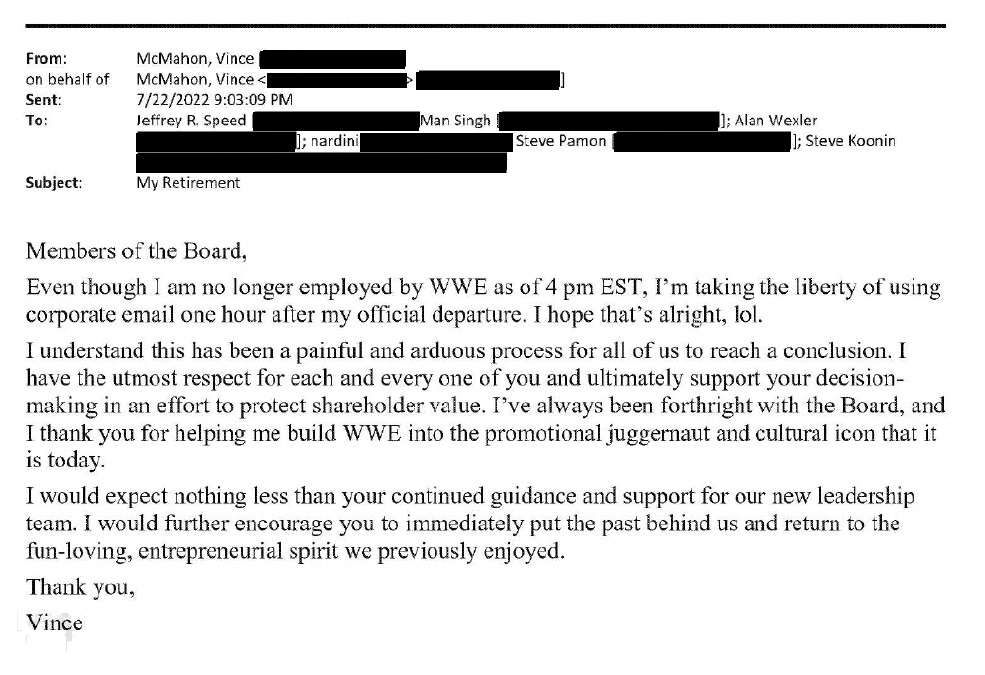
On the day McMahon retired — the first of his two memorable resignations — he sent a gracious farewell email to WWE’s independent directors, thanking them for their work and wishing them well, according to court exhibits.
“Even though I am no longer employed by WWE as of 4 pm EST, I’m taking the liberty of using corporate email one hour after my official departure,” he wrote. “I hope that’s alright, lol.”
“I understand this has been a painful and arduous process for all of us to reach a conclusion,” he told the board. “I have the utmost respect for each and every one of you and ultimately support your decision-making in an effort to protect shareholder value.”
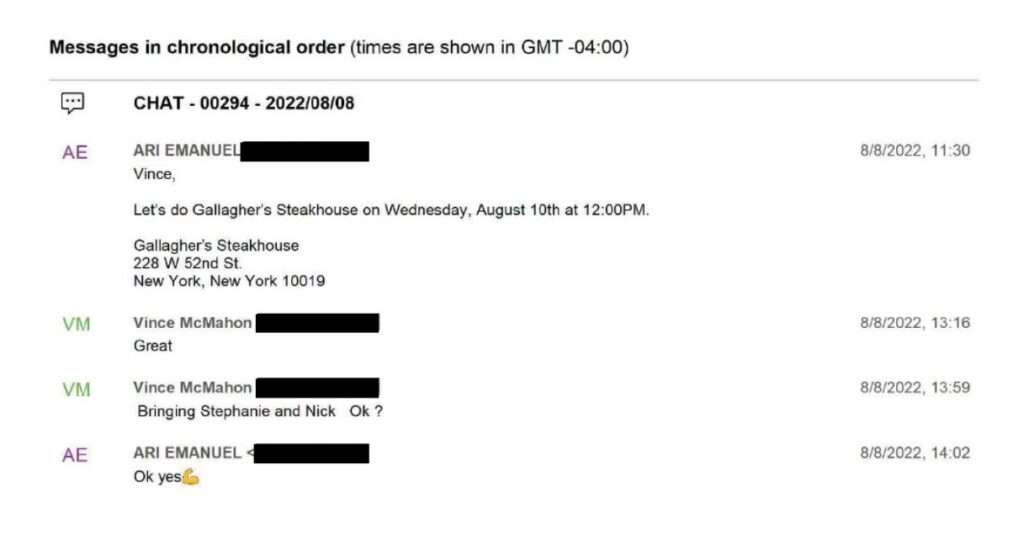
Less than two weeks after McMahon left the company he had led for decades, communications records show Emanuel and McMahon arranging an in-person meeting at a steakhouse in New York on Aug. 10, 2022. McMahon said he would bring along with him WWE’s then co-CEOs, his daughter Stephanie McMahon, and Nick Khan. At that point, McMahon had no formal role at WWE — but he continued to be the company’s largest and controlling shareholder. His only formal power during this time was voting control; however, that entailed that any company sale or merger would require his support.
Notably, the lawsuit doesn’t claim that McMahon wasn’t allowed to speak with potential buyers while he was publicly retired. And although there was no announcement at the time that WWE was for sale, Delaware corporate law generally doesn’t prohibit controlling shareholders from having private discussions with prospective buyers, provided they don’t breach the fiduciary duties that such powerful stockholders have, even if they’re not directors or executives.
Specifically, the plaintiffs claim that due to McMahon’s embattled position amid scandal, his interest in staying in power at WWE, his purported friendship with Emanuel, and his voting control — followed by his return to the board — the sale process was slanted into a foregone conclusion and wasn’t a genuine effort to determine WWE’s full value, thus financially harming investors. Securing McMahon’s personal future with the company he’d just returned to, they allege, was put above making the most valuable deal for investors.
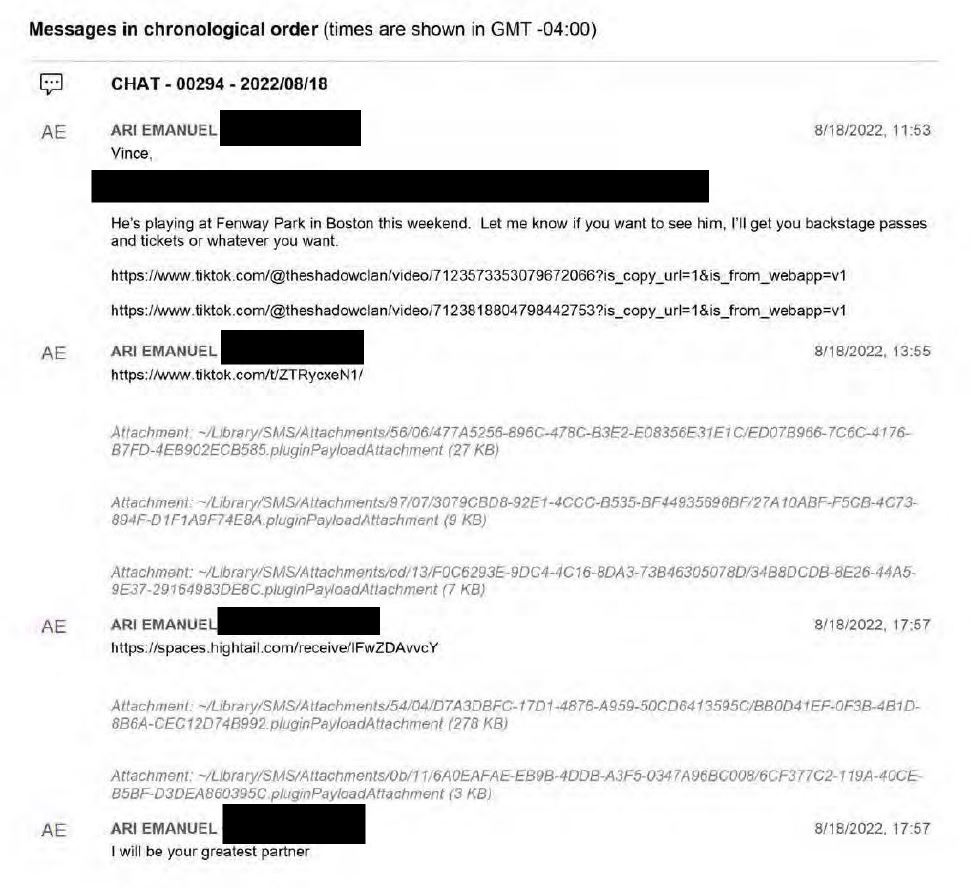
Eight days after they seemingly met for lunch, on Aug. 18, 2022, Emanuel sent McMahon a series of messages, including a few links to TikTok videos and an apparent invitation for special access to a Bill Burr comedy show at Fenway Park. Records indicate Emanuel then sent McMahon multiple voice messages. What Emanuel said to McMahon in those voice memos isn’t in the public record. The Endeavor super agent then sent McMahon a download link, the contents of which are also unknown. But Emanuel followed up with a striking text that suggests they might’ve been discussing something other than stand-up comedy: “I will be your greatest partner.”
On Aug. 22, 2022, Emanuel texted McMahon again.
“I know you met with Jeff Sine yesterday,” he wrote, referring to a senior banker at The Raine Group, who would later serve as WWE’s financial advisor in the sale process. They made plans to speak the next day before McMahon headed to Italy. Emanuel was eager enough to meet with McMahon; he said he was willing to fly from Paris to Italy to get together.
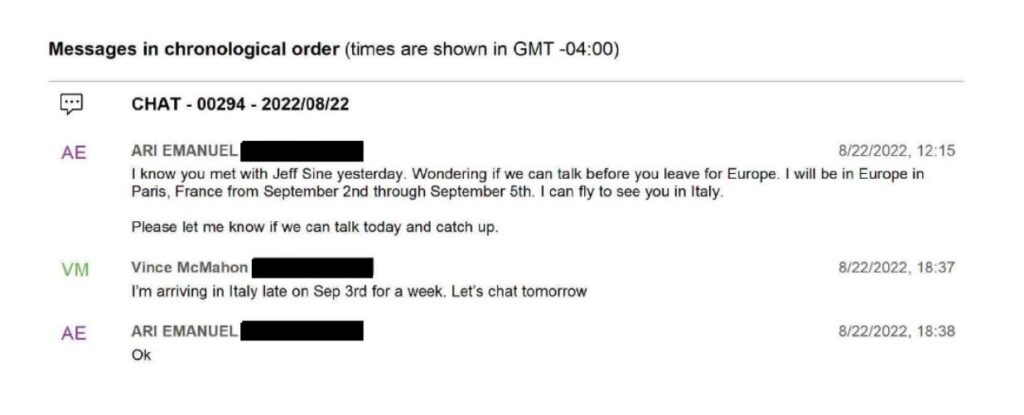
Whether they spoke later that day or what the substance of any conversation may have been isn’t reflected in the current public record. The exchange, though, shows Emanuel was already aware of McMahon’s advisor contacts.
Raine had a long history of working with Endeavor on its deals. The firm, which advises companies in sports and media, worked repeatedly with Endeavor in the years leading up to (and after) the TKO merger. Among many other transactions, Raine advised Endeavor on its 2016 acquisition of UFC, its 2021 initial public offering, and purchases of businesses Endeavor later folded into TKO, including Professional Bull Riders and On Location. Raine, however, also had experience working with McMahon on at least one occasion. The firm advised him on his 2020 revival of the XFL.
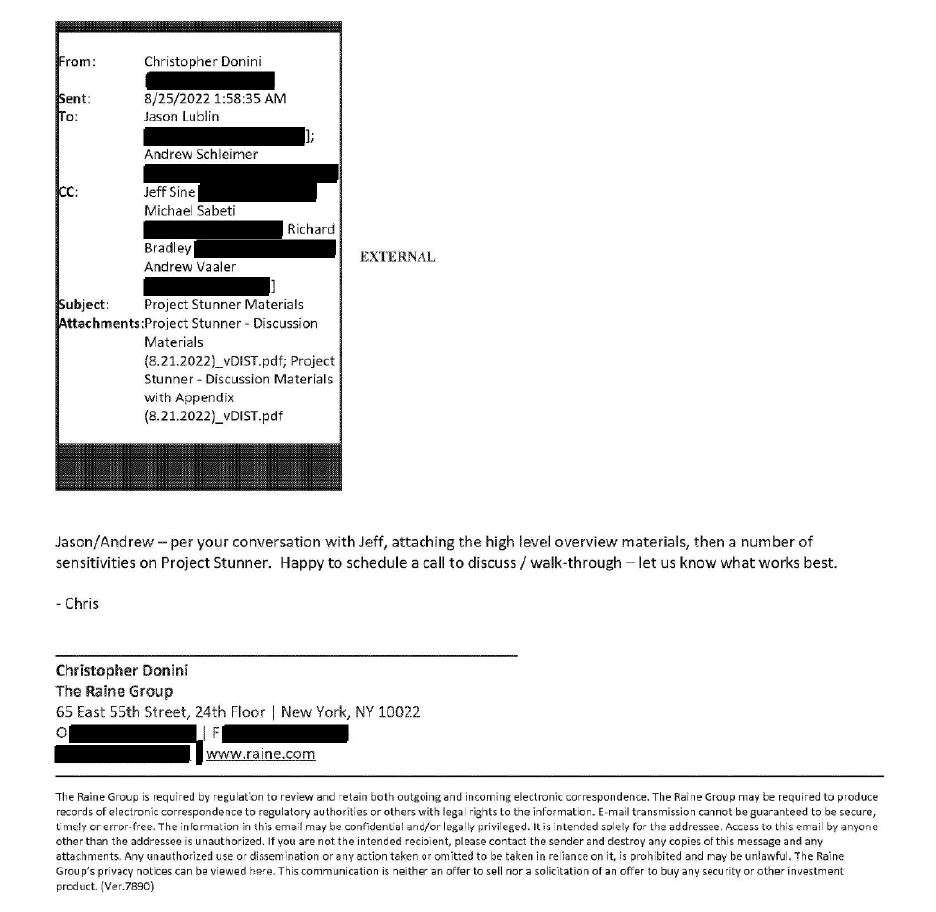
Three days later, on Aug. 25, 2022, Christopher Donini, a managing director at Raine, emailed materials to Lublin and Schleimer — the same Endeavor executives Shapiro texted a month earlier about McMahon’s eventual return. Donini copied Sine. The message referenced a prior conversation with Sine and attached what Donini described as “high level overview materials” and “sensitivities” related to “Project Stunner,” Raine’s apparent internal code name for the WWE transaction. Donini offered to schedule a call to discuss the materials.
Raine did not return a request for comment for this report.
“Stunner” is also the name of a possible Signal group chat the plaintiffs want more information about.
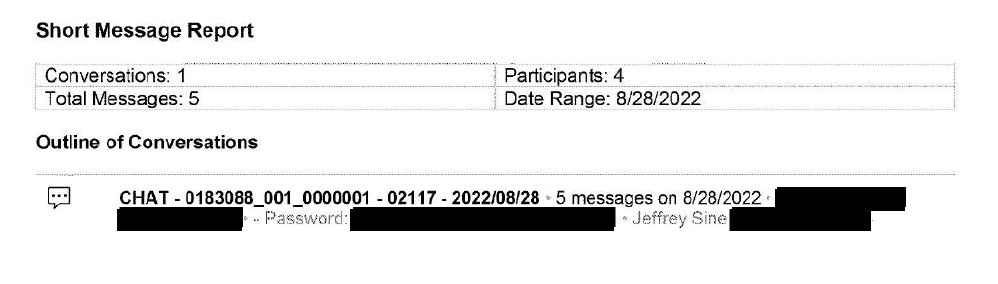
On Aug. 28, 2022, Sine texted McMahon about representing him in a potential transaction. McMahon replied, seeming to express caution, saying he had “some personal issues” to resolve before continuing the conversation, adding that he would reconnect with Sine and Emanuel the following week.
Sine then wrote that he would “like to work for you if we go forward,” adding that Morgan Stanley was “not prepared to represent you.” He emphasized that his role would be “for you only — not Ari or Endeavor,” and offered to speak by phone or meet in person. McMahon responded, “I love that idea Jeff,” and Sine told him to let him know when he was ready to proceed.
Months later, after a few tense formal emails between McMahon and WWE’s board around the holidays, in early January 2023, McMahon used his controlling voting power to unilaterally return to the company as a board member. He immediately rearranged the board’s membership and announced the company would explore a sale process — the events Shapiro anticipated back in July. Stephanie McMahon and other directors resigned, and Vince McMahon was reestablished as WWE Chairman.

As the sale process unfolded in early 2023, it drew interest from multiple potential bidders, including private equity firm KKR and Formula One owner Liberty Media. But recent deposition testimony from Ted Oberwager, a partner at KKR, and other court records indicate the firm’s bid didn’t fully develop before WWE and Endeavor made their deal.
Oberwager testified that KKR did not complete its diligence on buying WWE, did not submit a second-round bid, and never reached a point where it finalized a price or quantified potential synergies for a joint KKR-Liberty acquisition of WWE. He said KKR “did not finish our work” and never obtained sufficient information to establish a final reserve or walkaway price.
Note: Although originally designated confidential, the confidential treatment of these filings was challenged, and the parties later filed public versions, shown here.
What WWE and Endeavor have said about how the deal came together
In the months after the deal to merge WWE and UFC was agreed to, WWE publicly filed its narrative about negotiations with the SEC. WWE describes competing interest in March 2023 from multiple other bidders using anonymized names. A “Financial Sponsor 1,” possibly KKR, submitted a cash offer of $90 to $97.50 per share. “Strategic Party 1,” possibly Liberty Media, submitted a higher all-cash offer at $95 to $100 per share. The filing says WWE’s advisors encouraged discussions between the two bidders about a potential joint bid, but that those talks didn’t result in a formal proposal. The filing says both parties required outside financing, didn’t secure it, and lagged behind Endeavor in their timing. Meanwhile, Endeavor — which ultimately made an all-stock offer — didn’t require a financing partner and was able to move quickly.
KKR was contacted and declined to provide a comment for this report.
WWE’s filing doesn’t speak of interactions Emanuel and McMahon may have had as early as July 2022 about a potential deal.
WWE’s filing stated that the Endeavor offer was worth “$95.66 per share without synergies and $105.04 per share with $90 million of annual synergies,” putting that $105.04 value just over the high end of bids from the other two parties.
Based on WWE’s account, the company took the highest offer available. The plaintiffs argue, however, that the process wasn’t allowed to fully develop. A court filing refers to a WWE internal “High Case projection” that valued the company at up to $178 per share, even as the stock price hovered around half that at the time.
WWE’s filed narrative also lays out how WWE and Endeavor negotiated after an initial proposal in February 2023 that would have given Endeavor 57% of the combined company and WWE shareholders, 43%. After further negotiations, WWE countered with a revised structure that increased WWE’s stake to 49% and reduced Endeavor’s to 51%. According to WWE’s account, Endeavor agreed to the revised split, but only after terms were added guaranteeing McMahon a continued leadership role as Executive Chairman of the new company’s board, along with control of certain board seats and veto rights.
The version of the deal that left Endeavor with less equity was also the one that secured McMahon’s future with the company. While the shareholder plaintiffs posit that other bidders would have insisted on McMahon’s exit due to the sexual misconduct allegations against him, WWE’s narrative is not that WWE gave up something to assure McMahon’s future, but the opposite: Endeavor gave WWE more equity to keep McMahon, asserting his importance.
Additionally, in the months and years after McMahon’s July 2022 exit, with him more removed than ever from WWE’s creative direction, the company saw a rebound in fan interest reflected in significant increases in event attendance and some TV ratings, according to multiple analyses by Wrestlenomics.
WWE’s filing about the transaction, however, states Endeavor strongly valued McMahon.
During conversations on March 23 and March 24, 2023 involving representatives [for WWE and Endeavor], [Endeavor’s] representatives emphasized to [WWE’s representatives] that the governance proposals… were fundamental to Endeavor’s thesis for pursuing a transaction with WWE in light of, among other things, Endeavor’s belief that Mr. McMahon’s continued leadership… would be critical to the value creation driving Endeavor’s desire to engage in the transaction, and that agreeing to increase WWE’s securityholders’ pro forma equity ownership in the combined company to the 51/49 split that had been proposed by WWE was conditioned upon both changes required by Endeavor to the governance arrangements set forth in the March 23 Endeavor Term Sheet.
Emanuel’s public comments, too, suggest he saw McMahon as not just a net positive but essential. On CNBC the morning the merger was announced, Emanuel said on television, “Oh my god. Yes,” he wanted McMahon to stay.
Was McMahon actually inclined to go back into retirement?
“Did he have to convince you to stay?” interviewer Scott Wapner asked McMahon in the CNBC sit-down.
“Uh, not that much,” McMahon simply said.
Liberty’s Greg Maffei calls the deal “pre-wired”
After WWE and Endeavor announced the deal on Apr. 3, 2023, senior executives at Liberty Media privately contradicted that the process was competitive.
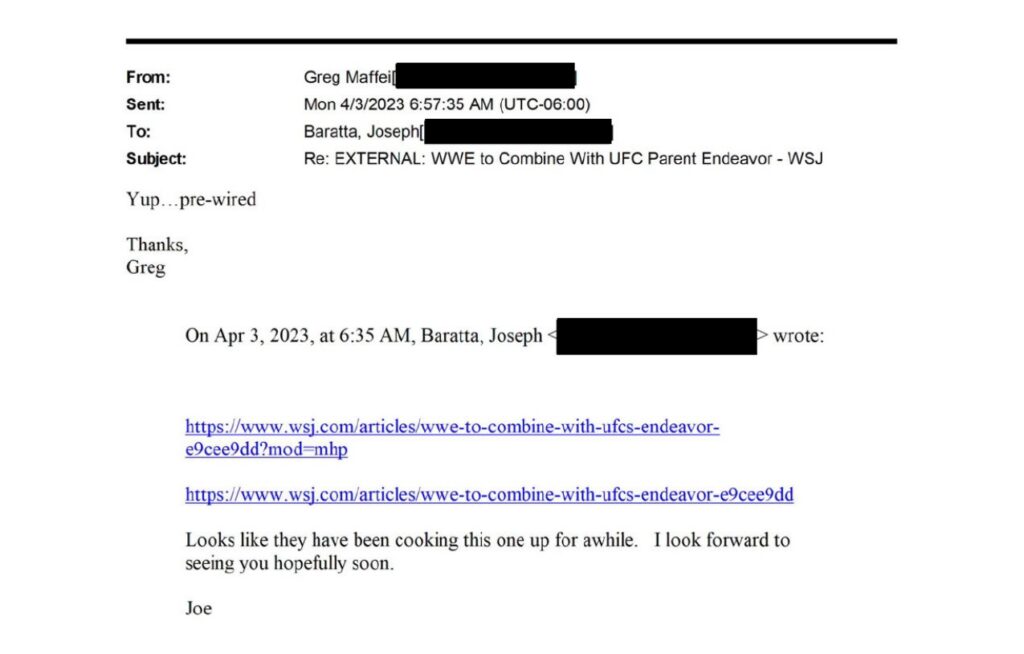
Liberty’s then-President and CEO, Greg Maffei, and a senior managing director at investment firm Blackstone, Joseph Baratta, exchanged emails.
“Looks like they have been cooking this one up for a while,” Baratta wrote, sharing a link to a news article about the deal.
“Yup… pre-wired,” Maffei replied.
Maffei didn’t elaborate, but his comment can be read as expressing that much of the transaction was already in place before the formal process began.
Later the same day, Marty Patterson, another Liberty Media executive involved in the company’s dealmaking efforts, reacted to a Puck article. Relying on unnamed “sources familiar with the deal,” the article by media reporter Dylan Byers reported Endeavor made pitches to WWE in mid-March 2023 and another “more emotional” one a week later at WWE headquarters. Byers’ insider report, titled “The Art of Ari’s Deal,” doesn’t suggest awareness of the advanced access Endeavor appears to have had to negotiations since the prior July. Byers earnestly framed Liberty as “stiff competition” and quoted Shapiro maintaining that the deal was “nip and tuck all the way.”
“The article meaningfully overstates the competitiveness of the process,” Patterson wrote to Liberty colleagues. He added that the article “serves [Endeavor]/WWE interests.”
Liberty Media did not respond to a request to provide comments for this report.
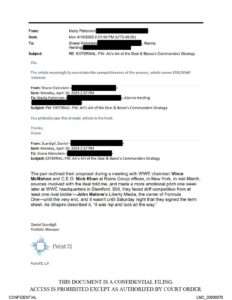
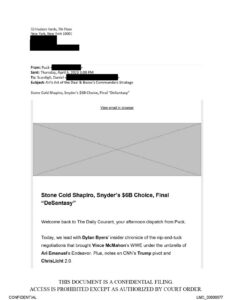
Note: Although originally designated confidential, the confidential treatment of these filings was challenged, and the parties later filed public versions, shown here.
How executives’ public comments compare with their private conversations
In an October 2022 interview — still during the interval before McMahon’s comeback but with media chatter of a WWE sale in the air — Shapiro compared Endeavor’s relationship with WWE to that of UFC before Endeavor acquired the mixed martial arts promotion.
“So we know WWE very, very well,” Shapiro said on The Town podcast. “Hell, we know Stephanie. We know Nick Khan,” each of whom were then co-CEOs leading WWE.
“There’s just all kinds of levers we can flip,” Shapiro continued. “And when it comes to WWE, yes, that would be something that would be interesting, that would be worth exploring.”
Shapiro didn’t mention the expectation he shared with Endeavor executives two months prior, that McMahon would return and look to sell WWE, and Endeavor would pursue. Shapiro instead said, “Would we buy it? Who knows. Last time I checked, it’s not for sale. But is it something we’d be interested in? We’re interested in anything in the owned sports properties segment.”
Emanuel, meanwhile, was cautious in his public comments ahead of the deal. He was asked about WWE by an analyst on an Endeavor earnings call on Feb. 28, 2023, by which time McMahon had returned, and the M&A process was formally underway.
“Unless you want me to go to jail, we don’t comment on our M&A practices,” the Endeavor CEO quipped.
“But here’s what I would say to you. We’re truly focused, as Jason [Lublin] said, on de-levering,” — corporate speak for “reducing debt,” which Endeavor had incurred a lot of to buy UFC in 2016.
For Endeavor, merging with WWE was not just an opportunity but a solution
While it was a legendary talent agency for many years before going public, Endeavor’s growth had been unimpressive since its IPO in 2021.
Debt was a major issue preventing Endeavor’s share price from rising to the heights its management believed it deserved. In comments on the same earnings call, and again at a conference just over a week later, Emanuel emphatically assured the investment community that Endeavor would not make a move that would further his company’s debt.
At Morgan Stanley’s conference Emanuel noted that Endeavor cut its debt in half recently. “I’m now sleeping, because of that, from four hours [a night] to eight hours, which is good. I’d sleep a lot more if it got lower,” he said on March 8, 2023.
On the surface, and running contrary to the records of Emanuel’s communications with McMahon, Emanuel might’ve sounded like he had little appetite for a major transaction like acquiring WWE. More debt was clearly off the table. But there was a way to make the deal without violating that promise. Besides the relationship between McMahon and Emanuel that the plaintiffs point to, a transaction that not only avoided new debt but also allowed Endeavor to offload its debt offers a possible explanation for why Emanuel may have been more willing to retain McMahon than others who might’ve viewed him as toxic and demanded his exit.
That solution was not a straightforward purchase of WWE by Endeavor, but a merger that pulled UFC out of Endeavor — along with the associated debt — to combine the leading MMA brand with the leading pro wrestling business. The debt would not disappear, but would no longer sit with Endeavor. It became the responsibility of the newly formed company we now know as TKO.
Combining WWE and UFC not only created synergistic revenue opportunities and cost savings — the latter, largely through laying off redundant staff — but further resolved a problem that hindered the talent agency’s stock story. Shapiro, now the executive who tours the media conferences, has since prolifically argued that TKO is such a “cash gusher” it’s well-equipped to handle the debt. That’s a view Wall Street appears to have accepted. TKO’s share price has more than doubled since the merger closed just over two years ago.
Meanwhile, on the WWE side, with the company openly on the market, on March 30, 2023, Khan went on CNBC, where he faced some challenging questions from anchor Morgan Brennan.
The television appearance was a few days before WrestleMania and the merger announcement that immediately followed. Khan said McMahon was not insistent on being included in a potential transaction, a position now a subject of the shareholder lawsuit.
“Vince made it clear to me and to the marketplace that he does not need to be included in any offer or any deal moving forward, and he has held to his word on that, as many of us predicted he would,” Khan said.
“Does not need to, but does he want to?” Brennan followed up.
Khan softened. “I’m not sure. That’s more a question for Vince,” he said, and pivoted to the benefits of McMahon’s return.
“It’s been quite supplemental to myself, to our head of creative, to all of our executives to have the expert of this business here when we want to reach out to him and have conversations,” Khan continued. “But I’m not exactly sure what he wants his future to hold.”
McMahon’s involvement with WWE creative and WrestleMania plans in 2023
Brennan noted that McMahon had been attending more WWE events and asked Khan whether McMahon had become more involved in the creative process.
Khan answered definitively: “No, is the answer to that.”
A month earlier, on Feb. 28, 2023, McMahon texted Khan about creative, according to new court filings.
McMahon wrote to Khan, relaying an interaction that presumably involved Paul Levesque — McMahon’s son-in-law and successor as head of creative — and long-time creative executive Bruce Prichard.
Text from me to Paul and Bruce: “Hey guys just double checking. Does Roman [Reigns] and Cody [Rhodes] know the new creative re [WrestleMania] and next year ?”
Bruce : “Not to my knowledge. I don’t know if Paul has had a conversation with either. Roman’s first appearance since we spoke is Friday in DC. Both will be there in person.”
Me to Paul: “ Paul have U “?
Khan responded to McMahon cryptically, writing, “Langis.”
“What in the blue hell is ‘Langis’ lol,” McMahon texted back.
“Read it backwards!” Khan replied, likely referring to the Signal messaging app.

That interaction, regarding “new creative,” runs counter to Khan’s statement a month later on CNBC that McMahon wasn’t involved in the creative process. The public record doesn’t show more about what “new creative” McMahon was referring to or whether he had any influence in Roman Reigns’ win over Cody Rhodes in the main event of that year’s WrestleMania, an outcome that surprised many fans.
Shareholders suing over the merger are less concerned with McMahon’s involvement in WWE’s creative decisions than with Khan directing discussions to Signal, which prominently features an auto-delete function. Plaintiffs allege key communications on Signal were not properly preserved, possibly circumventing special preservation measures required during mergers and acquisitions. If messages weren’t properly maintained, it could weigh into the lawsuit’s outcome.
The plaintiffs have asked the court to order Khan, Emanuel, Stephanie McMahon, and former WWE executive and McMahon aide Brad Blum to sit down with attorneys and take screenshots of any relevant messages they have on devices on which they used Signal. That decision is still pending with the presiding judge, Vice Chancellor J. Travis Laster.
Discovery is nearing its end, trial set for 2026
Some recently disclosed court documents cited in this report were previously filed under seal. Public versions, still containing redactions, were made available after this reporter submitted a notice to the court challenging the sealed filings’ confidential treatment, under a court rule that allows anyone to do so.
The shareholder lawsuit is now nearing the end of the discovery phase.
The closing of the TKO deal in September 2023 triggered multimillion-dollar bonuses for Khan and Levesque, which the shareholder plaintiffs allege were part of what enticed those executives to cooperate with McMahon’s purported scheme.
As part of the deal to merge WWE with UFC, McMahon was guaranteed a lifetime role with TKO unless he resigned. He did resign from all roles at WWE and TKO in January 2024 — leaving the company for the second time — after former WWE employee Janel Grant filed a federal lawsuit suing McMahon and the company, alleging she was sex trafficked and sexually assaulted by McMahon. He denies those allegations as well. That case remains ongoing in the U.S. District Court in Connecticut.
The shareholder case is being litigated in Delaware Chancery Court, a venue known for high-profile corporate lawsuits. If the plaintiffs prevail, they could recover monetary damages on behalf of stockholders and financial institutions that held WWE shares during the relevant period.
In addition to their roles as leading executives with TKO and WWE, Emanuel, Shapiro, and Khan are also current board members for TKO. Emanuel serves as Executive Chairman.
The merger lawsuit is scheduled to go to trial in June 2026.
