
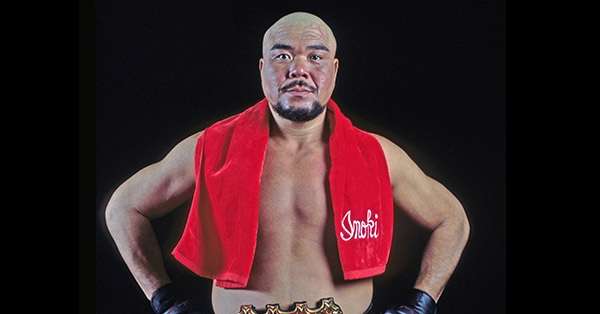
Former IWGP heavyweight champion Tadao Yasuda has died at the age of sixty-two.
Tokyo Sports reports that the former sumo, pro wrestler, and mixed martial artist died on Monday at his home in Tokyo.
Yasuda is remembered as one of the most unlikely IWGP heavyweight champions when he caught fire after a pair of MMA victories and the peak of Antonio Inoki’s obsession to create a group of shooters for legitimacy in New Japan.
He started his professional career in sumo at the age of fifteen in 1979 and spent thirteen years in that world under the name ‘Takanofuji Tadao’ with the Kokonoe stable. He had a very good career in sumo, reaching a mid-tier level, and competed against the likes of future wrestler Koji Kitao.
His retirement in 1992 was followed by starting at square one in professional wrestling. Unlike Kitao or the modern-day equivalent of an Aaron Wolf, he was not treated as a major star from another combat field but began as a young lion from the bottom. He lost to Hiroshi Hase in his debut in February 1994.
He became an undercard staple of New Japan shows, often in multi-man tags and teaming with several of the top stars like Shinya Hashimoto, Tatsumi Fujinami, and Keiji Muto, and he could serve as the fall guy.
Yasuda was part of the Collision in Korea shows in April 1995, which has the distinction of being the most attended shows ever, but with several caveats. He teamed with El Samurai on the first night in a loss to Masahiro Chono & Hiro Saito and lost to Road Warrior Hawk on the second show.
In 1997, he entered the G1 Climax in its single-elimination format, losing to Hiroyoshi Tenzan in the opening round. That same year, he teamed with Satoshi Kojima in the Super Grade Tag League (now World Tag League) and finished with two points.
It took Yasuda over six years before working at the Tokyo Dome, but he gained a spot on Antonio Inoki’s retirement show on April 4, 1998, teaming with Junji Hirata & Kazuo Yamazaki against Michiyoshi Ohara, Tatsutoshi Goto & Shiro Koshinaka.
He returned to the G1 that year and got past Ric Titan in the opening round before losing to Kojima and being eliminated. The next year, he finished with zero points in the round-robin format and was booked in a stacked block with Keiji Muto, Yuji Nagata, Tatsumi Fujinami, and Satoshi Kojima, and it was the year that Manabu Nakanishi was crowned the winner.
Yasuda’s career breakthrough occurred by equal parts luck and circumstance, with the rise of MMA in Japan and his mentor, Inoki’s desire to marry the two industries. On the first Inoki Bom-Ba-Ye show on December 31, 2000, Yasuda was booked against Inoki’s top protégé, Naoya Ogawa, and lost a worked match in 1:38.
Ogawa was at his apex following a series of matches with Shinya Hashimoto, culminating with the latter putting his career on the line in April 2000 and losing to Ogawa in front of a televised audience of 34 million people. The Inoki Bom-Ba-Ye card occurred right after Hashimoto’s firing by New Japan in a cloud of mystery, and the result was the formation of Zero One under Hashimoto’s leadership.
Despite Hashimoto’s friction with his previous company, New Japan did loan talent, including Yasuda, to team with Hashimoto against Tamon Honda & Masao Inoue on the promotion’s second major show in April 2001 at Budokan Hall.
But Yasuda’s pro wrestling career took a backseat in 2001 for his exploits in MMA, which ended with Yasuda reaching his career peak in terms of popularity and relevance. Due to his background, he was a candidate to represent pro wrestling and was booked to fight Masaaki Satake at PRIDE 13 in March 2001. In preparation, he was sent to train in Los Angeles.
They had a dreadful three-round fight over twenty minutes, and Yasuda was the victor by split decision and instantly gave him credibility among New Japan’s booking unit when success in MMA was valued above all else. More importantly, was the story of Yasuda that was told.
Yasuda had been consumed by gambling issues throughout his adult life, earning the nickname “The Debt King”. The story told was that he was fighting in PRIDE to pay off his debts and reconnect with his estranged wife and daughter. The win over Satake was overshadowed by the reunion with his family in a ‘made-for-TV’ moment.
The stakes were increased when Yasuda returned to fight on New Year’s Eve on December 31, 2001, against a much more dangerous fighter, Jérôme Le Banner.
Le Banner was 29 when they fought and was a world-renowned kickboxer in the prime of his career. He had just been knocked out three weeks prior by Mark Hunt in the K-1 World Grand Prix and was tasked with making his MMA debut against Yasuda.
Le Banner was totally gassed and out of his depth on the ground with Yasuda beating the K-1 kickboxer with a forearm choke of all things. Before the fight, they told the story of Yasuda meeting with his daughter before the fight and trying to recreate the miracle he pulled off earlier in the year.
Given the platform of Inoki’s Bom-Ba-Ye being much larger in 2001, it became a huge story, and New Japan saw money in Yasuda transferring this attention to professional wrestling.
Due to Kazuyuki Fujita suffering an injury and vacating the IWGP heavyweight title, a one-night tournament was held on February 16, 2002, with Yasuda coming out as the champion. He got past Giant Silva, Masahiro Chono, and Yuji Nagata at a sold-out show in Budokan Hall and was the peak night of Yasuda’s career.
He had one title defense against Hiroyoshi Tenzan before losing the title after forty-eight days to career rival, Nagata. While New Year’s Eve 2001 was a high point for Yasuda, it was the opposite for Nagata, who was thrown to the wolves and knocked out by Mirko Cro Cop, and was in serious need of rehabilitation.
Yasuda and Nagata would have many contests over their careers, including wins by Yasuda in the G1 Climax in 2002 & 2003.
The remainder of Yasuda’s New Japan career saw him form the Makai Club with Kantaro Hoshino and bring on a stable of shooters in line with Inoki’s vision for New Japan during this era, which was generally panned, with business facing a precipitous drop.
Yasuda had the distinction of wrestling Shinsuke Nakamura in the future WWE star’s first match on August 29, 2002, at Budokan Hall.
安田忠夫さんが亡くなりました。
デビュー戦の相手で、総合格闘技とプロレスの両立を経験した方だからこそ、
それに挑んでいた当時若手の自分に何度も気をかけてくださったことを忘れません。ご冥福をお祈りします。安らかに pic.twitter.com/LwqoLxX4qX
— Shinsuke Nakamura (@ShinsukeN) February 10, 2026
He left New Japan in September 2004 and began wrestling for Zero One and Hustle. He formed a team with Genichiro Tenryu and won the Hustle Super Tag Team Championship in November 2005, holding the titles for four months.
When Inoki launched his Inoki Genome Federation, he enlisted Yasuda to work contests with Josh Barnett, Mark Coleman, Rene Rooze (a former opponent from Pride), and Naoya Ogawa.
In October 2007, there were reports of an attempted suicide by Yasuda, with a friend rescuing him from carbon monoxide poisoning. Later, Yasuda denied that he attempted to end his life and that it had been accidental.
His career wound down with his own-produced event at Korakuen Hall on February 4, 2011. He wrestled three matches, teaming with Shinjiro Otani against Minoru Suzuki & Yoshihiro Takayama, a match with Akebono, and his final match against Genichiro Tenryu, while losing all three.
