
The pending acquisition of Warner Bros. Discovery by Paramount Skydance is going to represent a seismic shift in the consumption of media and trickle down into combat sports.
The questions are endless, and the answers are few and far between on how the landscape will shake out. First, there is the approval process for this $110 billion enterprise value assigned by Paramount, and clocking in at $31 per share of WBD stock.
Unlike Netflix’s offer, Paramount is gobbling up the entirety of WBD and adding distressed cable assets to its already large programming bundle. The game of “chicken” with Netflix is going to leverage Paramount to an estimated $79 billion of debt on its books when all is complete, ensuring that the cuts will be deep, bloody, and gruesome.
Paramount is projecting a picture of stabilization and growth for its industries, words not often described when its COO is already assigning a figure of $6 billion in “efficiencies” to be found. Netflix’s co-CEO Ted Sarandos says that figure is conservative and believes $16 billion is more realistic.
If phase one of the David Ellison era was to show the industry that he had arrived and was a player, that phase is complete. That theory was supported with massive overspending to acquire the UFC’s rights for $7.7 billion over the next seven years.
Monday’s call with analysts confirmed the inevitability that Paramount+ and HBO Max would be merged after the approval of the sale. It combines two streamers with a gulf between them and Netflix, and the hope of mounting a serious competitor for the streaming leader. HBO Max provides a worldwide count of 131.6 million subs with an aim at 150 million by the end of 2026 through international expansion, and Paramount+ accounts for 79 million worldwide.
Yes, there is overlap in subs, but in the U.S., it’s hardly the redundancy you would expect with Antenna reporting 7.6 million subscribed to both services.
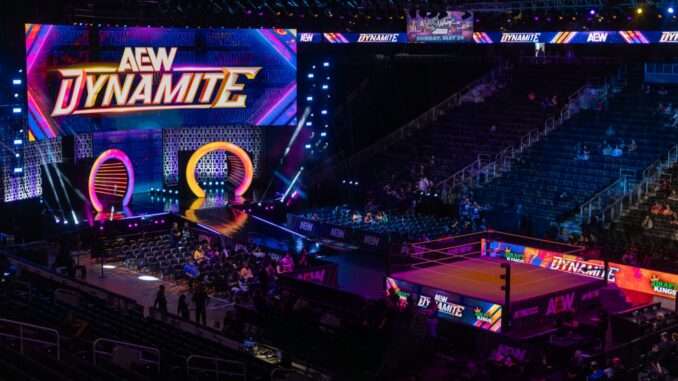
Enter AEW and its future at the top of the mind of every wrestling fan, and how this acquisition applies to the WBD property.
The company is in the middle of a multi-year rights deal worth a reported $178-185 million in average annual value through the end of 2027 with an option for an additional year. Unlike the previous rights agreement, this one contains a streaming component for Dynamite and Collision on HBO Max, along with access to purchase its pay-per-views on the streamer. Alongside, the caveat that it’s now clear WBD owns a less than ten percent stake in AEW, as disclosed in a recent CNN article and never denied by Tony Khan when asked.
It’s impossible to forecast how AEW will settle under new ownership and what side of the value/liability ledger it falls under. But it doesn’t hurt to outline the factors at play.
In the short-term, UFC and AEW will be cousins under the same umbrella, although AEW is not classified under the sports portfolio at WBD.
Under a merged streaming service (which could be a long time away from launching), it provides both entities the ability to be in more U.S. homes, and AEW sells its pay-per-views to a wider base, providing the merged service continues to offer a pay-per-view component as HBO Max installed last year.
We also learned on Monday’s call that Paramount can make UFC programming available across all its platforms, specifically mentioning TNT. Given the night that UFC occupies, it would directly affect Collision’s 8-10 p.m. ET slot, and a decision would have to be made.
UFC is a valuable property to Paramount, and while the math is nearly impossible to make this deal a profitable one for Paramount, it’s a long-term play and one that will be given every priority to maximize its value. AEW is a complete unknown in comparison to how it will be viewed.
The optimist would say that if AEW’s audience is within the realm of the typical UFC Fight Night event, and costs a fraction, it could be seen as valuable programming that doesn’t command the rights fees of the major sports entities. It also has a monetizable component through pay-per-view, which UFC has bowed out from in the U.S. If Paramount opts to simulcast UFC programming on TNT and/or CBS, it is hardly a death knell for Collision. It could move Collision to a new night, it could move to a different start time, or it’s pre-empted every so often if the TNT window for UFC is used sparingly.
The pessimistic viewpoint is that Paramount’s sole objective over the next five years is justifying an obscene price tag for WBD to its shareholders and cutting anything with a pulse. In these scenarios, there are no sentimental favorites but rather, unemotional slashing across the board where everything has a dollar figure attached and is part of a lengthy equation toward shareholder value. One simple decision can be made in eighteen months that the option year for AEW is not picked up, placing all its eggs into the UFC basket for its combat sports dossier, and it’s a nine-figure savings, regardless of any upside or ownership stake.
These are extreme outcomes but not unrealistic ones. The next eighteen months are critical for AEW to demonstrate its value and audience retention, which is key currency in today’s media landscape. Therefore, if the floor falls out from underneath and they are orphans, other programmers see value in professional wrestling.
Another major factor to contend with is the fallout of the pending NFL renewals across the major broadcasters. The NFL has an opt-out clause with its broadcast partners in 2029/30, and it’s a guarantee that for any players wanting to stay in the NFL game, they will pony up handsomely and spend more for the existing package they already signed for. In a distressed media economy where the NFL is your ticket for admission to the game, it’s going to leave these outlets extremely leveraged for its non-NFL packages. That’s well and good for the big players, whose rights are locked up for years, but for AEW, it’s a gamble to be on the open market over the next few years. The same goes for SmackDown, which will run out its deal with the USA Network in October 2029.
It’s a two-sided coin where AEW either lands on the side of “bargain programming with a reliable audience” or “expendable programming” in a cost-slashing period for Paramount. The positive is that a decision isn’t going to be made tomorrow, and there is plenty of room for AEW to brace for the future and see where the chips fall under this seismic alteration of the media landscape in the U.S.
This story won’t end this year, but it’s one that could present enormous chaos to the industry as onlookers seek to find out where the professional wrestling piece fits into a massive puzzle.
