

Audio version of this article available on the POST Café
“It’s been a bizarre night. It’s been a night Ali will never forget, and certainly the fans in attendance will never forget, and maybe it wasn’t what they expected, but perhaps they are seeing something that they have never seen before and will never see again”.
– Jerry Lisker on the Ali vs. Inoki broadcast
In the era of “celebrity fights,” it is reasonable to envision a boxer and professional wrestler meeting in a ring on the agreement of a myriad of rules, but no one would expect the top boxer in the world to do so.
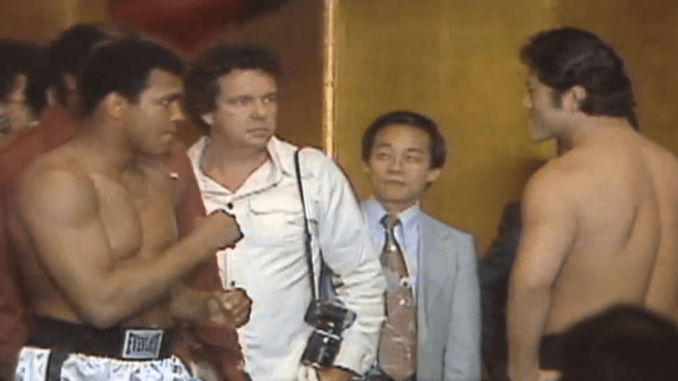
This week is the 50th anniversary of a fight equally famous and “infamous” depending on your perspective, when Muhammad Ali shared the ring with Antonio Inoki for fifteen long and excruciating rounds. The idea that reflection on this fight would occur a half-century later would sound preposterous if one consumed the immediate reactions from fans and media on that day in June 1976.
The boxing side saw it as a farce with Ali taking an incredible payday to lower his reputation to the dregs of professional wrestling. It probably hit too close to the narrative of “Requiem for a Heavyweight,” where past-his-prime heavyweight Louis “Mountain” Rivera had to lower himself to the carnival sideshow of pro wrestling in a demeaning exchange of fame for fortune. However, this was not a movie, and Ali was not Rivera. This was the undisputed heavyweight champion, an iconic figure worldwide, and at 34, had just come off his trilogy victory against Joe Frazier and was slated to conclude another three-fight series with Ken Norton that year.
So why take this detour?
Antonio Inoki was as entrenched with New Japan Pro Wrestling as the lion mark. A protégé of Rikidozan, Inoki’s less-than-amicable split with the JWA (Japanese Wrestling Alliance) allowed him to take control of his own career by launching New Japan Pro Wrestling in 1972. In the exodus of the JWA stood NJPW and nascent All Japan Pro Wrestling, led by Inoki’s training mate, and now rival, Shohei “Giant” Baba. It was an easy story for the public to digest as the former teammates now struck out on their own to further their visions of the profession and fight for superiority.
Baba had many advantages, one being his cultivation of a relationship with the National Wrestling Alliance (NWA) and its championship, with an ability to book the top U.S. talent. Inoki was cornered and needed to find an alternative path to legitimacy in the eyes of the fans without the assistance of the well-known body of U.S. professional wrestling and access to the prestige its champion lent.
It forced Inoki and his right-hand man, Hisashi Shinma, to create Inoki as the brand and present him as “real”. Whatever you want to say about professional wrestling, the discussion always led to debates: “Yeah, but if it was real, what would happen?” That simple “what if?” became New Japan’s ethos and propelled the promotion to grand heights and detrimental lows in the decades to follow. It is firmly established by the company’s inaugural event on March 6, 1972, when Karl Gotch defeated Inoki in the main event.
New Japan was still a young company when 1976 rolled around, and the placemat was set on the table months before the Ali fight. On February 6, New Japan brought Olympic Judo gold medalist Willem Ruska to Japan to put Inoki over and allow its star to be marketed as “The World’s Greatest Fighter”. New Japan was investing in legitimacy through orchestrated means and allowing fans to believe that if all else was equal, Inoki was the toughest and would have a credibility that Baba could not replicate.
Ali represented the biggest fish in the sea for New Japan to catch, but would require a massive worm to dangle in front of the worldwide celebrity.
Ali was not a stranger to professional wrestling, often citing his fascination with Gorgeous George and Freddie Blassie during a June 1961 interaction in Las Vegas. Ali was in the studio for a radio interview, promoting his fight with Duke Sabedong, and was joined in the studio by George, who was wrestling Blassie the night after Ali’s fight. The future heavyweight champion observed how the wrestling match outdrew his fight and reflected with author Thomas Hauser how it was a lesson in the importance of talking and hyping a fight that mattered. While George is often the figure credited for Ali’s style, it’s been questioned if Ali mistook George for Blassie, given how his delivery and speech were closer aligned with the latter than the former.
Vince McMahon Sr. toyed with the idea of producing a Boxer vs. Wrestler contest with his top star, Bruno Sammartino, which didn’t materialize but got the ball rolling. With other promoters unwilling to assist with McMahon in footing the heavy price tag, New Japan caught wind and saw its opening. An unprecedented figure of $6.1 million was offered to Ali (larger than any of his payoffs to date, answering the question as to “why?” he would agree). To put it into context, his first fight with Frazier netted Ali $2.5 million in 1971.
While NJPW would promote the fight from Nippon Budokan in Tokyo on June 26, 1976 (June 25 in the U.S.), there would be an entire American arm of the promotion anchored by Vince McMahon Sr. and Bob Arum of Top Rank Promotions. Territories across the U.S. would have access to the Ali vs. Inoki fight via closed-circuit and run cards in their town.
There was no larger undertaking on this side of the world than McMahon Sr. booking Shea Stadium with his own Boxer vs. Wrestler attraction with Andre the Giant performing against “The Bayonne Bleeder” Chuck Wepner. It wasn’t enough for a stadium-sized show, and McMahon Sr. had to plead with his injured WWWF champion, Sammartino, to exit the hospital and work the event. Just weeks prior, Sammartino was dropped on his head by Stan Hansen, and despite finishing the match, he did so with a broken neck and was laid up in the hospital. McMahon Sr. was desperate and pleaded with the Italian superstar, with the provision of a cut of the closed circuit in his payoff (which would not come to pass and left bitter feelings on Sammartino’s side). McMahon pressed upon his top star the threat that striking out at Shea Stadium could torpedo the company.
Sammartino, against conventional wisdom, worked the show and is credited with saving the card, as it drew 32,000 and was arguably the only success story of the day.
The AWA booked Chicago Stadium with Nick Bockwinkel vs. Verne Gagne, Paul Boesch landed NWA champion Terry Funk to defend against Rocky Johnson in Houston, Atlanta’s Omni promoted Jack Brisco vs. Dory Funk Jr., Mike LeBell ran with Roddy Piper and Chavo Guerrero in Los Angeles, The Sheik vs. Pampero Firpo in Detroit, and the list ran on of territories hoping to cash in that day.
Meanwhile, a summit was going down in Japan in preparation for how this “fight” would go. New Japan was not forking over millions of dollars to risk their gravy train being put into a disadvantageous position with the world’s top boxer. The design was spending this money as an investment in Inoki to gain a win over Ali, but a compromise to allow the boxing champ to save face. The layout was outlined in Josh Gross’ excellent book on the fight, that Ali would pummel Inoki with strikes and that the Japanese star would blade, and nearing the end of the fight, Ali would back off and protest to the referee that he’d done enough damage, allowing Inoki to blindside Ali with his patented enzuigiri kick.
Whether it was cold feet, his inner circle of boxing people that voiced concerns about his image, or that Ali wasn’t comfortable with gambling with his reputation, the star wouldn’t participate in the planned scenario. Despite participating in worked matches in the U.S. with Buddy Wolfe and Kenny Jay on Wide World of Sports to promote the match, he was not ready to spike the football on a worldwide basis and be accused of “throwing a match”.
Gross outlined the agreed-upon rules as the fight would proceed as an actual fight, although greatly prohibiting Inoki’s strengths:
Kicking was mostly prohibited and would be declared a foul unless the person delivering the blow was kneeling, squatting, or lying on the canvas. In attempting to bring an opponent to the ground, leg sweeps, leg whips, and leg pulls were allowed using shins or the side or top of the foot. Other fouls included hitting below the belt with a fist; hitting with the knee or elbow to any part of the body; hitting with any part of the body to the groin; butting with the head; jabbing, gouging, or thumbing the eyes; hitting or attacking after a ref break; any blow to the back, to the neck, or kidneys; and all chops as traditionally used in wrestling, such as chops with the side of the ungloved hand. Palm or heel strikes were fine, so long as they didn’t connect with the throat or Adam’s apple.
If the fight hype landed with a tongue planted firmly in cheek to the American consumers, it certainly wasn’t the tone of the Japanese public, as they sold out Nippon Budokan with 14,000 people paying $2.5 million. Depending on your perspective, it is either a blessing or a curse that 54 million people watched the fight live, and another 28 million watched a replay that evening on TV-Asahi.
The fight itself is something that must be seen to be believed. The English broadcast is handled by Frank Bannister and Jerry Lisker of the New York Daily News, and they represent most of the viewing public, ranging from pure spectacle to astonishment at the strategies and venturing into anger over the lack of action and fouls committed.
When you say the phrase “Ali vs. Inoki,” the immediate image that springs to mind is Inoki on his back in what would be described as a “crab position,” aiming for the legs of Ali over fifteen rounds and landing successfully 107 times with those kicks. But the punch stats tell the story with Inoki going 0/3 and Ali a mere 4/7. Inoki was deducted several points by referee “Judo” Gene LeBell for an errant elbow and a knee to the groin, which would play a major factor in LeBell’s scorecard at the end.
The fight is a perfect encapsulation of “styles make fights,” and when Inoki’s ruleset was dialed back, his answer was to take away Ali’s path to victory and remove his ability to box. The result was neither man having sufficient tools beyond Inoki’s leg kicks, with an audience unaware of what they were seeing in a primitive fighting environment where boxing ruled the day, and Inoki was closer to an actor than a fighter in the public’s perception. Frequently, Ali can be heard degrading Inoki for not standing and fighting and using offensive remarks to conjure Inoki’s fighting spirit to stand and fight.
When the final bell sounded, it was off the scorecards where Kokichi Endo (a former pro wrestler) scored it 74-72 for Ali, Boxing judge Kou Toyama went the opposite with a 72-68 card for Inoki. It came down to referee LeBell, who took into account his point deductions and ruled it a split draw after a 71-71 tally. For modern audiences, it would be impossible to justify any card for Ali, who landed his best punch in the fourteenth round.
“If it were me, I would hold both of their purses. I wouldn’t pay neither one of them, and I would give them a suspension to both of them because they are cheating the public tonight, and I mean that sincerely” – Bruno Sammartino
There were stories of fans storming out of closed-circuit locations in the U.S, feeling they had been hoodwinked into the promise of a fight and were victims of a bait-and-switch. The Ali supporters saw it as a black eye on his reputation to join the circus for one night, while Inoki supporters didn’t fully understand his strategy and labeled him a coward for not fighting.
Ali’s trainer, Ferdie Pacheco, told Thomas Hauser, “Fighting Inoki was an incredibly stupid act. To subject a great legendary fighter to a carnival atmosphere like that was wrong. Ali was a showman, but that wasn’t much of a show, and it put his entire career in jeopardy for some dollars that he could have made just as easily without risking his reputation and his health. So, it was bad, but what happened afterward was even worse”.
The damage to Ali’s legs was shown between rounds, and some have suggested he was never the same after this fight, although at 34, he had been through several wars, and keeping an intense schedule, something had to give. After a sojourn to the Philippines, he returned to the U.S. and discovered blood clots in his legs, requiring a hospital stay and right into camp for his fight with Ken Norton in September. He won his next three fights, although going the distance in each before his 1978 loss at the hands of Leon Spinks.
In the cruel irony of Ali’s impetus to engage in such a spectacle, the financial reward was too good to be true. The promise of $6 million turned into a delivery of $1.8 million, and Inoki only received $400,000 of the promised $1.8. The closed-circuit performance in the U.S. didn’t take hold with a reported 250,000 tickets sold to locations, but did lay the groundwork for an expanded reach for major events to be hosted by Jim Crockett Promotions with Starrcade and the WWF with WrestleMania years later.
In Japan, Inoki didn’t slow down but learned his lesson of controlling the outcome for future worked matches with Chuck Wepner, Allen Coage, Willie Williams, Leon Spinks, and Shota Chochishvili.
Like many events that are viewed one way in the moment, time can be exceptionally forgiving and, in some ways, enhancing of the original substance. While Ali’s engagement in this fight with Inoki was never considered a highlight on his resume and is still reflected upon as an “err” in judgment when he died ten years ago, the opposite can be said for Inoki. In time, the fight was marketed as the “birth of MMA” in Japan and Inoki as its forefather, lasting fifteen rounds with the toughest man on the planet and using his smarts to last with a dangerous striker for such a length.
Inoki’s penchant for realism and the accreditation that it accompanies was a rich cocktail of success in his career and peaked in the early ‘80s when New Japan was on fire, and he became an iconic figure in Japanese culture, even evading scandals within New Japan and his political career. That same cocktail would leave New Japan intoxicated by the 2000’s when MMA was established in the country, and the “what if?” questions of wrestlers entering real fights were answered in harsh terms too often and neutered a generation of the promotion’s rising stars with few exceptions.
The fascination behind different styles of fighters would not deteriorate and became the question that propelled Art Davie to market the UFC in its infancy. The mixture of martial arts, combined with a sheen of blood and danger wrapped in a caged fence, became its selling point and found an audience on pay-per-view.
Ali and Inoki didn’t change the fight game, but it did present an idea and ask a question that the public wanted to pay to see answered on that date in 1976. They left that day without an answer, but not without further curiosity into the dynamics of fighting and finding the proper equation to answer, “What if?”
Additional reading:
