
Part 1 – The Early Years
Part 2 – WWF Goes National
Part 3 – Tabloid Terrorism and WWF Exit
Part 4 – The WCW Years
The industry had undergone dramatic changes by 2002.
Gone were WCW and ECW, and by extension, any true competitors to the market leader.
Vince McMahon won the war, but the game continued, every week, for multiple hours, always with another pay-per-view to sell and a star to market.
It was considered a layup that McMahon would be able to author the easiest wrestling story ever handed to him, WWF vs. WCW. For various reasons, from refusing to upset its pay structure and morale by paying top dollar for the biggest names, still fighting a war that was over, and an inability to see their competitors as equals, it was a failed concept that generated one exceptional pay-per-view figure and fizzled its way until the last rites were read in November 2001.
Major names from WCW stayed at home, many collecting money still owed to them from their previous deals and banking it.
Near the top of the list was Hulk Hogan, but it was no longer 1986, and whatever value the former mega star brought to the table, his WCW rep also carried a liability.
On its face, no one should have fought for WCW harder than Hogan because no one profited off its success more than he did. With one of the richest deals in the industry’s history, he could print money during his tenure, and armed with all the incentives to create new stars to headline with, because he would enjoy the fruits of that labor.
Instead, his political acumen gained a reputation for serving Hogan first and Hogan only. He made millions but left plenty on the table.
A year-long program with Sting was marred by the Starrcade fiasco, a pay-per-view rematch with Bill Goldberg could have been the biggest WCW ever produced, and he never did a meaningful match with Bret Hart when he landed in WCW’s lap.
It was a case of someone given so much power and a playground to abuse it.
So, as WWF’s business had softened by 2002, you look to the past and you look to stars that have generated success. It was time for McMahon to set aside personal feelings and professional concerns and make the deal with Hogan.
There was plenty of animus built up since his departure from the lingering feelings by McMahon over the steroid trial, openly mocking Hogan with the “The Huckster” character when the company was clawing at WCW, and McMahon going so far as to claim Hogan was “not as big as he thinks he is” during a 1998 interview on TSN’s Off the Record.
But business is business, and McMahon felt it could be achieved with Hogan, and vice versa.
Hogan wasn’t coming alone, as Scott Hall and Kevin Nash were part of the package as McMahon would take his next shot at putting a WCW creation on his screen, one with similar results as the invasion.
The three arrived on screen at the No Way Out (an appropriate acronym) pay-per-view in February 2002, but it was only the appetizer for the next night’s episode of Raw in Chicago.
Hogan is met by The Rock in the center of the ring with an electric response, setting up the pair’s match at WrestleMania – Hogan’s first in nine years and a dream match scenario.
You could say there wasn’t a bigger match to make, but there was in the form of Steve Austin. However, the successor to Hogan balked at the plan, and it was a match that the WWE never got into the ring with this limited window where they had access to both stars.
The setup was one for the ages with dueling chants and a buzz throughout the Allstate Arena, nearly marred by a laughable follow-up moments later when The Rock was struck by a hammer to the back of the head and then inserted into an ambulance, which was promptly smashed into by a Hogan-driven semi truck.
The Rock lived, but thankfully, the memories of this angle largely perished, and the memories are reserved for the magic that occurred in Toronto on March 17, 2002, and Hogan’s return to one of his greatest cities.
Many would point to the WrestleMania match as one of Hogan’s last great moments, where the Toronto audience backed the 48-year-old and with an atmosphere few ‘Mania matches have ever experienced, and launched Hogan’s nostalgia run.
Like 1990 with the Ultimate Warrior, Hogan hung his head in defeat, but he was the story of the night, and despite his age and body, his mind and savvy were still in their prime.
McMahon went all the way, having Hogan unseat Triple H at the next month’s Backlash event to become Undisputed Champion and return Hogan to the red and yellow.
The N.W.O. faded with Hall fired within months over his behavior on an international flight, and Kevin Nash succumbed to a torn quad injury in July, leaving Hogan by himself.
The championship run felt like a step too far, and a byproduct of the previous years was a certain level of quality in the WWE main event picture that Austin, Rock, Triple H, Kurt Angle, and Chris Jericho were producing, and Hogan was not of that level. He quickly dropped the title to The Undertaker in May and would feud with Kurt Angle, form a team with Edge, wrestle Chris Jericho, and put over Brock Lesnar in as strong a way as possible in Lesnar’s lead-up to SummerSlam.
It was a run that exceeded expectations, with Hogan losing clean on multiple occasions, and fans got the nostalgia run of seeing Hogan one more time in a WWE setting.
Of course, Hogan was also very aware of the talent he was putting over and had expectations that the loss to Lesnar would be reciprocated with a win over the rising star later that year. McMahon was hell bent on moving forward, and Lesnar was his project that year with no plans of having his former star pin his current one.
Hogan learned the art of absence, making the heart grow fonder. He left in the summer of 2002, resurfacing for WrestleMania season and setting up a program for the inevitable match with Vince McMahon.
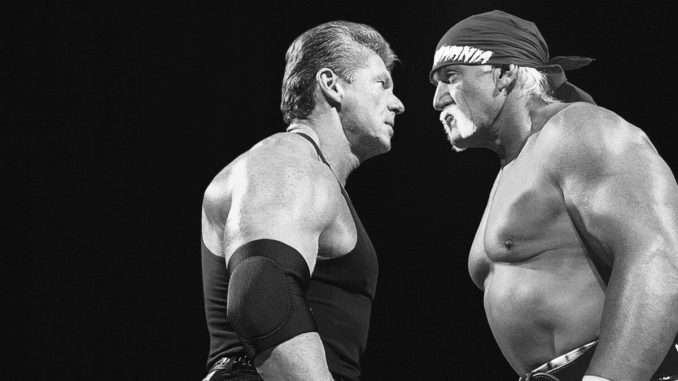
On a show stacked with Kurt Angle vs. Brock Lesnar, Steve Austin vs. The Rock, and Shawn Michaels vs. Chris Jericho, the program pushed hardest and received top billing in the promotional material was Hogan and McMahon.
The show’s performance on pay-per-view was the lesson: 560,000 buys and a decrease of 35 percent from 2002.
It was WrestleMania’s lowest figure since 1997 and would never hit this low of a number during the pre-WWE Network era.
While McMahon was a tremendous on-screen character, there were enough instances that paying to see McMahon wrestle was a tougher ask than watching him on weekly television. In February 1999, McMahon and Austin had the hottest feud in years, and when they finally had a match on pay-per-view, it did a very good number with 455,000 buys, but was topped by Hogan vs. Flair that same month in WCW.
Hogan would spend the spring under a mask as Mr. America, as an updated version of the Midnight Rider. His next sojourn occurred after a June taping at Madison Square Garden, and Hogan disappeared despite teases of McMahon putting his hair on the line in the future (an idea he held onto for several years).
During this period, he flirted with the upstart NWA TNA promotion out of Nashville, going so far as to shoot an angle with Jeff Jarrett after Hogan worked a match with Masahiro Chono at the Tokyo Dome in October 2003. Hogan never made his way to TNA, but while out of sight, the company wouldn’t be out of mind when Hogan needed a fallback plan years later.
He returned for his induction into the Hall of Fame in April 2005, which focused on the stars of the first WrestleMania and naturally segued to his next performances.
He teamed with Shawn Michaels against Muhammad Hassan & Shawn Daivari and set the stage for a turn by Michaels on the 4th of July edition of Raw to create another “first time” match.
Michaels flipped to the heel role and did some of the best character work of his career that summer, and the idea was to do a multi-match series with Hogan, but the two were in political opposition and each carried a lengthy amount of baggage, producing one of the hysterical and unprofessional showings in a major match.
Michaels was to lose the match and proceeded to oversell Hogan’s aging offense in comical fashion that some could have viewed as a physical protest. Michaels defended his performance, stating it was the way he always oversold as a heel.
To the men’s credit, the show was a massive success at 640,000 buys, doubling the previous year’s amount.
Michaels cut an unflattering promo on Hogan the next night, and no follow-up match would occur.
Hogan returned the next year, defeating Randy Orton at SummerSlam in a mid-card promo designed to promote Hogan’s new reality series, “Hogan Knows Best,” and incorporate daughter Brooke into the story.
It would end up being Hogan’s final match ever in WWE.
Once again, Hogan and McMahon would find themselves at odds. In January 2007, while Hogan was on the air with then-friend Bubba the Love Sponge, he took a call from Ann Russo at WWE.
She was unaware she was on the air and started asking Hogan about who he thought should be inducted into the WWE Hall of Fame later that year in Detroit, and started running names by Hogan they were considering. Reportedly, McMahon was furious over this breach by Hogan, and there was another cold war between them for years.
While his wrestling days were becoming fewer with each passing year, Hogan’s attention was directed toward his daughter Brooke and making her into the next Britney Spears. They found “Hogan Knows Best” as their vehicle for Brooke, although it placed an enormous strain on the family.
Hogan had been married to Linda Claridge since December 1983, tying the knot right before his return to the WWF in St. Louis that month. The two had Brooke in May 1988 and Nick in July 1990.
The strain on Hogan’s marriage was growing, and in 2007, Hogan would make a decision that would irreparably harm his career and the image he had crafted for decades. The true effects of which would not be realized for years to come.
More family strife occurred in August 2007 when son Nick was behind the wheel of a Toyota Supra with friend John Graziano as a passenger and smashed into a median. Graziano, who was not wearing a seatbelt, suffered a traumatic brain injury and would require full-time assistance for the rest of his life.
Nick Bollea was accused of speeding and would plead no contest to felony charges of reckless driving. He was sentenced to eight months in Pinellas County Jail.
Hogan would visit his son inside the prison, and it would be his first experience of a recorded message becoming public, with the tone and content of the conversation taking many by surprise.
Hogan is heard in a May 2008 recording frequently using the “n word” to refer to son Nick, with a portion of the transcript posted by Bay News 9:
“You and me been sitting on some serious phone, phone dialogue here n—a,” Hogan said.
“Yeah, nibb-ah,” Nick said.
“N—a, n—a, that means, that means you (are) my best friend,” said Hogan.
Nick was serving an eight-month sentence for a car crash that left his friend, John Graziano, permanently disabled. In another phone call, Hogan talks about God and reincarnation.
“You know that God gave you this vibe and this, this, energy that you and I are going to live forever, bro,” he said. “I just hope we don’t come back as a couple, I don’t want to say it, blizz-ack gizz-uys, you know what I’m saying?”
“Brutal,” Nick responded after they both laughed.
The tapes also revealed Nick referring to John Graziano as “a negative person”, while Hulk adds that, “I don’t know what type of person John was or what he did to get himself in the situation. I know he was pretty aggressive and used to yell at people and do stuff. For some reason, man, God laid some heavy (DELETED) on that kid, man. I don`t know what he was into”.
Beyond Nick’s prison sentence, Hulk and Linda’s marriage deteriorated, and after twenty-five years, they filed for divorce, which was a costly one for the former wrestling headliner.
“Hogan Knows Best” ran for four seasons on VH1 but tore his marriage apart. Hogan was seeking new entertainment vehicles to latch his aging star power with from an “American Gladiators” reboot to “Hulk Hogan’s Celebrity Championship Wrestling”. In November 2009, St. Martin’s Griffin released his second book, a follow-up to his 2002 book, both of which had strong arguments to be shelved in the fiction section of any library.
Reeling from the financial burden of the divorce and frozen out of WWE, it seemed that Hogan’s options in the industry were limited.
Until TNA Wrestling came calling, looking for its savior, as Hogan found his.
Part 6 will delve into Hogan’s tenure at TNA, yet another return to WWE, and the biggest scandal of Hogan’s career.
