
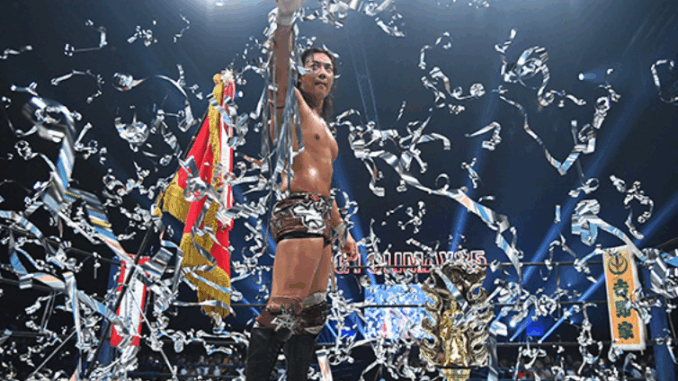
The G1 Climax is in the rearview mirror with the 35th edition wrapping this past weekend, and Konosuke Takeshita took the trophy, defeating EVIL in the final, and earning a future title shot.
This year’s tournament is forcing many New Japan Pro Wrestling fans to analyze the weaknesses in booking decisions, repetitive formulas, and the event’s low attendance, which is the least attended G1 Climax over the past decade.
We have assembled our POST Wrestling roundtable to go through the highs and lows of the G1 Climax from 2025, along with a look toward its future.
Let’s start with the positive, and what was the most enjoyable part of the G1 this year?
Karen Peterson: The wider scope of younger talent was definitely what I was most excited about. We’ve discussed at length the importance of laying a proper foundation for the company post-Tanahashi Retirement (complicated with Tetsuya Naito and Hirooki Goto-sized holes in the cards) in 2026, and this was the perfect opportunity to shift the spotlight onto the future of the company. It felt like such a squandered opportunity to elevate the younger guys.
Bruce Lord: The consolidation and emergence of Yuya Uemura and Ryohei Oiwa as strong and credible performers with clear bell-to-bell styles and presentations was the golden thread throughout the tournament for me this year. While Yota Tsuji and Shota Umino felt as though their stock held its position (for better or worse), Uemura and Oiwa were consistent highlights despite their tepid booking, with live crowds and casual viewers alike rallying behind the two. Over the last year Uemura had been working to overcome his slot in the lame duck Just X Guys faction plus his injury layoff, and Oiwa hadn’t managed to consistently conjure the grit and fire of his NOAH run since returning to the Lion Mark, but when the bell rang both men’s personalities, styles, and passion for honest to god puro shone bright in this year’s G1.
Kate from Montreal: Ryohei Oiwa was a great surprise, given that this was his first time in the tournament. Yuya Uemura, as good as he has been thus far since returning from excursion, did feel like he is on track to take over as the ace of the company. (Which is why he should have won, but I’m not bitter.) Shota Umino was better than he was last year. His match with Zack was miles better than the one they had at WK. He still feels over-pushed and irredeemably boring in his current role. Yota Tsuji remains incredibly charismatic, although it feels like they have to stop forcing him into the Okada mould of a guy who can spit out 30-minute matches every time, because he just doesn’t have that endurance. He can be great on his own terms, within his own limits. That said, he seems flat to last year in terms of his position after the tournament. He’s gone from feeling like the hottest of the “next generation” to being one of a handful.
Eric Marcotte: Watching the progression of New Japan’s younger talent continues to be the most intriguing part of keeping up with the New Japan product in 2025. Yota Tsuji and Shota Umino remain the most established of the young crop as legitimate main eventers, but I would not say either man has emerged as a draw. Ren Narita’s growth has been stunted in his current role in House of Torture, and while I think Ryohei Oiwa and Oleg Boltin are very solid performers given their respective levels of experience, I do think both men need more time before we know where they will slot in the overall picture of the roster. Yuya Uemura was, in my opinion, the standout performer of the tournament among the younger talent, and I would personally not be opposed to the company strapping the rocket to him as they attempt to create a new face of New Japan Pro Wrestling.
John Pollock: In a vacuum, I still felt this year’s tournament produced some excellent wrestling matches. The trio of Konosuke Takeshita, Shingo Takagi, and Zack Sabre Jr. were “nearly” flawless, and I was pleasantly surprised with the overall performances from Drilla Moloney and Ryohei Oiwa in their first G1s. Top quality in-ring wrestling was a hallmark of the G1, and it’s tougher and tougher to draw a larger audience on that merit alone, because the quotient of excellent wrestling is so high in the industry. On another note, Walker Stewart was fantastic as the narrator of the tournament with several dramatic calls and working like a chameleon with whomever he was paired with, from Chris Charlton, Rocky Romero, El Phantasmo, Drilla Moloney, and even Hartley Jackson.
What was your biggest problem with this year’s tournament?
Karen Peterson: I really got frustrated with the pulling of the rug out from under the younger talents and high-quality matches in favor of the Takeshita vs. House of Torture telenovela that was presented. The G1 I fell in love with was about ‘the wrestling’, how it was completely different from Western pro-wrestling, and although there was the occasional throwaway comedy or plunder match, it didn’t suck the air out of the room like it did whenever I saw a HOT match on the card.
Bruce Lord: Is “the booking” too broad an answer? Maybe I can be a bit more specific and still touch upon the two bugbears which made some cards a slog to be endured, rather than the sort of shows which first drew me to New Japan: the continued forestalling of significant elevation of young talents for the sake of bogging New Japan down with more putrid House of Torture dreck. No one, neither the remaining veterans nor the younger talents, has ever gained anything from temporarily thwarting House of Torture, and the latter in particular suffer as falling for the same stale weapons and run-in spots makes them look like ignoramuses who’ve learned nothing from watching the veterans play grabass with the House for the past half decade, rather than a credible new wave of talent capable of using their brains, brawn, and guts to wipe the House’s dogshit off their collective boots and walk forward into the future.
Kate from Montreal: House of Torture, especially with how far Evil progressed. This has to be everyone’s answer, right? More explicitly, HOT is at its empty heart a comedy act. The fact that they often get a heel pop from the audience does not change that, and having them perform well in the G1 lowers the stature of the entire tournament. Having a dastardly heel get a long run in this type of competition is fine (e.g., Jay White, or Kyle Fletcher and Ricochet both making the semifinals in the Continental Classic last year), but they have to be able to back it up with talent, and no members of HOT are doing that right now.
Eric Marcotte: In short, the booking continues to be a problem in New Japan, and it certainly impacted this year’s G1. This is a company that is very much struggling to create new stars, and as a follower of the New Japan product, it is frustrating watching them continually refuse to truly get behind any of their young talent. While Konosuke Takeshita’s standing in the company certainly benefited from ultimately winning the tournament, is there any other wrestler who gained something over this past month? Is there anyone who feels like a bigger star, or was there any feud teased throughout the tournament that will grab attention? I am not sure. My overall takeaway from this year’s G1 was that the Japanese crowd seems ready to get behind EVIL as a top babyface, and I have a feeling that was not New Japan’s intention when they were mapping out this tournament.
John Pollock: The atmosphere for most of the shows was a detriment and led to several instances of the guys working twice as hard for half the reaction. In the larger picture, it was a signal that its core native talent is not going to be perceived as the “heirs to the throne” anytime soon, and while the slow build is a strategy, it’s not the one this company needs right now. Three House of Torture members spread across the blocks was a recipe for a formula that has long since become tired and only exposes the lack of a serious tournament structure when run-ins, weapons, and referee distractions become the norm. It’s very hard to shake the feeling of a “cold product,” and that was my conclusion at the end.
Does the current month-long format still present the best available option for the tournament?
Karen Peterson: Given the size of the participant field, it’s unavoidable, unless they extend the schedule to provide for more rest and recovery days in between tour stops. The only way to shorten the schedule would be to further trim the participant field, which may not necessarily be a bad idea if the intent is to be match quality over match quantity.
Bruce Lord: The actual calendar placement and the time between the opening night and the finals still works just fine for me, and I’m glad that the two blocks of ten competitors format was retained from last year after the dodgy four block experimentation. I think the play-in matches have proven to be useful booking devices and would like to see them retained, but conversely, the expanded playoffs water down the overall significance of night-by-night block action, presumably for the political payoff of keeping talents and specific fanbases sated. In theory a well-booked two block G1 with one final match should still give plenty of the also-ran wrestlers who finish well out of last day contention some direction and momentum (Gedo’s need to keep 80% of the field alive on the last day has long since worn thin and strained credulity to the breaking point), though I found that basic element of tournament booking to be lacking this year; matches where someone was fighting for something other than points or advancement were few and far between (Sabre vs. YOSHI-HASHI being one notable exception), and most of the promotion’s next programs were set up in the multi-man matches on the night of the finals, rather than in the tournament matches themselves. Part of me also wishes there were more ten-match cards as there were in the past, but frankly, that’d depend upon a serious boost in star power I don’t see New Japan reaching by next July.
Kate from Montreal: A month seems to be the sweet spot. Any shorter would force the schedule to be so compressed that a lot of the shows would be ten straight tournament matches, which feels like it would be exhausting, not just for international viewers, but for audiences, who would get no variety in terms of the type of matches they saw during a show. Any longer and it would feel like it went on forever. One thing they should absolutely reinstate is the 20-minute time limit. That opened the door to more draws and made the pacing feel much more brisk.
Eric Marcotte: The current format of the G1 is unproblematic, and after a couple of years of four blocks, with far too many competitors, I think the company has found the sweet spot in terms of balancing the usual modern ten-man, two-block format with the playoff matches for additional late tournament drama. Casual followers of New Japan Pro Wrestling may struggle to keep up with the near twenty cards spread out of the course of the entire month when there are so many other options to get their wrestling fix, but I would argue New Japan needs to focus on rebuilding their core fanbase before focusing on making their content more accessible for a wider audience, and I do not think the tournament’s current format is a barrier for that core fanbase.
John Pollock: I am not against the length of the tournament, but I’m also not a proponent of a mandatory twenty participants if there are not twenty viable options for the field. In a year where they lost Tetsuya Naito, Hirooki Goto, Gabe Kidd, and didn’t use any true outsiders, I didn’t need to see nine matches from SANADA. Taichi and YOSHI-HASHI worked extremely hard, but they don’t represent your future, and we know Hiroshi Tanahashi won’t be back. So, I’d be happy to see a consolidated field. G1 is no longer a big part of the average wrestling fan’s calendar during the summer, and running nineteen shows is a tougher attraction than it was six years ago in a pre-AEW world. The flipside is that if this product were hot, fans would make the time, but we’re not dealing with “what ifs”. The fact is, New Japan isn’t, and their fans aren’t.
The best match of the G1 this year?
Karen Peterson: I keep looping circles around Oiwa/Finlay (7/19), Tsuji/Uemura (7/22), Takagi/Moloney (8/13) & ZSJ/Takeshita (8/16), so take your pick. I like them all for pretty much the same reason: these are the guys the company should be building the company around moving forward, and are consistently the wrestlers I enjoy watching.
Bruce Lord: Uemura versus Oiwa on Night 13 was my match of the tournament, both for the larger symbolic reasons mentioned above, but also for how intelligently and smoothly the two played off their similarities and differences. Rather than simply ticking off their own signature spots and sequences, there was a larger chess game of anticipation and countering throughout this match, even while each man’s strategy and style was on clear display for anyone possibly seeing them for the first time. There was preternatural chemistry on display here for a first-time singles match between wrestlers who’d only tangled in three multi-man matches previously. Takeshita/Sabre and Takeshita/Shingo were also fantastic matches and were on par (though quite stylistically different) with this match, bell to bell, but Uemura and Oiwa felt like a breath of fresh air and brought some much-needed optimism for the future deep into the tournament.
Kate from Montreal: Predictable answer, but Ryohei Oiwa vs Yuya Uemura not just because it was an excellent match (which it was), but because it was one that felt unique in the tournament and that would appeal to exactly the kind of fans who turn to NJPW for something different. It was the sort of thing that would have died an agonizing death on American TV, but it was beautifully executed and memorable in a way even a lot of other good matches weren’t. Honorable mention to Konosuke Takeshita vs David Finlay- I feel like this one would have seemed better if it had occurred literally anywhere else in the tournament except directly after Oiwa-Uemura.
Eric Marcotte: Some years, it is not difficult to guess what the best match of the G1 Climax will be going into it, and this was, in my mind, very much one of these years. Konosuke Takeshita versus Shingo Takagi from Night Six was the best match of the entire tournament this year, a hard-hitting, dramatic match between the two best wrestlers signed to New Japan contracts. They had a solid match at Wrestle Kingdom, but this match was a considerable step up from that outing, and I believe that they have an even better match within them that they are saving for the future.
John Pollock: I have several candidates, but I’m giving my vote to Konosuke Takeshita and Shingo Takagi from July 26 at Ota Ward, which had to a follow another stellar match featuring Zack Sabre Jr. and El Phantasmo. The bar was really high for this one, and they more than met the moment, lifting the audience down the stretch and having a Tour de Force of strikes while fighting exhaustion. Takeshita varying up his wins with the chicken wing was a nice addition in the early portion against Gabe Kidd, and this one, as well. ZSJ and Takeshita in the semi-final, Oiwa vs. Uemura, and Takeshita vs. YOSHI-HASHI all ranked near the top of my list.
The worst match of the tournament?
Karen Peterson: I would hate to say the Finals, but the fact that I couldn’t ultimately recommend it– it might actually be Takeshita vs. EVIL. It was supposed to be the culmination of a month of the best wrestling in the world. Employing the entire 13-man House of Torture to ruin the Finals of the G1 should have yielded a bigger rebellion from the locker room. While SZJ dragging Narita by his ankle was quite satisfying, I wished there was a locker room blitz from the baby faces because too many of the younger talents were cheated out of the opportunity for the sake of a singular storyline. Seeing the flashes of the wrestler EVIL used to be finally resurfacing against Takeshita just made me sad, too.
Kate from Montreal: Evil vs Yota Tsuji (semifinal)- Sure, it ended with the horrific reality of Evil being in a G1 final, but let’s not let that distract from the fact that the entire match was a mess. Tsuji’s head smacked the mat hard enough to warrant the referee interrupting the match for a minute (normalize head injuries ending a match immediately). But then they kept right on going and going and going… Other HOT matches were technically worse, but this one was a combination of bad-looking offence, stupid interference spots, a flat-out dangerous call by the ref, and, yes, the ridiculous ending. (Even if you argue that an injury to Tsuji caused the match ending to be changed, the best way to ensure that you don’t have Evil in your G1 final is to make sure that you don’t ever put Evil in a position where an injury could propel him through to your G1 final.)
Bruce Lord: So many choices! It’s tempting to relitigate a number of particularly egregious punkings out of young talents to the House (Oiwa/SANADA, Boltin/EVIL, and of course the impossibly stupid booking of EVIL to defeat Tsuji in the semi-finals), but I do think I have to go with the symbolic and sentimental “favourite” of EVIL’s defeat and elimination of Hiroshi Tanahashi on Night 15. Protecting Tana’s mystique bell to bell across his retirement has been an all-hands-on-deck project for New Japan this year, but here he was left out to dry. For a company which seemed bent on milking Tana’s retirement year for all it was worth (with probably too many singles matches leading to diminishing returns and gates), New Japan rarely made his last G1 feel special, and his final match in it was less a noble but weakened warrior going out on his shield and more a disheveled pensioner being shoved over by bored teenagers outside a drugstore and robbed of his meds.
Eric Marcotte: Unsurprisingly, the House of Torture dominated the discussion in terms of the worst matches of the tournament. Many of the matches play out in such a similar fashion that it is quite difficult to narrow it down to a single “winner”, but I ultimately went with SANADA versus Ryohei Oiwa from the A Block Final card. Oiwa was coming off his best match of the tournament against Yuya Uemura, and I think New Japan did an excellent job of quelling any momentum he may have generated after that performance with a dull, heatless, House of Torture shenanigan-filled, ten-minute match to eliminate him from the tournament.
John Pollock: EVIL and SANADA from July 22 in Sendai was my lowest-ranked match and a pairing I never need to see matched again. On one hand, they consolidated the House of Torture devices into one match, but somehow, that made it even worse. On a larger scale, there were plenty of other matches where the booking did far greater damage than the July 22 match did to my psyche. Yota Tsuji coming up short against EVIL was universally panned. Taking the importance of the G1 Final down several notches was a poor choice. Ren Narita managing to get a bad match out of Konosuke Takeshita was a major achievement, and EVIL managed to have the most forgettable of matches with Hiroshi Tanahashi’s in the latter’s swan song.
Who was the tournament MVP?
Karen Peterson: For his debutante entry, Drilla Moloney truly solidified his place amongst the heavyweights. Much like his War Dogs Leader, David Finlay, I found myself cheering for the bad guy against just about everyone he faced, including some of my sentimental, baby-faced faves.
Bruce Lord: While Shingo and Takeshita deserve honorable mentions, no one did more to thrill crowds and do right by his opponents than world heavyweight champ Zack Sabre Jr., even accounting for the fact that I liked his matches with Narita and YOSHI-HASHI far less than the general consensus. That Zack worked so fluidly night after night with each of his opponents is no surprise, but that he managed to be exactly the sort of opponent each man needed at each moment in their tournaments while still maintaining the continuity of his cocky submission master persona is the sort of thing that makes Zack an all-time great and a desperately needed rock of stability in present day New Japan. From wars with Shingo and Takeshita, which brought the tournament’s glory days back to life in the moment, to a stunning do-over of the Wrestle Kingdom main event with Shota Umino, which showed what that match could have been, Zack was the man in G1 35, darling.
Kate from Montreal: Konosuke Takeshita. No one had more high-quality matches.
Eric Marcotte: While Konosuke Takeshita offered many of the tournament’s best matches, and Shingo Takagi was as solid as you would expect throughout the block stage, I thought Zack Sabre Junior was the tournament’s best overall performer this year. His matches against Takeshita and Takagi were unsurprisingly great, but he also got some of the very best matches of the tournament out of the Great-O-Khan, YOSHI-HASHI, Shota Umino, and El Phantasmo
John Pollock: Just like last year, I can’t imagine this tournament without Konosuke Takeshita, and yes, he was off the charts (except with Ren Narita). But I’m going with Shingo Takagi because I found myself so enthralled by his consistency and just had match after match that were off the charts. He’s run the gamut from being underappreciated to rising and becoming IWGP Heavyweight Champion, and feels like he’s quietly settled as the aging veteran who still produces at the highest level. Whether it was Takeshita, ZSJ, Drilla Moloney, or Shota Umino, his match quality was incredible, and he was the guy who got me most consistently engaged.
Name one performer you would like to see as a fresh face added to next year’s G1
Karen Peterson: Bring Hangman Adam Page back to Japan. Full stop. His last G1 was in 2018, and I think he would raise hell with all the fresh blood in the NJPW waters.
Bruce Lord: Leaving aside the mixed reaction a perceived “outsider” winning the tournament received this year (I’m assuming that the ship has long sailed on either Desperado or Hiromu moving to heavyweight, that NOAH will be looking to keep its own assets in-house, and leaving Aaron Wolf as an open question), I’d be aiming to bring in an AEW talent who’s on the rise, wouldn’t need to be protected too heavily, and would bring something unique to the G1 mix while also understanding the expectations and history of the tournament. No one fits that bill like Brody King. He would play the classic monstrous American to a T for homegrown New Japan babyfaces, have fantastic hoss fights and brawls with the NEVER stalwarts, swat the House of Torture geeks like flies, and be a legitimately unique quantity on every card, leaving the open question of how each of his opponents would work to cut him down.
Kate from Montreal: Josh Alexander. It seems like such a natural fit for this environment. I actually assumed he was going to do it this year before he showed up in AEW.
Eric Marcotte: What New Japan needs most are performers around whom they can build compelling tournament-long narratives. In 2023, Kaito Kiyomiya was narratively one of the most focused-upon performers in New Japan despite being contracted to Pro Wrestling NOAH, and I think it is time that story was followed up upon. Kazuchika Okada humiliated him, and then he entered that year’s G1 in an attempt to pursue revenge, only to win a grand total of two matches in his block. I think reinserting an angry Kaito Kiyomiya into the tournament, seeking revenge against the young crop of New Japan talent with which he shared his 2023 G1 block, would make for a very engaging tournament in 2026.
John Pollock: For me, it was very evident that there should always be an “outsider” to present nine fresh matches and someone that adds a different flavor to their block; it was sorely missed this year, with the closest being Takeshita. In AEW, I think once certain talent ascend to a certain tier, they are not going to be candidates to be gone for so long, and therefore, Kyle Fletcher is probably out of the running as he’d be a strong choice. Daniel Garcia and Brody King would be on my shortlist. However, I think a level of cooperation with Pro Wrestling NOAH would be beneficial to both, whether it’s Go Shiozaki, Masa Kitamiya, or OZAWA, and in turn, NJPW reciprocates for the N-1 Victory with an exchange.
What is the final of next year’s G1?
Karen Peterson: Any combination of David Finlay vs. Yota Tsuji vs. Yuya Uemura vs. Drilla Moloney, please and thank you. If not that, Bruce, WH & I versus Gedo.
Bruce Lord: I just said I was leaving Aaron Wolf an open question, but it’s hard to see him not being given a monster push in 2026, barring him being an absolute in-ring disaster, which there doesn’t seem to be any rumour or concern about coming out of his ongoing training. Recent booking atrocities aside, I could see either Tsuji or Umino being champ going into G1 36, and could very easily see Yuya Uemura losing out to Wolf in the finals on the latter’s path to his first world heavyweight title win.
Kate from Montreal: Yuya Uemura vs Konosuke Takeshita (Uemura winning)- Ideally, you’d want to be in a position where two of your rising stars could meet in the final. Realistically, Takeshita feels like a bigger deal than anyone on the current NJPW roster (not counting Tanahashi) and likely still will next year.
Eric Marcotte: Sensibly, I would like to say that next year, New Japan fully commits to pushing one of their younger talents as the company’s next top star, with Yuya Uemura defeating an established main eventer like Zack Sabre Junior or Shingo Takagi in the finals to win the 2026 G1 Climax. However, given recent booking trends, perhaps a more likely final would be EVIL versus SANADA.
John Pollock: My gut says that 2026 is going to be completely centered around Aaron Wolf, and he’ll either be a breakout star or considered a bust, and I cannot fathom the pressure they are going to put on him. Regardless of what the verdict is, I think 2026 will be heavily focused on the rookie, and I’ll go all in with the belief he makes the final. His opponent? I’ll roll the dice, and it’s landing on Yuya Uemura.
