
TNA’s final pay-per-view of 2025 showcased the best and worst of the promotion with a show that bred mixed results, but left the real question of where TNA is headed.
With 2 ½ months and a pair of TNA+ specials on the calendar, the company is in a semi-holding pattern as murmurs of a forthcoming media rights deal persist, straight from the mouth of its president, Carlos Silva.
Bound for Glory was the twenty-first edition of the pay-per-view, beginning in 2005 when it proclaimed the show to be its version of WrestleMania, featuring all its major stories and matches that peaked annually.
TNA was often unable to translate its viewership, at its peak on Spike TV, into pay-per-view buyers, and was a constant stumbling block for a group with a deep roster of past, present, and future stars, mired by questionable creative moves and a muddling of its identity to serve all possible tastes.
In 2014, the group hit a glacier and was on death’s door when it lost its deal with Spike TV and was forced to find a life raft, which led to dismal landing spots on Destination America, Pop TV, the Pursuit Network, and finally on the Anthem majority-owned AXS TV.
Stabilization was not achieved until years after the loss of Spike, after the Canadian-based Anthem Sports & Entertainment installed Scott D’Amore and Don Callis to operate the day-to-day duties while overseen by Anthem exec Ed Nordholm. Callis would leave permanently in 2021 as D’Amore remained in his position until he was ousted in early 2024.
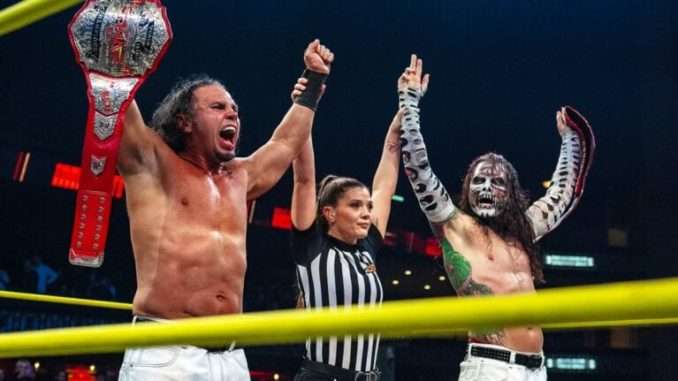
It did the company no favors to enter a nasty public spat with Matt Hardy and his wife, Reby, over the control of its Broken Universe IP, and they were operating from a place of zero leverage and influence among talent and business partners.
Slowly, it made inroads, and as WWE reintroduced mass cuts as a common occurrence, TNA could bring several reclamation projects to reinvent itself.
Quietly, it assembled a unique roster of undervalued talent, repaired relations with New Japan Pro Wrestling, underwent a successful rebranding to TNA to tap into nostalgia, and, most importantly, found an odd bedfellow in WWE.
The last eighteen months have seen TNA achieve levels not seen since its peak on Spike TV in the late 2000s, when it was a profitable entity before the signings of Hulk Hogan, Eric Bischoff, and a slew of talent, where expenses soared in 2010.
Often, it was a case of TNA shooting itself in the foot when it had a good thing going. Last January, the TNA rebranding was surprisingly met with a lot of positivity and, more importantly, aided in the business of its Hard to Kill event at The Pearl at the Palms in Las Vegas. Riding the wave of that show, there was a power play, and D’Amore was left on the outs, the person many associated strongly with the brand and one of the few links to TNA’s 20+ year history. Talent and fans alike viewed TNA and its management as the “bad guys,” and it was thought that any newfound momentum just evaporated.
But, along comes its unlikely partnership with WWE, and quickly, momentum was restored. WWE saw a useful function for the smaller group, primarily as a tool for its NXT brand. Whether it was seeing TNA as another bullet to insert in the chamber as a weapon against AEW, a bridge to inject TNA’s stars onto its own platform, or to win some easy points as an “ally” and play nice with another company, the result has been a positive one for both sides.
TNA has seen its attendance and relevance grow, its stars have come off as such on NXT programming, there is constant back-and-forth collaboration, and NXT has created fresh matchups and stories with the tried-and-true concept of a rival brand infiltrating the home team’s turf.
So far, Jordynne Grace has already made the switch, and Joe Hendry feels like he is someone on his very last legs in TNA, wrapping up with recent jobs on television and not featured at all on TNA’s big show this past weekend.
For TNA, whether they entered this relationship with their eyes wide open to the historical lessons of working with WWE and how companies have fared, or were naïve from the jump, it was at a stage where they had to make the gamble and accept any collateral damage along the way.
In the U.S., the market is dominated by two brands, with one superpower in WWE, and TNA is a distant third. While it’s a catchy and SEO-friendly headline to assume TNA will overtake AEW, it’s not backed by any data that would suggest TNA will be on an even playing field with the #2 worldwide group that has a $185 million annual broadcast agreement.
While that may be the desire of WWE to push that narrative and use TNA as a proxy, it should not be TNA’s goal. Rather, it’s a company that should be aiming for its best television deal possible and inching toward profitability after nearly a decade of Anthem-funded losses. It comes with the caveat that TNA cannot be assessed as a traditional “profits and losses” project by Anthem, which is using TNA programming to funnel its broadcast properties and earn other values from this acquisition beyond whether a show makes or loses money.
Where TNA is not enjoying success is the professional wrestling television rights bubble, which is in a precarious spot after the introduction of Nielsen’s “Big Data + Panel” model, which has disrupted WWE and AEW’s core programming.
The Anthem purchase of AXS TV in 2019 occurred as cable was slowly eroding, and that trend has intensified in recent years. TNA viewership data isn’t even available publicly as a metric to assess where it stands in comparison, pay-per-view data is extremely limited, and leaves analysts to assess its performance through live event attendance.
Bound for Glory boasted an impressive number of 7,794 at the Tsongas Center in Lowell, Massachusetts. It sounds impressive, but comes with the caution that it’s a company-released number and was 28% higher than the last reported figure by third-party WrestleTix, which combines tickets sold and handed out in its estimates. Still, even going by WrestleTix’s number of approximately 6,100, it is still a tremendous number to draw in Lowell. NXT Heatwave only distributed 1,874 tickets at the smaller Lowell Memorial Auditorium in the market, per WrestleTix on August 24. The advance for AEW Dynamite on November 24 in nearby Boston is only at 2,300, and Saturday’s WrestleDream event in St. Louis has not hit 6,000, yet.
Silva did the media rounds before Bound for Glory, citing how close they were to a new distribution deal, even stating it would go into effect at the start of 2026 while cautioning it’s not completed, yet. Typically, executives nearing the goal line of a deal have their lips stapled shut, but Silva is dangling the latest carrot for a company rich in reaching for the next object to take it to the “next level”.
They started on Spike on Saturday nights and needed a better night, a longer show, a prime time airing, head-to-head on a Monday night, bigger stars, more recognizable names, more pay-per-views, and all those things came and went. Now in 2025, this is the latest “level up” for TNA.
It comes at a chaotic time in television, where WWE Raw viewership on Netflix has been greatly analyzed and recently hit its lowest viewership numbers after moving the show up an hour and seeing Monday Night Football return. The “Big Data + Panel” results have caused massive decreases on SmackDown, NXT, and Dynamite, and should at least give pause to any entity earmarking millions of dollars for another pro wrestling promotion.
This version of TNA appears to understand its role. If it’s a vehicle to oppose AEW on Wednesday nights, so be it. If talent are swooped up by WWE, they’ll find the next ones. If WWE wakes up one day and is tired of this relationship, then at least TNA has gotten wider exposure and possibly a better platform out of it. That’s the “glass empty view”, but the opposite side has been a cooperative WWE that has booked the TNA performers on par with their own, reciprocated with talent swaps, and initiated a give-and-take, allowing this program to have legs and a needed spark on NXT, allowing it to be more than a one-sided arrangement.
The questions for TNA in the new year center around this distribution deal and where they land, what the finances consist of, and whether this company can rebrand its balance sheet from red to green and stand on its own two feet.
