
It was twenty years ago that wrestling fans woke up to an all too familiar story, the death of another young performer.
It was November 13, 2005, and Eddy Guerrero was a seasoned veteran with a decorated resume, an improbable rise in the “land of the giants,” and was a key anchor on the SmackDown brand.
He was thirty-eight years old when he was found in his Minneapolis hotel room, hours before a double taping of Raw and SmackDown, before setting off for the company’s European tour.
Heart failure was the culprit for a man who taxed his body both for recreational drug purposes in his past and for the realities of being a “little man” in a big man’s industry.
Now, before we go any further, why “Eddy” instead of “Eddie?” We rely on Guerrero’s own words from his 2005 biography, Cheating Death and Stealing Life:
I was billed as Eddy Gory Guerrero. Everybody wanted to see the last link to the Gory Guerrero tradition. My dad actually told me to spell my name “Eddy”. He knew that it would stand out more than the regular spelling I use today. Personally, I prefer the “Eddy” spelling.
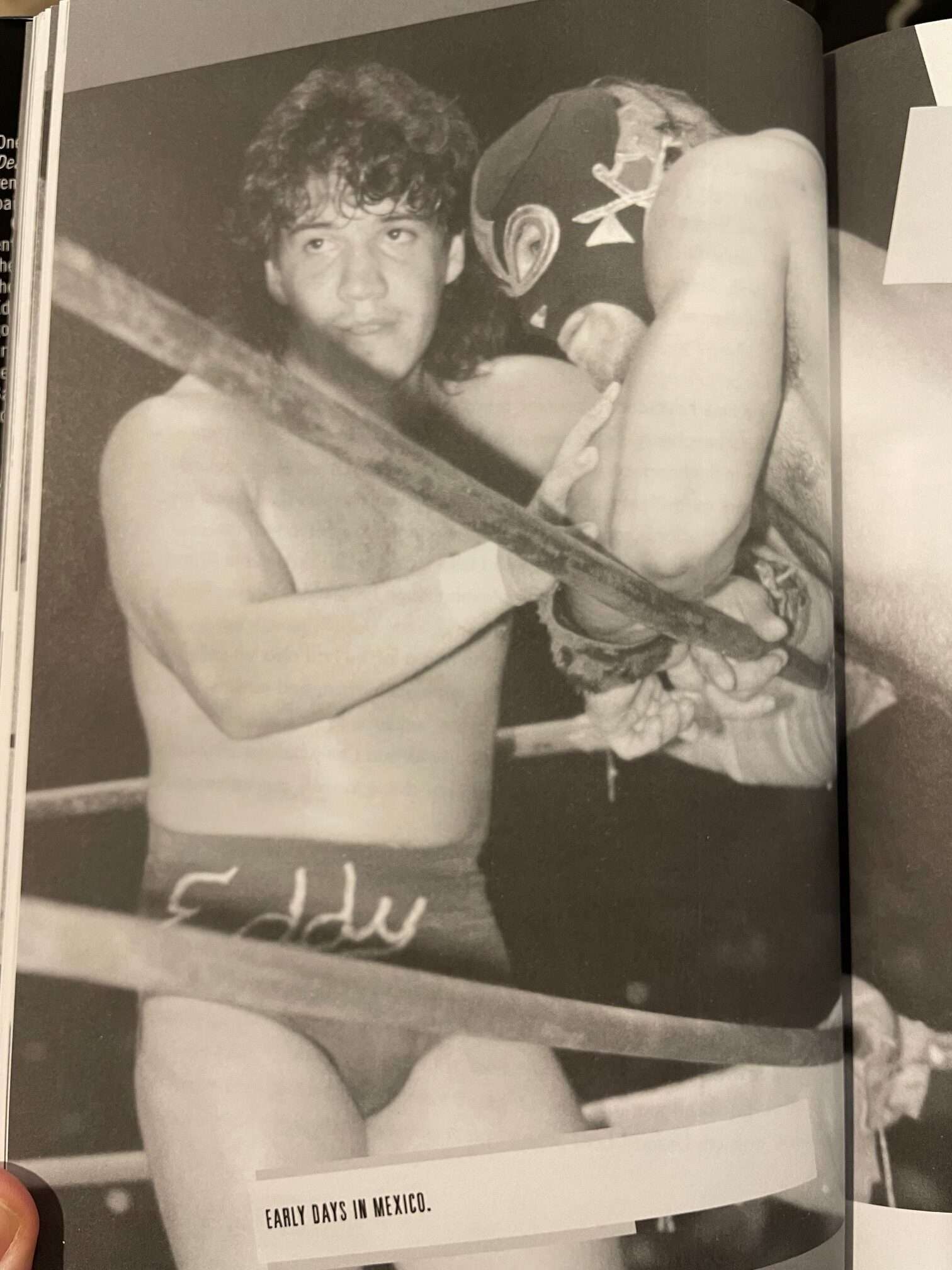
It was an era when talent dying before their fiftieth birthday had become way too common, and we, as an audience, had become way too numb to it. It was wrestling’s dirty secret of the rigors of the road, the expectation of superhuman physiques, and an even more superhuman traveling schedule to make all the towns and bring these comic book characters to life from coast to coast.
Guerrero was considered an evolution of WWE’s narrowing of who could become a star in its pipeline. The same company that plastered Hulk Hogan and the Ultimate Warrior on lunchboxes was also the company that morphed into the ‘90s with smaller talents like Bret Hart and Shawn Michaels. The company entered its second boom period with charismatic performers in Steve Austin and Dwayne “The Rock” Johnson, but hit a lull in 2003 when those two exited the company.
The next wave of experiments on top featured Guerrero and Chris Benoit, the two being anointed as each brand’s champion in 2004, resulting in a once memorable (now haunting) image of the two embracing at the close of WrestleMania 20. It was symbolic in that the two “smaller” individuals were capping off the biggest show of the year in the promotion’s home arena in the largest media market.
Behind the celebrations and confetti were two men desperate to be among the best in their profession, and those realities included bulking their bodies and compromising long-term health with short-term fame and fortune.
Instead of a celebration, both would be dead within years, with Guerrero dying a saint and Benoit remembered as a monster.
It is very hard to disentangle Guerrero from Benoit because the two were so closely linked throughout their careers. Guerrero gained notoriety as a descendant of his famous wrestling family with Mexico as his foundation. Benoit became a surrogate of the famed Hart family while using Canada as his springboard and the second iteration of Stampede Wrestling to launch his name. The two would each attract international acclaim for their work in Japan, with Guerrero under a mask as Black Tiger while Benoit became Wild Pegasus.
Their wrestling GPS took both men to ECW in the mid-’90s, providing a different flavor to the hardcore brand under the guidance of Paul Heyman. Along with Dean Malenko, the three were able to wax poetic with their mat work and technical abilities in a forum of loud rock and in-your-face lyrics. It was the counterargument to any ECW defender, who was accused of supporting a company comprised of only blood and guts.
Often, it is said that “timing is everything” in professional wrestling, and in 1995, the launch of Monday Nitro and Eric Bischoff’s full-throttle attack against the World Wrestling Federation required soldiers. In Bischoff’s theory of becoming “better than” or “different than”, one of those columns was reserved for outpacing his competitor with better wrestlers and a more diverse style.
Enter Benoit and Guerrero to shore up WCW’s undercard, and the field was changing. The two were swooped up by WCW along with Malenko and further complemented its roster with the addition of Rey Mysterio, Juventud Guerrero, Jerry Lynn, Chris Jericho, and Psicosis, among many others.
It was a laneway that WWF was not occupying, and Bischoff was savvy enough to see that high-end, state-of-the-art pro wrestling had a market and differentiated his product. This was exacerbated by the launch of its Cruiserweight division (and the wise choice of going against history and avoiding the “light heavyweight” branding).
Guerrero was not pegged as a Cruiserweight off the bat. In fact, it was the #2 belt in the United States Championship, which he would win in December 1996 as his first title in the company. WCW saw Guerrero and Dean Malenko as players who could adjust as Cruiserweights and be positioned in the U.S. title picture rather than being pigeon-holed.
Guerrero broke through in 1997 with a heel run that embodied the full-rounded nature of a thirty-year-old. He exuded a demeanor that was second to none while also reaching a level of physical transformation where he became his leanest and most cut.
While the industry was thriving with both companies increasing their popularity, the toll was being paid after the cameras stopped rolling. The combination of an intense travel schedule, the wear and tear of the rising scale in the ring, a party-like atmosphere in every town, and more money to go around, it is inevitable that tragedies would occur.
One of the popular drugs of the era was GHB, a highly addictive drug designed to calm the nervous system and give the user a high. Guerrero became one of many to subscribe to its effects, but nearly took his life years earlier when he smashed his car on New Year’s Eve in 1998 after passing out behind the wheel.
While Bischoff has earned his critics over the years, he earned major points from Guerrero as the two had re-negotiated a new contract before the accident, but had yet to sign it. Bischoff stuck by his word, and Guerrero never missed a pay cheque. His response was to rush himself back, and by June, he was wrestling and looking more ripped than ever after returning. In Guerrero’s book, he revealed an overdose that occurred in late 1999 and a subsequent issue over the holidays, where he was shot up with adrenaline to continue breathing.
Within four weeks, he had left WCW and was appearing on WWF programming after a walkout with Benoit, Malenko, and Perry Saturn during the peak of the Monday Night War.
The bad continued as Guerrero’s first match in the WWF resulted in a dislocated elbow and more time on the shelf. Despite his physical ailments and continued drug dependency issues, he soared in 2000 as the breakout personality among The Radicals and latching onto a compelling storyline with Chyna, which brought his personality to the forefront and reengaged Joanie Lauer’s character throughout the year.
However, in 2001, Guerrero’s problems persisted, and his best friends in the company had to take Jim Ross, then head of talent relations, aside and plead for help. They sent Guerrero to rehab in hopes of seeing a light at the end of the tunnel, but that light was a mere flicker, and by November, it appeared to be blown out.
Guerrero was fired by the WWF, and life was about to stare him in the face and force massive change. His family life was no better with a separation from his wife, Vickie.
After becoming a major star with the top two promotions in the world, Guerrero had a hard reset and had to tackle the independent scene. He took bookings with the upstart Ring of Honor, IWA: Mid-South, and returned to New Japan Pro Wrestling. Guerrero received high marks, not just for his professionalism, but that his ability to stay clean was not just lip service.
It was a testament to how highly regarded the performer was because just four months after being fired after a DUI, he was re-hired by the now WWE and immediately put over for the Intercontinental Championship while still honoring existing Indie dates as champion.
Instead of becoming a statistic in a long line of wrestling tragedies, Guerrero became a redemption story in WWE. He got his job back, kicked his drug habit, and even reconciled with his family and reunited with Vickie.
His full circle moment occurred on February 15, 2004, when he won the WWE Championship from Brock Lesnar, and on that night, he was the top star in the industry.
But life isn’t always a fairytale, and beneath the image Guerrero projected on television was a man who struggled with depression and was constantly battling the inner voice that doubted his success. He placed an enormous weight on his shoulders as champion.
I confess, in a great many ways, I wasn’t prepared to carry the company on my shoulders. For right now, all my inner strength is better suited to maintaining my sobriety and keeping my life flowing smoothly. There will come a time when I’ll be fully prepared to wear that belt again. And when that time comes, I promise I’ll be ready to carry that title with all the dignity and strength it deserves.
In 2005, there were few characters as over as Guerrero and his program with Rey Mysterio drew huge audiences, especially among Spanish viewers, as their quarter hours did shockingly well. One example was a tag match with the two against MNM in July 2005, which added 1,931,000 viewers during its quarter on UPN. Several weeks later, the tease of Guerrero revealing his “secret” about Rey led to more than 1.6 million viewers tuning in during the quarter. It was noted in the Wrestling Observer Newsletter that after the storyline concluded, SmackDown’s Hispanic audience decreased by twenty-eight percent.
Throughout the year, the two went from best friends forming a team to Guerrero becoming jealous and slowly losing his mind, and holding a secret involving Rey’s son over his head. It was Guerrero’s peak form as a character, now famously remembered for the introduction of Dominik Mysterio and the ladder match at SummerSlam for his custody.
The end occurred as he was being paired with Dave Bautista, with the idea that Guerrero had turned over a new leaf, but the audience was waiting to see if Guerrero was genuine.
On the SmackDown taping that became his tribute episode, Eddy was set to wrestle Bautista and Randy Orton for the World Heavyweight Championship.
But it never happened.
WWE is deeply saddened by the news that Eddie Guerrero has passed away. He was found dead this morning in his hotel room in Minneapolis. Eddie is survived by his wife Vickie and daughters Shaul, 14, Sherilyn, 9, and Kaylie Marie, 3.
His death rocked the WWE locker room to its core, no one worse than Chris Benoit, who, from all accounts, spiraled after the death of his close friend. One only has to watch his message to Guerrero on the tribute special to see a man visibly shattered by the loss of his friend.
After Benoit’s suicide in 2007, it was discovered that his wife, Nancy, had bought him a diary to write to Eddy, and excerpts were released, showing a man who was in desperate need of help and struggling to cope with the loss.
This wasn’t a wrestler’s death that WWE could assign blame elsewhere, as someone no longer affiliated with their company or brushed aside; instead, it was one publicized heavily, and its response was the introduction of the Wellness Policy.
It’s hard to imagine in today’s environment, but WWE posted a video of Vince McMahon addressing the locker room about the policy, taking questions from talent, and providing specifics about testing procedures. It was surreal, but then again, everything after Guerrero’s death felt that way.
There are plenty of issues to take up with the wellness policy in its first iteration, adding more teeth to the policy after the Benoit murders in 2007, and learning after Brock Lesnar’s failed tests in UFC that it did not apply to part-time performers. But, it is unmistakable that the rate of young wrestlers dying in the industry has dramatically decreased, and we are not seeing the level of concern for performers that once existed, from ridiculous physiques becoming a feature, not a bug, or performers in no condition to be on live television.
It wasn’t enough that the talent had to memorialize their colleague with four hours of television tapings that night, but they had to hop on planes and head into a two-week tour overseas as zombies, still processing the space in the locker room. Even worse, many could not attend Guerrero’s funeral due to the tour, and their grief had to be compartmentalized because “the show must go on”.
Then, it got worse.
It was pitched and presented that Guerrero’s death would become woven into the on-screen storytelling, mainly centering around Randy Orton as a heel character. Before the end of November, Guerrero’s memory was being used for heel ammunition and hit rock bottom in early 2006 when Orton was programmed with Rey Mysterio and delivered the line that Guerrero wasn’t in heaven, “he’s in hell”.
It was some of the dirt-worst programming in WWE’s history and left a bad taste across the board. Few attached to the company were willing to speak their true thoughts, but Mick Foley used his blog on WWE.com to condemn the decision:
It did not honor his legacy; it exploited his death. I hope it will end, and the sooner the better. For by exploiting his death, we achieve what I thought wouldn’t be possible: We cheapen his life.
In April 2006, Guerrero was inducted into the WWE’s Hall of Fame with Mysterio, Chavo Jr. & Benoit inducting him. Only fourteen months later, Benoit’s horrific actions led to the deaths of his wife Nancy and son Daniel, before taking his own life.
While this period led to a wave of deaths in pro wrestling, few legacies have withstood such a length of time. Twenty years later, Guerrero is fondly remembered as an all-around complete performer who elicits chants worldwide due to an influence on modern-day talents who grew up as fans of the late star.
WWE has managed to invoke his memory into the character of Dominik Mysterio, which has never felt like an exploitation, compared to the company’s handling in the immediate aftermath in 2005-06.
Talents like Mercedes Moné have cited Guerrero as their driving influence and memorialized him through her ring gear and by incorporating the Three Amigos and Frog Splash into her repertoire.
The “Eddy spot” was among the highlights as recently as Monday when John Cena won the Intercontinental title from Dominik, and a packed arena is educated and understands the spot instantaneously as an homage.
The legacy of Guerrero has withstood after twenty years, benefited from becoming a celebrated figure of WWE’s history, a major influence on today’s talent, and someone whose ring work and promos cross over generationally.
But it’s also important to learn of the struggles he dealt with from the tight rope walk of perfection he tried to balance from the start of his career, a demanding family legacy to live up to, a realization that steroids were a necessary evil to compete for top spots, and putting undue pressure on his body for years.
The December 21, 2005, edition of the Wrestling Observer Newsletter laid out the hard facts of his death:
The death of Eduardo (Eddy) Guerrero was officially labeled as a heart attack due to heart disease caused by a lengthy history of anabolic steroid usage and recent usage of narcotics medication according to the death certificate released by the Hennepin County (Minneapolis) Medical Examiners’ Office.
The official cause of death was due to arteriosclerotic heart disease, which is a hardening and narrowing of the arteries that supply the heart with blood and oxygen. That, combined with Guerrero’s both enlarged and damaged heart, and his suffering from organomegaly (several enlarged internal organs, likely due to usage of Growth Hormone), created an imbalance. The heart and larger organs needed more blood and oxygen than normal to remain functioning, while the narrowing arteries provided less blood and oxygen to the heart and those organs.
Guerrero was a perfectionist, and it’s a dangerous trait. It drives the very best to excel because there is a deep fear of failure that pushes them to go where others won’t, but it’s a double-edged sword because perfection is never attainable. You’re always left wanting more, hyper-focused on what didn’t go right, instead of celebrating what did.
On November 13, 2005, Guerrero exhaled his final breath, and the struggle to succeed, to defy, to be perfect, was over.
Twenty years later, his audience doesn’t focus on what didn’t go right, but instead, celebrates everything that did.
