
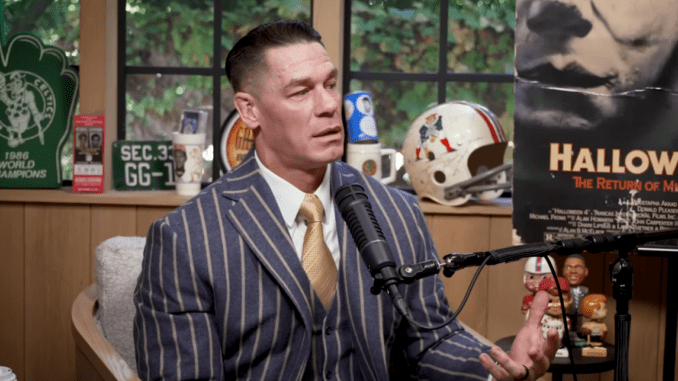
John Cena sat down with Bill Simmons for an extensive chat covering his career in promotion of his final match at Saturday Night’s Main Event on December 13th.
Cena spent nearly two hours with Simmons, sharing a lot of his approach to professional wrestling and how it differed from others, with a heavy focus on the past year.
It was interesting to see how Vince McMahon would be framed in this interview, considering Simmons is closer to the subject than most, given that he was the executive producer of the Mr. McMahon series on Netflix.
It felt like Cena was avoiding directly mentioning McMahon’s name, instead referring to “those above me”, “creative department”, and his “mentor”, although Simmons outright named McMahon when Cena alluded to him.
Nothing was broached about McMahon’s sexual misconduct allegations, but Cena did share that he loved McMahon and didn’t want him to leave WWE.
He stated he had no regrets over the past year, including the heel turn, which he noted was something the audience didn’t want in his final year, and they adjusted. He places 2025 as one of the best years of his career and remains steadfast that he will never wrestle again after December 13.
Highlights from the interview:
- Cena spoke about his relatively short rise from leaving OVW in 2002 to becoming champion in April 2005. He credited being one of a very talented class, that he wasn’t the first champion from his class (Randy Orton), and benefited from good timing.
- He called this period “another golden age” akin to the national expansion and Attitude Era, and believes COVID played a factor because they didn’t shut down programming when others did. (Pollock’s note: The pandemic was definitely a difference maker for the UFC, which saw the brand align on a political level as part of the public conscience. Cena also mentioned better TV deals and new stars that came out from this period, and those are all factors I’d place above COVID.)
- He understands the skepticism about his retirement because they are rarely held, but he will set this precedent and has no intention of wrestling again. His body is sore, and is a step slower and would love to do this forever, but he knows he can’t do it physically, and it’s been a lot to do thirty-six dates this year.
- Injuries over the years included tearing his pectoral, both triceps, and his neck, coming after eight years of playing football and bodybuilding before pro wrestling.
- The choice to be a babyface or heel was above his level. He left it to management and didn’t get involved in those types of plans and preferred to take what he’s given and make the best of it.
- Stated that his match with Cody Rhodes at this past year’s WrestleMania was “Act 1”, designed to be a methodical match and not the peak of the story, which SummerSlam would later represent. He acknowledged that many people didn’t like the WrestleMania match but didn’t get into the specifics.
- He went into his philosophy of nailing down the story of a match and using Brock Lesnar and AJ Styles as examples. For Lesnar, his SummerSlam 2014 match was designed to be shocking and make Lesnar look unstoppable as a precursor for the next big babyface star to knock him off in Roman Reigns. With Styles, their program in 2016-17 narrowed in on the idea that Styles was a better wrestler, but Cena got the lucky breaks.
- He says the question of “why are we fighting?” is one that not all wrestlers establish or keep too vague, like trying to win or getting a title.
- On his heel turn, he acknowledged it was a version of himself the audience did not want in his retirement year. He said, “It takes five years to get a guy over, regardless. If you turn him, it’s going to take a year or two for it to really sink in.” (Pollock’s note: There are plenty of examples to the contrary of the five-year adage, which is often cited. Some of the biggest stars immediately shot up because they were fresh, and the audience got behind them. It was the entire way Vince McMahon Sr. operated in getting a heel over in two to three months in preparation for Bruno Sammartino. Regarding whether it takes a year or two for a heel turn to sink in, then the most comparable turn to Cena’s was that of Hulk Hogan in 1996, which was an immediate success.)
- He has no regrets about the heel turn, couldn’t have given any more than he did to make it work, and followed the audience when they wanted him to turn back.
- For 10-12 years, WWE was the most important thing in his life, and that isn’t the case anymore.
- He believes there is a lot less “political activity” in WWE today than in 2002 when he came up, and hopes he set an example by his actions.
- His biggest mentor was Vince McMahon, who always gave great explanations to his questions and would teach him lessons that way. Cena became interested in how he could help grow WWE, and McMahon had the best answers.
- Cena’s biggest failure was not taking advantage of the introduction he was given in 2002, but luckily got another chance with the rap character.
- Two of his big achievements were the year-long build toward his first match with The Rock at WrestleMania 28, and this year-long retirement tour.
- Shawn Michaels and Seth Rollins were two of the best he’s wrestled because they can work with anyone.
- He never had a drink of alcohol until The Undertaker poured him a drink when he was 26.
- He said no one is irreplaceable when asked about Vince McMahon. He never wanted McMahon to go because he loves him, but it taught Cena that everyone is going to go eventually.
- Originally, he wanted to dedicate the entire year to WWE, but they settled on thirty-six dates, and it was for the best because it would have been so difficult.
