
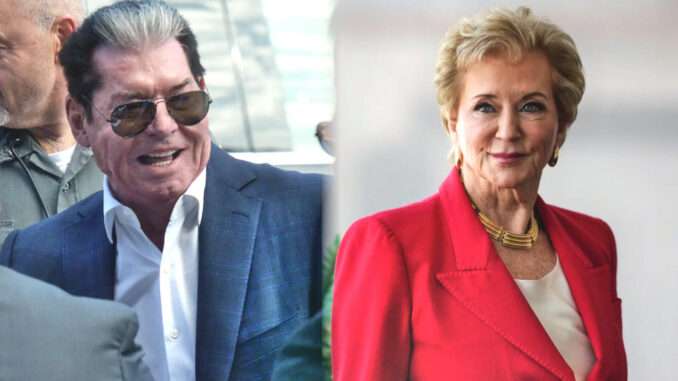
Vince McMahon and U.S. Secretary of Education Linda McMahon are asking a federal judge to require the former “ring boys” suing them to litigate under their real names, arguing that continued anonymity would unfairly hinder their ability to defend against the allegations as the case moves into discovery, the phase when depositions may take place.
The plaintiffs’ motion filed earlier this month on behalf of the seven former ring attendants asks the court to let them continue using “John Doe” pseudonyms and to enter a protective order limiting how their identities can be shared during discovery. The plaintiffs’ identities were confidentially disclosed to the defendants earlier in the case. Attorneys for the former ring boys, now adults approximately in their 50s, argued that public disclosure of their names would expose them to serious psychological harm, re-traumatization, and unwanted attention, especially given the high-profile of the defendants and the interest the case has drawn from the wrestling audience.
The plaintiffs allege they were sexually abused when they were children, mainly by former ring announcer Mel Phillips, who died in 2012. The former ring boys claim WWE and Vince and Linda McMahon were negligent in not preventing the alleged abuse from happening. The defendants have all denied responsibility and awareness of abuse.
The McMahons, who are still married but acknowledge they are separated, each filed largely aligned oppositions on Monday evening. WWE and TKO have not filed an opposition and are not expected to do so. According to the plaintiffs, those corporate defendants have taken no position on whether anonymity should continue.
The former leading executives for WWE argue that continued anonymity will harm the ability for witnesses to come forward who may support their defense, among other arguments for why anonymity should not continue.
Attorneys for the McMahons also discussed certain limited confidentiality orders that the judge may consider.
The plaintiffs will have the opportunity to file a reply on this issue.
At the center of the legal argument that both sides addressed are the “James factors,” named after a case from the Fourth Circuit (the higher court above the Maryland federal court where this case is being litigated) that guides the court on how to decide whether a party should be allowed anonymity.
Courts in the circuit weigh five factors:
- whether the case involves highly sensitive personal matters;
- whether identifying the parties would create risk of physical or psychological harm;
- the ages of the people whose privacy is at stake;
- whether the defendant is a government entity;
- and whether anonymity would be unfair to the defendants.
The plaintiffs argued earlier that these factors should favor anonymity. They say the subject matter, alleged childhood sexual abuse, weighs heavily in their favor, and that public disclosure of their identities would lead to renewed trauma as well as harm to family members.
The U.S. Education Secretary’s opposition brief pushes back with a forceful opening paragraph:
Plaintiffs initiated this sprawling lawsuit against high-profile defendants, making serious and damaging allegations. Plaintiffs took steps to ensure that these allegations would be magnified and sensationalized throughout the media landscape, pushing Defendants’ names into the headlines and harming their reputations in the process. At the same time, Plaintiffs have preserved complete privacy for themselves, identifying themselves publicly only as “John Does,” and revealing their true names to Defendants only after Defendants acquiesced to onerous—but temporary—confidentiality terms.
Attorneys for Linda McMahon say that anonymity is unfair, for one reason, because the ring boys will be able to contact any witnesses they believe will corroborate their allegations, “[b]ut if other witnesses refute Plaintiffs’ claims, Plaintiffs’ anonymity could prevent these witnesses from coming forward.”
Vince McMahon’s opposition argues that anonymity has already unfairly favored the plaintiffs over the defendants.
His attorneys cite comments from an interview this outlet conducted in October 2024 with Greg Gutzler, a lawyer for the former ring boys, just after the lawsuit was first brought to court. At the time, the case had five plaintiffs. Vince McMahon’s brief points to Gutzler saying, “[W]e have had other victims come forward, other witnesses come forward, and what you see in these cases is you will see the floodgates open where people who have knowledge… even if they are not victims, they are going to come forward with their truth, with their pictures, their documents, their emails, and that’s how these things come together.”
In the months that followed since the case became public, three additional plaintiffs joined the case with their own allegations that they were sexually abused as children in the course of their work setting up rings for WWF live events, primarily in the 1980s.
Vince McMahon’s lawyers say the plaintiffs have been able to benefit from public knowledge of the case, and that advantage has been “asymmetric.” Contrary to that, his counsel contends that allowing the plaintiffs to continue under “John Doe” pseudonyms prevents the defendants from discovering yet-unknown witnesses, while the plaintiffs, “by their own counsel’s admission, develop their entire case on the back of such evidence-gathering.”
Vince McMahon’s attorneys assert that maintaining anonymity would make it harder for unknown witnesses with information that potentially clears him of blame to come forward, because they would have no way of knowing that their knowledge relates to the plaintiffs, whose identities are sealed.
Linda McMahon’s opposition emphasizes what her attorneys describe as the inherent unfairness of “one-sided anonymity,” particularly where serious accusations are made against private individuals rather than government entities. She notes that she is a public figure who must defend herself not only in court but also in public, while the plaintiffs would face no comparable scrutiny if allowed to remain anonymous.
Similarly, Vince McMahon contends that allowing continued anonymity while he is publicly named one-sidedly magnifies reputational harm to him. His filing states that the lawsuit is not a private dispute but a highly public case involving well-known figures, extensive media coverage, and allegations that date back more than 30 years.
While opposing continued anonymity, both McMahons say they are open to more limited confidentiality measures. Linda McMahon says she doesn’t oppose a reasonable protective order governing sensitive discovery materials, but rejects what she characterizes as “blanket anonymity.”
Vince McMahon’s counsel proposes a specific alternative if the court allows the plaintiffs to continue to use pseudonyms. He suggests that any protective order should be limited to the pre-trial phase, allow disclosure of plaintiffs’ names to potential witnesses without cumbersome restrictions, and restrict the plaintiffs and their attorneys from making public statements or issuing press releases.
In their arguments, both McMahons cite recent cases involving Sean Combs and Kevin Spacey, where plaintiffs were required to proceed under their real names. Those decisions came from federal cases in New York, under the Second Circuit. The ring boys’ lawsuit is being litigated in Maryland District Court under the Fourth Circuit, meaning the Combs and Spacey cases are “persuasive” rather than “binding” precedent. The Maryland federal court isn’t required to follow those precedents but may consider them.
Judge James K. Bredar will make a decision on the anonymity issue sometime in February at the earliest, after the plaintiffs’ deadline to file a reply.
