
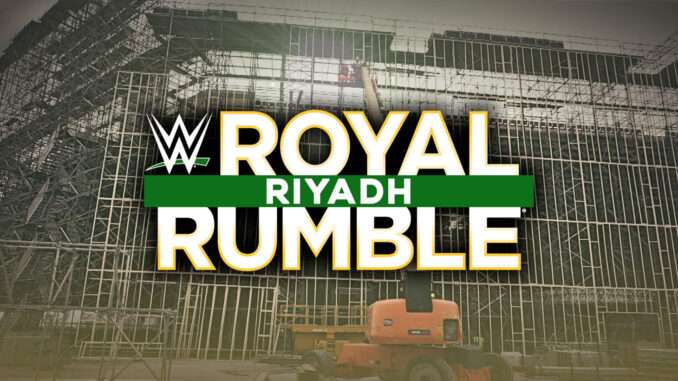
Earlier this month, images emerged from Riyadh’s King Abdullah Financial District (KAFD) showing a stadium-like venue built atop a government-owned parking lot. The district itself is a state-backed banking development in Riyadh, central to Saudi Arabia’s Vision 2030 ambitions.
As January progressed, more photos and videos appeared online of the stadium being constructed from scratch in just a few weeks, giving fans anticipating Saturday’s Royal Rumble frequent updates on the project.
Michael Cole remarked on the extraordinary speed of the construction during the opening minutes of this week’s Monday Night Raw, telling viewers watching worldwide on Netflix: “Less than a month ago in a parking lot in Riyadh, Saudi Arabia, WWE started building a stadium for this Saturday’s Royal Rumble.”
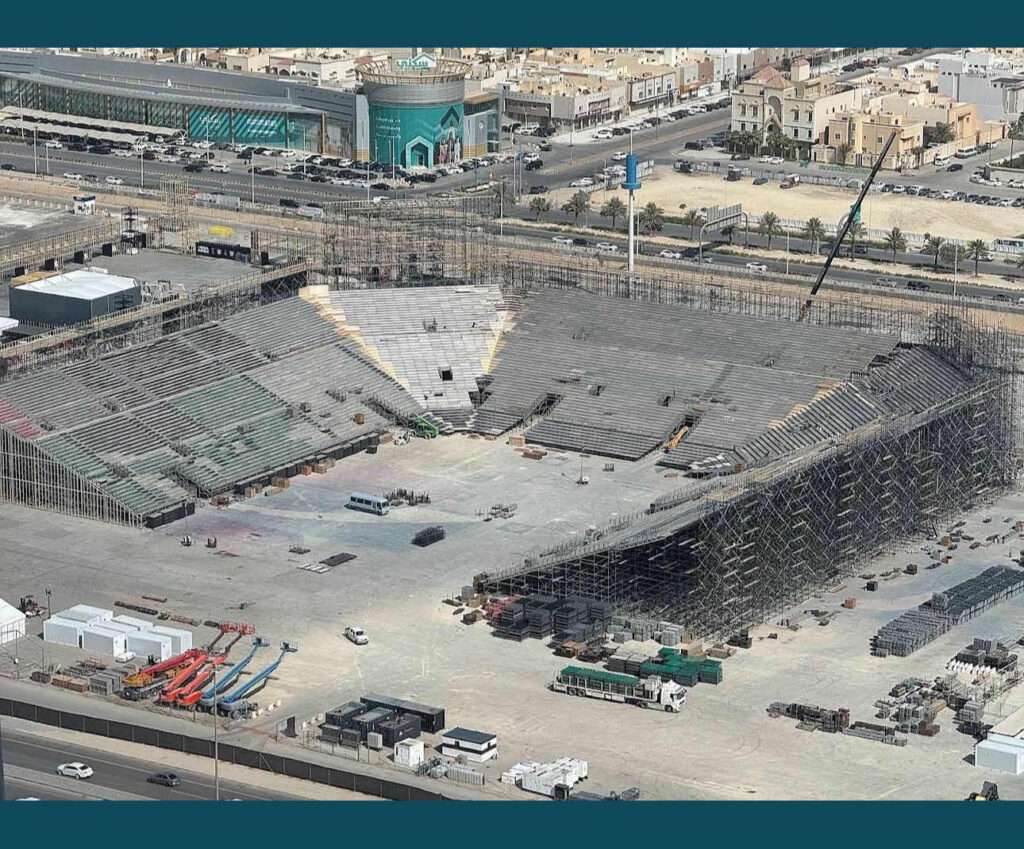
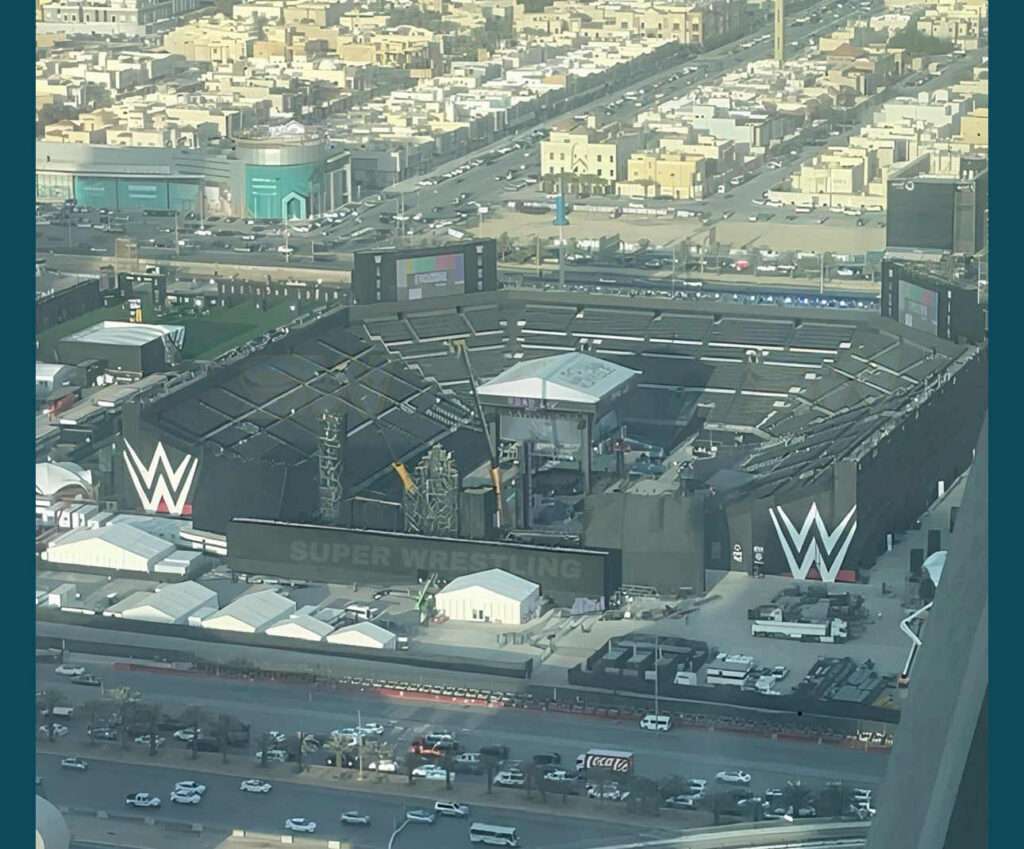
Above: Photos posted on Jan. 13 and Jan. 27, 2026, by @Mar1_pw
While framed as an engineering achievement on WWE’s broadcast, the phenomenon also raises questions about how such a project could be delivered so quickly and whether the conditions under which it was built can be independently assessed.
To be clear, this report is not claiming that abuses occurred during the construction of the Royal Rumble venue. What we tried to answer and could not was whether the conditions under which it was built can be meaningfully assessed. Our questions sent to parties that may have knowledge to speak to that issue went unanswered. Questions sent to several local government organizations and to WWE and its parent company, TKO, asking about worker protection policies and whether any safety incidents occurred during construction received no response. If we receive any responses from those parties after publishing, this article will be updated.
In Saudi Arabia, construction relies heavily on migrant labor, and, despite recent reforms, worker exploitation in the industry continues to be documented by international human rights organizations, including Amnesty International and the Business & Human Rights Centre. Saudi authorities have acknowledged the issue in recent years, including through a National Policy on forced labor launched in January 2025 by the Ministry of Human Resources and Social Development, which the government says is intended to improve workplace safety and align labor practices with international standards.
When we made human rights organizations aware of the stadium project related to the Royal Rumble event, they indicated to POST Wrestling that the rapid timeline alone warrants scrutiny.
We also contacted a wide range of Saudi government authorities, foreign embassies, and labor authorities. Emails were sent to the General Entertainment Authority (WWE’s main partner in the country), the Public Investment Fund (the owner of KAFD), the Ministry of Human Resources and Social Development (HRSD), the Royal Commission for Riyadh City, Riyadh Municipality (Amanat al-Riyadh), and the Saudi Embassy in the United States. We contacted the embassies in Saudi Arabia for Bangladesh, India, Nepal, and the Philippines, countries with large migrant worker populations in the kingdom.
The Migrant Workers Office of the Philippine Embassy in Riyadh responded, saying that it could not answer queries about labor oversight or worker protection, stating it had not processed manpower requests for the WWE event and had received no information from Filipino workers about involvement in the project.
Amnesty International’s labor rights researcher Ella Knight explained that in Saudi Arabia, migrant workers, including those involved with such stadium construction projects, “continue to be subjected to systemic human rights abuses, such as wage theft, excessive working hours, appalling living conditions and hazardous working environments.”
Saudi government says the kafala sponsorship system has been abolished. Human rights advocates argue the reforms are not enough.
Like in many countries throughout the world, Saudi Arabia relies on migrant workers, who leave their home countries for temporary employment, typically fleeing economic hardship to fill manual labor and other jobs that local residents are less likely to sign up for. In the context of Saudi construction projects, the vast majority of laborers building roads, stadiums, railways, and skyscrapers are foreign-born workers.
This labor system has long operated under the kafala sponsorship system. The Arabic word “kafala” translates roughly to “guarantee,” or “sponsorship.” The system has existed since the 1950s in Saudi Arabia and other Gulf states, closely tying a migrant worker’s legal status, visa, and residency directly to a specific employer or “sponsor,” meaning workers often can’t easily change jobs or leave the country without their employer’s permission, creating what human rights advocates say is a deep power imbalance that often leads to exploitation.
ALQST is a Saudi-based independent human rights organization, with a focus on the treatment of migrant workers, among other issues. Abdullah Aljuraywi, Monitoring and Campaigns Officer for ALQST, told us, “Large-scale construction projects in Saudi Arabia” — like the one that built the stadium for WWE — “rely heavily on low-wage migrant workers under the kafala system, who often endure extremely long hours in unsafe conditions.”
But in June 2025, Saudi Arabia officially abolished the kafala system as part of wider reforms related to its Vision 2030 economic plan, the same vast plan that WWE and many other sporting events are connected to. The government replaced the kafala system with a contract-based employment model that gives migrant workers greater freedom to change jobs and travel without employer consent. That change, however, hasn’t satisfied human rights groups we spoke with.
“Recent reforms of the kafala system do not go far enough,” Catriona Fraser, a migrant workers researcher for Business & Human Rights Centre, told us. “Unions and protests are also banned in the country, curtailing workers’ ability to protest rights abuse and gain remedy and justice.”
Saudi officials might contend that, along with the abolition of kafala, they’ve also implemented digital labor contracts as part of their effort to meet international labor standards. They argue that enforcement mechanisms have improved, though independent verification remains a challenge.
Knight, from Amnesty International, agrees: “Despite changes in recent years, the system leaves [migrant workers] heavily dependent on the goodwill of their employers for their legal status and livelihoods, directly enabling forced labor practices.”
“Labor conditions [for migrant workers in Saudi Arabia] are generally very abusive and deeply exploitative and can place workers’ health and lives at risk,” Nicholas McGeehan said. McGeehan is a Programme Director for FairSquare, an advocacy organization that investigates labor and human rights, particularly in Gulf countries. He added: “The risks are exacerbated when deadlines — like the one you describe here — are tight.”
“Workers who demand overdue wages or request better conditions risk arrest, detention, and even deportation,” Aljuraywi of ALQST said.
Final moments of quiet before an epic #RoyalRumble weekend. pic.twitter.com/reAoOzymnZ
— Triple H (@TripleH) January 30, 2026
Large construction projects in Saudi Arabia, like the new stadium built for WWE, being called “Riyadh Season Stadium,“ often rely heavily on smaller subcontractors who hire large numbers of unskilled migrant laborers from abroad, Aljuraywi added. “These workers frequently lack proper safety equipment and clear instructions in a language they can understand. Smaller subcontractors, often Saudi-owned, and larger companies overseeing these projects often ‘hide behind’ these subcontractors, to avoid accountability.”
Fraser, with the Business & Human Rights Centre, said Saudi Arabia was among the countries with the highest number of reported migrant worker abuse cases in 2025, with construction accounting for a large share of those incidents. Her organization’s database documents allegations, including wage theft lasting months, deaths at work, extreme heat exposure, and other issues.
Rights groups say companies must do more due diligence
“The structure of the construction industry in Saudi Arabia exacerbates the risk of abuse,” Fraser said, citing extensive subcontracting, pay-when-paid practices — which is when a contractor only pays workers after it has been paid itself — and tight deadlines that can drive excessive working hours and safety risks.
Those dynamics could intensify as Saudi Arabia accelerates its ambitious economic development ahead of major international events like the World Cup in 2034. One of the first migrant worker deaths related to World Cup construction has already been reported, according to the Business & Human Rights Centre. In March 2025, Muhammad Arshad, a migrant laborer from Pakistan working as a foreman on Aramco Stadium in Al Khobar, Saudi Arabia, reportedly fell to his death from the upper level of the stadium.
Rights advocates we contacted say questions raised by the Royal Rumble venue reflect patterns likely to continue as the government ramps up major projects. McGeehan of FairSquare said those questions are particularly relevant for international business partners that work with the Saudi government, like WWE. Among the questions we sent to WWE and TKO, which went unanswered, was whether WWE conducted a risk assessment, particularly in light of how quickly the stadium was built and the country’s track record on migrant labor treatment.
Saudi Arabia’s push to host major sporting events — ranging from soccer to Formula One racing, to golf, to boxing, and beyond — is part of the government’s Vision 2030 strategy, aimed at diversifying the economy and improving the country’s international image. WWE has been a prominent participant in that effort since 2018, holding two premium live events per year in the country under a ten-year deal worth at least $50 million per event, a one-day payment from the General Entertainment Authority that exceeds any publicly reported live gate in pro wrestling history. It’s not known whether the Royal Rumble — easily the biggest WWE event to date in the kingdom — carried a higher fee. WWE also announced plans to bring WrestleMania to Riyadh in 2027, which will be the first time WWE’s biggest annual event will take place outside of North America.
TKO’s UFC and new boxing venture also have highly profitable deals with the Saudi government.
Rights groups argue that as Saudi Arabia diversifies its economy and spends enormously on major sporting events, international companies, like WWE, should recognize the human rights risks.
“As the country diversifies its economy and hosts major sporting events, companies gaining lucrative contracts must be alert to these heightened risks and conduct effective human rights due diligence to ensure the rights of migrants building these projects are respected,” Fraser said.
Labor rights related to migrant workers are among a wider set of human rights abuses alleged against the Saudi government. Others include restrictions on free expression, broad executions of citizens, such as dissenting journalists, and women’s rights.
