
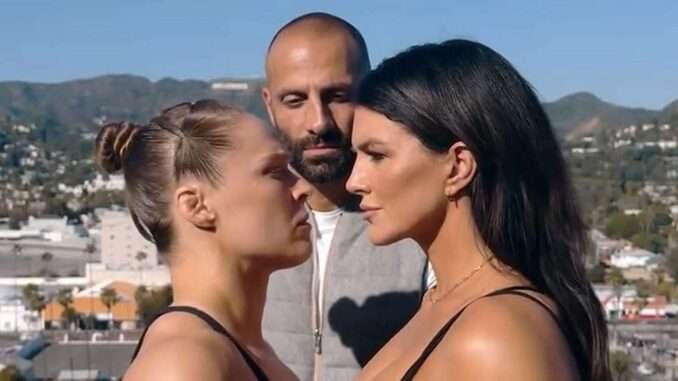
In the attention-grabbing economy of streaming, Netflix has never been one to dip its toe in the water; once again, it is diving headfirst with one of the largest fights in MMA.
On Saturday, May 16, the industry and many onlookers will be focused on a major MMA event without the letters “UFC” attached.
Ronda Rousey and Gina Carano will once again prove the adage that mainstream attention is acquired not by the connection with a fighter’s prime but rather by star power in the eyes of the public that commands interest so many years later.
If you took the gap between Carano’s last fight to the present, you would nearly have a high school graduate. Rousey left the sport in the most unceremonious fashion imaginable, shattered by a loss to Holly Holm and blitzed by Amanda Nunes one year later before entering professional wrestling.
Both are cornerstones of women’s mixed martial arts, and if there is a “tried and true” promotional method that generates interest, it’s a clash of generational stars with an immediate “Holy shit” response, which Tuesday’s news provided.
While the promotional efforts of Jeff Osbourne at Hook ‘N Shoot and figures like Tara LaRosa and Megumi Fujii will never receive their proper due, it was the efforts of Carano and Rousey that made women’s MMA into a fixture of the sport, forcing the industry to adapt.
Gary Shaw was a successful boxing promoter and saw the rise of MMA in the mid 2000’s, becoming the promoter of Elite XC and gaining distribution on Showtime. The UFC was shattering pay-per-view records, promoting bouts between Matt Hughes and Royce Gracie, Tito Ortiz and Ken Shamrock, and Ortiz with Chuck Liddell. Elite XC needed a spark and provided something that UFC could not.
Its maiden voyage on Showtime was headlined by Frank Shamrock and Renzo Gracie, invoking the familial rivalry which served well to the fight audience but not to the wider public. Shaw went to bat for the female representation on the card, booking a fight between Gina Carano and Julie Kedzie. Showtime was hesitant but provided the green light on a “succeed or go home” basis for the women. This was an era where women were confined to three-minute rounds and plenty of insecurity from their male counterparts when it came to card placement.
The women stole the show that evening in Southaven, Mississippi, and Elite XC had its first star in Carano. The promotion didn’t have a long life, but it reached the heights of network television on CBC through the promotional hype surrounding Carano and Kevin “Kimbo Slice” Ferguson.
Elite XC met its demise, and rising out of the ashes was Scott Coker’s Strikeforce to catch the pieces and land on CBS and Showtime. He promoted the biggest women’s fight to date in August 2009 as Carano met her match in Cris Cyborg in a Rocky Balboa vs. Ivan Drago match-up. It was Carano’s last fight, and at 27, seemed poised for a career in Hollywood, leaving MMA in the rear-view mirror.
Months after the fight, Zuffa purchased Strikeforce in March 2011, the same month when Olympic bronze medalist Ronda Rousey made her pro debut for King of the Cage.
Rousey accumulated three amateur wins, submitting her opponents with armbars in less than sixty seconds. Her pro debut with Ediane Gomes only required twenty-five seconds for the Olympian. By summer, she was inked to Strikeforce and debuting on its showcase, ‘Challengers’ shows, with another twenty-five-second sub of Sarah D’Alelio. There was an easily identifiable excitement of seeing how fast Rousey could catch her opponents with her submission of choice, while long-time confidant and mentor “Judo” Gene LeBell clocked her fights with his stopwatch, cage side.
On November 19, 2011, it was one of the biggest nights in MMA history with Dan Henderson and Mauricio “Shogun” Rua producing an all-time classic in San Jose at UFC 139. Across the country, Bellator showcased its greatest fight to date with the first meeting between Eddie Alvarez and Michael Chandler in Hollywood, Florida. Lost in the headlines that weekend was a Friday night card in Las Vegas where Rousey submitted future Bellator champion Julia Budd and was poised for a landmark fight in the new year.
If there was a demarcation point for women’s MMA in the U.S., it occurred on March 3, 2012, when Miesha Tate defended her bantamweight title against Rousey in Columbus, Ohio. The fight was among the biggest ever promoted by Strikeforce and had the attention of the MMA universe, and most importantly, Dana White.
White had been a vocal detractor of women’s MMA, famously stating females would never fight in the UFC, despite overtures to Gina Carano to fight in the WEC years earlier.
Tate and Rousey promoted the fight vigorously, knowing that this was their shot to command the most eyeballs and set the sport up for success. It was a grudge fight, taking the existing allure of Rousey’s fights and adding that dynamic as all the stars were in alignment. Rousey submitted Tate that night, with the two forever linked, much like Carano and Kedzie were.
The question of “if” turned to “when” women would fight in the UFC, and it was answered one year later when Rousey was introduced as the first UFC women’s bantamweight champion at a press conference in Seattle in December. The stage was set for February 23, 2013, with opponent Liz Carmouche and headlining a UFC pay-per-view at the Honda Center in Anaheim.
As Carano experienced during her peak, Rousey was maligned by fighters and fans for “leapfrogging” Dan Henderson and Lyoto Machida for the headlining spot at UFC 157. If it sounds ludicrous today, it was just as silly back then. The success of the pay-per-view muted some skeptics, but it was a constant battle for Rousey to contend with.
It was a golden era for the UFC, welcoming Rousey in February and Conor McGregor two months later. The two became not only the biggest stars in the sport, but two of the biggest athletes of all time.
Rousey kept up a torrid pace of promotion, injuries, turnarounds, and being the ultimate company woman. Her rematch with Tate after a season of coaching the Ultimate Fighter saw them meet at UFC 168, and Rousey refused to shake hands and was cast as a villain to the public. Tate lasted until the third round, submitted with a similar armbar, and before Rousey could exhale, she was announced for another fight in six weeks against Olympic silver medalist Sara McMann.
McMann, Alexis Davis, Cat Zingano, and Bethe Correira lasted a total of two minutes and ten seconds with Rousey, but the toll was mounting as Rousey continued to put the company first when they needed a favor.
Rousey was set to compete in January 2016, but an injury to Robbie Lawler forced his fight with Carlos Condit in November to be moved to the new year. UFC had booked a stadium in Australia and asked Rousey to move up her fight by nearly two months. The opponent was Holly Holm, and everyone knows the outcome as Rousey was viciously head-kicked and stunningly lost her belt to a dangerous striker, who many saw as a quiet threat and had been preparing all along to fight Rousey.
It was one of the most devastating defeats, going beyond the physical, and destroying Rousey’s psyche with her need for perfection shattered into a million pieces. To the public, she was never the same, holding resentment against the media and fans for her perceived belief that they had turned on her. It took her years until releasing her second book in 2024, “Our Fight”, where she finally went into detail discussing the loss and the circumstances of her health going into the fight.
It was thirteen months before she returned to the Octagon, receiving an automatic title fight against new champion Amanda Nunes, who had become the new force of the division. Rousey refused to speak to the media in the lead-up to UFC 207, and the once media-savvy promotional machine was now an angry and detached version, at least to the public. Some fighters walk into the cage, and you know they are not mentally present, and Rousey fits the bill of a fighter who had lost before the fight began. Nunes targeted her head and ended Rousey’s MMA career in forty-eight seconds, finding herself on the wrong end of a short one-sided contest.
At 29, Rousey was done with MMA, and it seemed like MMA was done with her, too. It was a nasty split as Rousey held contempt for the fanbase and media, and in turn, many were very dismissive of her incredible accomplishments and building a lane for the women in the UFC to occupy multiple weight classes and become a staple of each card.
The wild card component is Netflix, which takes this from a nostalgia play to a major event and places the two female fighters in front of a worldwide audience on the largest streaming service.
It’s amplified by Jake Paul and Nakisa Badarian’s Most Valuable Promotions, presenting its first MMA event and a needed shot in the arm for the sport.
Rousey has shared her desire for this fight, pushing Carano to get into shape and stating it was the one fight to bring her back. Without Carano, there may not have been a second act for Rousey after leaving judo in 2008. Carano exited the sport but left a laneway for Rousey to occupy and expand into a highway featuring multiple weight classes, instead of one-off bouts for the women.
Carano’s image has undergone extensive change from her days as the face of women’s MMA to being positioned as a poster child for “cancel culture”, after being dropped by Lucasfilm and Disney for implying those with right-wing views are similar to victims of the Holocaust. She was dumped by the entities from “The Mandalorian” and engaged in an Elon Musk-funded lawsuit against them, later settling.
Rousey tried her hand in professional wrestling, working for WWE from 2018-19, leaving to have her first child, and returning in 2022 for another run. She became disenchanted with the industry and was critical of Vince McMahon and Bruce Prichard in her latest book.
The brutal honesty extended to her health and being open about years of concussion problems dating back to swimming as a child and amplified by judo, MMA, and pro wrestling. She spoke with ABC News to promote the book release last year:
Yeah, I just had so many things I couldn’t talk about until now, namely my concussion history. Where in my judo career out of like ten years, I had concussion symptoms more often than not. This is before all the research about CTE and everything was out.
And so by the time that I got into MMA, every time you get a concussion, it’s easier to get another one. And, I quickly discovered in MMA any kind of significant strike, I’d be seeing stars, getting concussion symptoms. So I had to develop a system of fighting that was more efficient than anything I had ever seen before. So I would not get, not get touched at all because I just knew I couldn’t take that kind of damage. And, it just continued to get worse and worse.
You know, I, I had matches, I was winning in less than a minute, you know, 16, 14 seconds. But there’s 50 rounds of sparring that goes into every one of those matches. And, it started to get to the point where, like the lightest jabs or touches were giving me concussion symptoms.
It’s enough of an alarm bell that the California State Athletic Commission is invoking more stringent testing, and it should be of utmost concern. That said, the world of combat sports is a profit-first, ask questions later industry, and if California walks, there will be multiple states eagerly willing to snatch the fight.
Rousey has never spoken negatively about Dana White, but disclosed that she pitched the fight to the promoter and couldn’t get the deal completed. Now, she will oppose the UFC for one night and is coming out swinging to challenge Paramount+.
For one night, they’ll capture the MMA zeitgeist, and two signature stars will likely earn among the biggest paydays of any MMA fighters in history. If successful, it opens up Pandora’s box of Netflix’s further interest in promoting MMA and building something rather than a “one and done” promotional stunt.
In an industry where UFC controls ninety percent of the market share, two signature stars are going to test the power and influence of the other ten percent.
