
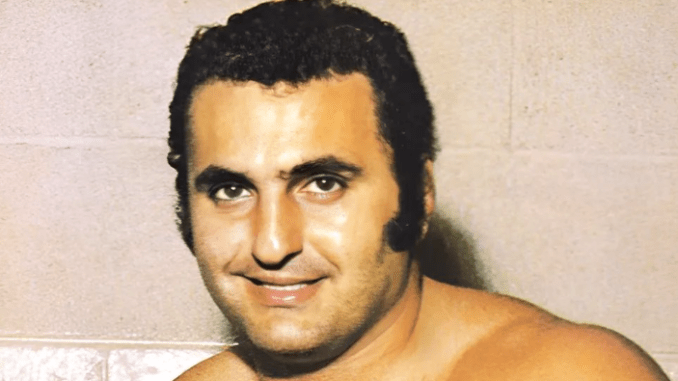
“Flying” Fred Curry, a high-flier in an era where the style was extremely primitive in the United States, died last week at the age of eighty-two.
Curry (Fred Thomas Koury Jr.) was a second-generation wrestler following in the massive footsteps of Fred Sr., better known as “Wild” Bull Curry. The senior member of the family was one of the pioneers of what would be described as hardcore wrestling and has been a fringe candidate on the Observer Hall of Fame ballot for years.
Fred was a natural athlete and excelled in multiple sports in high school, including track and field, football, and wrestling. He would end up in professional wrestling but took an extended route to get there, first attending the University of Connecticut and becoming a teacher before following in his dad’s footsteps.
He started as a referee in Nova Scotia and made his in-ring debut on June 26, 1963, against Boris Malenko at the Boston Garden.
It was during this period that Fred was referred to as “Young Bull Curry”. It contrasted with the next stage of his career, where he tried to distance himself from his father and become a babyface, and incorporate his athletic background into a style way ahead of its time and farthest from Bull Curry’s forte.
Many remembered Curry’s style, specifically his quick succession of dropkicks, which was a state-of-the-art sequence. In 1972, it earned him an honor from Pro Wrestling Illustrated as the “Most Popular Wrestler of the Year”, which he shared that year with Jack Brisco.
Texas was a big part of Curry’s resume and formed a team with Fritz Von Erich and held the area’s tag belts when Curry replaced an injured Dan Miller. Curry also had a run as NWA Texas Junior Heavyweight Champion, by defeating Tito Carreon in July 1964.
His major territories included Detroit for Big Time Wrestling, where he embarked on a lengthy series of matches with The Sheik (Ed Farhat) and took that program to Toronto, where Farhat was a fixture during his reign as U.S. Champion. Curry won the Detroit version of its tag titles on nine occasions with partners Billy Red Lyons, Dam Miller, Tony Marino, Luis Martinez, Bobo Brazil, and Hank James spanning ten years through the mid ‘60s to ‘70s.
In 1968, he toured Australia with the World Championship Wrestling promotion and teamed with Jack Brisco.
Curry also became a fixture in Hawaii and won its heavyweight championship on August 2, 1972, from Gene Kiniski and held over two months before dropping to the Sheik in Honolulu.
The only stay he had in the WWWF was in 1979, where he wrestled for the promotion throughout the year, including one match at Madison Square Garden against Victor Rivera on March 26. The two wrestled on a show headlined by then-champion Bob Backlund defending against Greg Valentine and a rematch between Bruno Sammartino and Ivan Koloff sixteen years after their famous title change at the same arena. Bull Curry has the distinction of being Sammartino’s first opponent ever at Madison Square Garden when they met on January 2, 1960, and started Sammartino’s incredible legacy at the venue over the next two decades.
Curry retired around 1980 and made a return ten years later, wrestling a young Terry Brunk, working as “Sabu the Elephant Boy” in August 1990 in Toledo, Ohio. Curry is also listed as having a match in October 2001 when he would have been fifty-eight years old.
Several notes, courtesy:
– Bigtime Memories: Fred Curry
– RIP: The Life and Career of “Flying” Fred Curry (Tony Richards)
