
By Brandon Thurston & Jason Ounpraseuth
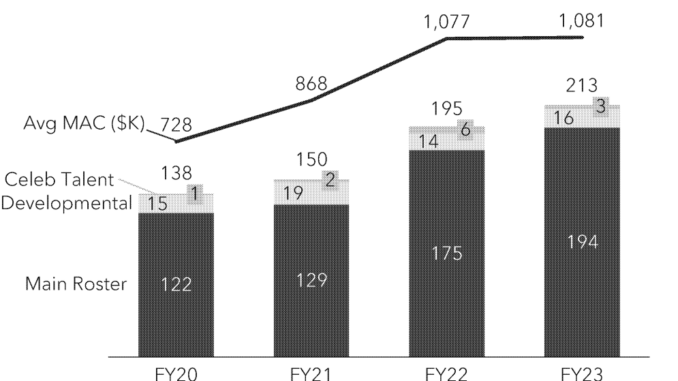
WWE spent an implied average of about $1.5 million per main roster talent in 2022, according to figures in new court filings. That average may be skewed by top-earning wrestlers. That year, WWE spent $195 million on talent, including developmental wrestlers, which was about 15% of the company’s overall revenue of $1.29 billion.
WWE’s pay to main roster talent also nearly doubled between 2020 and 2022, from about $890,000 on average to about $1.5 million. (Note that the “Avg MAC” data points below imply different averages and appear to include developmental talent in their calculation of average compensation.)
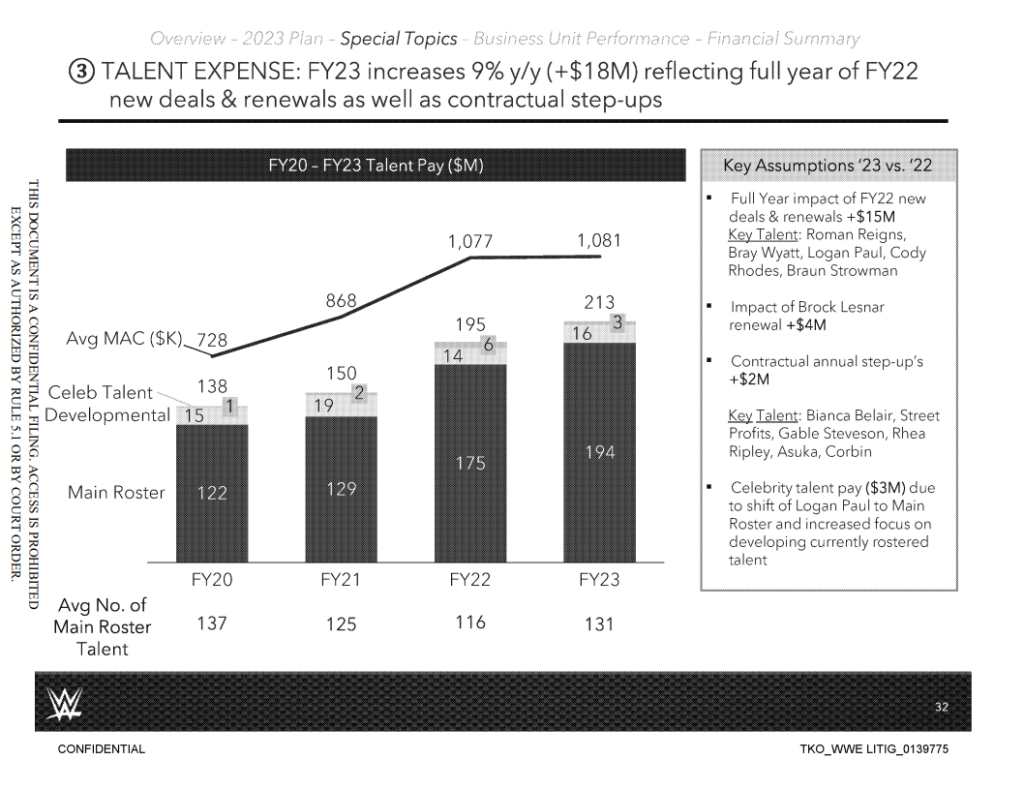
The documents, filed publicly this week as part of the ongoing merger shareholder lawsuit, were prepared for a WWE Board meeting in early 2023. The filings include a presentation deck that’s a few years old but now provides rare insight into how much WWE compensates its performers. The slides, which were filed as part of the ongoing WWE shareholder lawsuit, show forward-looking expectations of talent pay, keeping the rate at about 15% of the company’s revenues.
Another slide specifically named 15% of company revenue as the projected rate of talent compensation through 2028.
Compared to traditional sports leagues like the NFL, NBA, MLB, and NHL, players receive about 50% of the designated revenue under their respective collective bargaining agreements. The WNBA and the WNBA Players Association agreed to a new CBA this year, where the sides reportedly agreed to a 20% revenue share.
In the Johnson vs. Zuffa antitrust case, it was disclosed that UFC fighters were paid just over $1 billion between July 1, 2016, and April 13, 2023, while taking in $6.1 billion in revenue over that period. The percentage of the company’s revenue paid to fighters during that stretch equates to 16.8%.
WWE athlete pay is well below the percentage of top sports leagues. Notably, those leagues collectively bargain through players’ associations; WWE has no such collective representation. Classified as independent contractors, talent also need to pay for some of their own travel expenses, not including air travel. However, it’s evident that talent pay continued to rise even after the timeline shown in these slides. TKO’s quarterly disclosures have repeatedly identified “higher talent costs,” as recently as the merged company’s most recent earnings release for the end of 2025.
The compensation of specific wrestlers was not shown in the filings, but raises to certain top talents were alluded to. Roman Reigns, Bray Wyatt, Logan Paul, Cody Rhodes, and Braun Strowman were among the key talent who received contract renewals that totaled $15 million. Brock Lesnar’s contract renewal amounted to $4 million. Bianca Belair, the Street Profits, Gable Steveson, Rhea Ripley, Asuka, and Baron Corbin were among the key talent who received an annual contract step-up that totaled $2 million.
The summaries of talent pay were broken up between the main roster, developmental, and celebrities. Main roster talent compensation for 2022 totaled $175 million, increasing to an expected $195 million in 2023, with WWE reporting about 130 main roster talents. That implies main roster talent in 2023 was expected to be paid an average of $1.5 million, similar to the prior year. It’s unclear how high the ceiling is for talent compensation, which may be skewing that average.
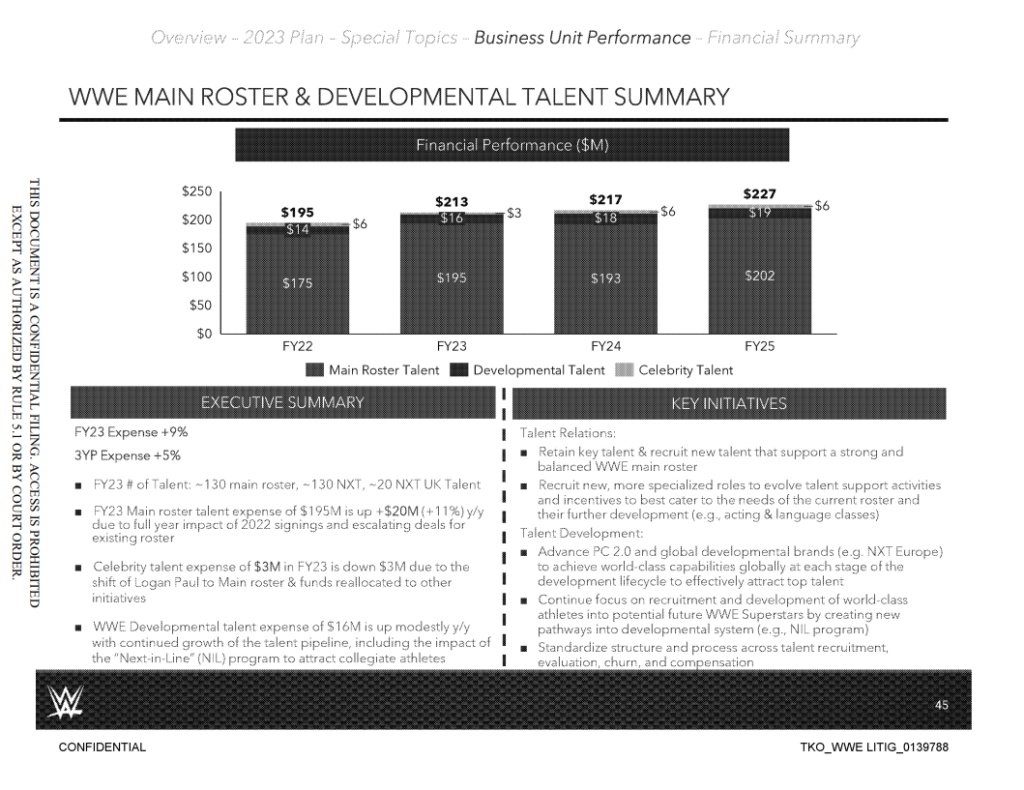
Developmental talent for 2022 was reported at $14 million, increasing to $16 million in 2023, with WWE counting about 130 NXT talents and about 20 NXT UK talents at the time. That would imply that developmental talent was paid an average of about $107,000 in 2022. Again, this is only an average, not a median, and may be skewed by outliers.
WWE did not immediately respond to a request to comment for this story.
The slide notes that expenses for celebrity talent — who are separated into their own category apart from the main roster or developmental — were down from $6 million in 2022 to an expected $3 million in 2023. WWE attributed this to Logan Paul’s move from being designated under the celebrity category to the main roster category. The slides also note that some funding was “reallocated to other initiatives.”
The increases in talent pay came years after AEW’s launch and amid reported bidding battles for talent.
In Kevin Kelly, Brandon Tate, and Brent Tate’s lawsuit against AEW, an executive stated in a sworn declaration that Tony Khan’s company spent $60 million on 290 wrestlers and non-wrestling talent over a period of about two years.
