
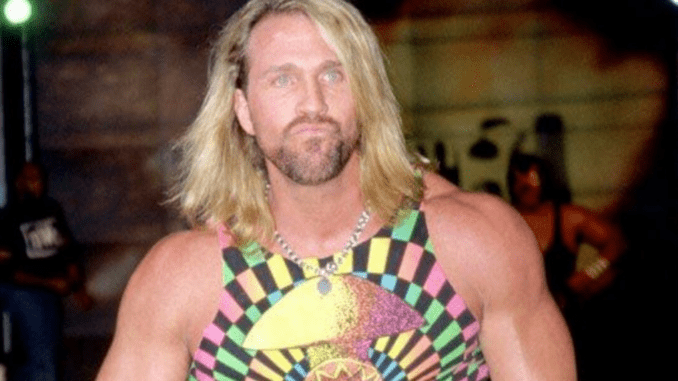
Former WCW talent Van Hammer (Mark Hildreth) has passed away, with longtime friend Marc Mero disclosing the news.
Hildreth spent nearly his entire career with WCW after he was spotted by Dusty Rhodes and signed right after he began wrestling in 1991. He was considered exceptionally green but had the coveted physique and was a constant recipient of a push at various times throughout his tenure.
It is with a heavy heart that I share the passing of our dear friend, Mark Hildreth, known to so many as Van Hammer. At this time, we are still awaiting answers regarding the cause, pending an autopsy.
Mark was a fighter in every sense of the word. Life threw its share of… pic.twitter.com/Tb7d0zQtJr
— Marc Mero (@MarcMero) April 19, 2026
After serving in the U.S. Navy, he left his home state of Maryland and trained under Boris Malenko in Tampa, Florida. His class included Marc Mero. Hildreth had one match at North Georgia Wrestling, which was affiliated with Dusty Rhodes, who was back in WCW as its booker in 1991. Mero was contacted for a tryout with WCW, and Hildreth served as his opponent; both were signed. According to Hildreth, Dusty openly compared him to Hulk Hogan and saw him as a major star.
His on-screen persona was “Heavy Metal” Van Hammer, where they shot an expensive music video and introduced him at the Clash of the Champions special in September 1991, squashing Terry Taylor in less than a minute and keeping his matches short.
His physique was a major factor in the confidence the company had, with Hildreth acknowledging his reliance on steroids when reflecting in a 2014 interview with the Palm Beach Post:
You’re definitely more durable on steroids. You can work through injuries and heal more quickly. And then there’s the fact that people who build their bodies often predicate their self-esteem on how they look. That was true with me.
As Van Hammer, he went on a two-month undefeated streak until losing to Cactus Jack at the November 1991 edition of Clash of the Champions.
From Foley’s book Have a Nice Day:
Hammer had two things working against him. One, he was given a push well before he was ready for it, and two, he was given the gimmick of a heavy metal guitar player, even though he couldn’t play a lick.
Hammer was also a natural heat getter with the boys. He didn’t mean to, he was actually a nice guy, but he had a tendency to bury himself with his ways. Statements like, “I cam here to save the company” didn’t sit well with guys who’d busted their asses for years and didn’t have their own $25,000 music video.
As a result, most guys didn’t care to help him out or even have a decent match with him. I, on the other hand, saw him as a challenge, like a piece of clay that I could mold. Instead of looking at his faults, I chose to look at his strengths, which were: He was an exceptional natural athlete, and he was willing to do whatever I wanted. And I wanted to do a lot.
It became a pattern throughout his career where he’d go on a big winning streak and ultimately, never ascend to the next level and slowly fade back down the card. In 1992, his big moment was winning the Jesse Ventura Arm Wrestling Challenge by beating Ron Simmons in the final. Months later, he was on the other side of the monstrous push as Sid Vicious squashed Hammer in thirty-five seconds at Slamboree.
Van Hammer left WCW in 1993 and had a two-night tryout with the World Wrestling Federation in July, in matches against Virgil and Damien Demento, which didn’t result in a hiring.
He was out of the industry until being rehired by WCW during the Monday Night War in late 1997 as a member of Raven’s Flock. It lasted several months before beating Perry Saturn to break free of the group, and adopted a hippie persona in 1998.
After Kevin Nash became booker in January 1999, Van Hammer got his next push as he went on another winning streak in the spring, including a pay-per-view win against Mikey Whipwreck and setting up a loss to Television Champion Rick Steiner at Bash at the Beach.
His next character was “Major Stash” in the Misfits in Action with Hugh Morrus, Lash LeRoux, Chavo Guerrero, and Major Gunns, with an obvious drug reference assigned to Hildreth. He was a short run with the group and ended his WCW career after a loss to The Demon (Dale Torborg) on the July 12, 2000, edition of Monday Nitro.
He was a high-paying deal with WCW (making over $225,000 in 1999) and had to transition to life after wrestling as he was approaching 42 after his WCW exit. He worked the independents and did one tour for Big Japan Pro Wrestling in late 2001 and largely ended his wrestling career by 2003, coming back for one final match in 2009 for Maryland Championship Wrestling.
He acknowledged a dependency on steroids and heavy drinking after WCW as he tried to find new career paths.
He had gotten sober, but in January 2020, he made national news when he was charged with driving under the influence and hitting a five-year-old boy on a bicycle. Hildreth would plead guilty to the charges, including leaving the scene of the crime, and received a one-year probation sentence, and had his driver’s license revoked. The child was taken to the hospital but didn’t suffer serious injuries.
He had previous DUI charges in 1985 and 2004.
Mero stated that they are awaiting the results of an autopsy for the cause of death.
Mark Hildreth was sixty-six years old.
