
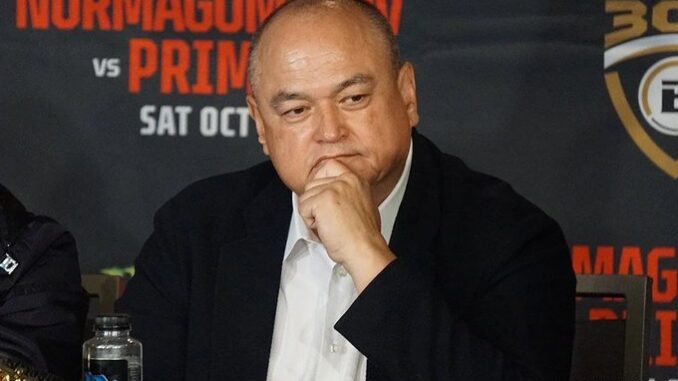
Scott Coker has offered additional news on his forthcoming MMA entity, with a launch estimated for early 2027, backed up by a slew of investors.
The former Strikeforce and Bellator executive announced plans to launch a new MMA group next year with funding from venture capital and private equity investment firm Creator Sports Capital. The upstart reported had $60 million behind it with additional capital from Griffin Gaming Partners, Upper Deck, D.C United owner Steve Kaplan, and Tony Hawk.
Scott Fontana of the New York Post spoke with Coker, who informed the outlet of its plans to launch in January and come out with a series of shows immediately rather than a one-off.
We’re looking at a January date. And when I say January, it’s not going to be just one event. It’s going to be bang-bang-bang, bang-bang-bang. … It’s going to be a gauntlet of events that we produce in the first half of the year.
Coker says he is aiming for twelve events in 2027, followed by eighteen in 2028, and twenty-two in 2029, with plans to run shows across the U.S. and European & Asian markets.
Not surprisingly, Coker is looking at a tournament format with one marquee weight division crowning a champion at the end of the first year.
We’re going to have the tournament format, and the tournament format leads to new-star development. And that’s something I think we’re really good at: fighter procurement. I think we’ve done it better than anybody else, but we will bring in free agents to sprinkle from the top down, and that’s going to be a very robust roster, let’s say, in a year or two.
Coker is the co-founder of the promotion alongside Peter Levin of Griffin Gaming.
The article noted the necessity of securing a media rights deal, which is a requirement for any promotion of this scale. It comes as the PFL is in the final year of its rights deal with ESPN and will be shopping for its own domestic rights package.
There are many questions attached to this startup regarding the level of fighters they can attract, how many free agents actually exist that can draw an audience, and the overall viability of a non-UFC entity.
Coker adds that they opted to cap their financing at $60 million and “could have easily raised another $40 million,” but would have diluted their control of the company in exchange for more funding.
