

Downloadable audio available for POST Wrestling Café members
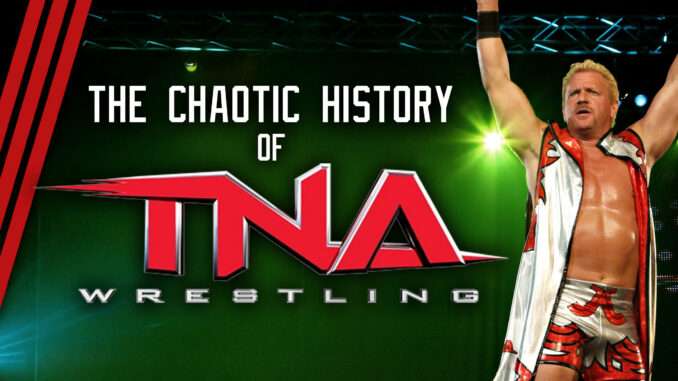
The story of TNA has been revisited over the past week after three hours dedicated to the beleaguered promotion on Vice TV’s Dark Side of the Ring.
Presented through the Jeff Jarrett lens as a story of a rising alternative in the exodus of WCW and ECW, the tale depicts a company on the upswing but anchored by its fame-hungry owner, who torpedoed the momentum and enlisted the help of self-serving individuals to spiral the company.
To conclude after “Jeff Jarrett and the Battle for TNA” that Jarrett equaled “good” and Dixie Carter “bad” is way too simplistic and charitable to Jarrett, who had his flaws and missteps. Conversely, while Carter is an easy target, her family’s angel investment was one of many gifts from the heavens that benefited TNA.
As a sacrifice for time, several figures are omitted, including Bob Ryder. The former WCW employee and 1wrestling.com owner was on the famous boat outing with Jeff & Jerry Jarrett when the idea was conceived and would be a fixture in TNA through its many ups and downs and into the Anthem years. He died in 2020 and had the distinction of being the promotion’s first hire.
Any practical assessment would see the flaws in TNA’s 2002 business plan, based on the idea that consumers would spend $9.99 per week without any television support. The theory that fans had been buying anywhere from 1-3 shows on a near-monthly basis in the previous years, with extra cash to spend with WWE alone in the field. The early figures seemed too good to be true, mainly because programming executive Jay Hassman deceived Jeff & Jerry Jarrett with inflated pay-per-view figures. The Jarretts thought they had hit the jackpot, but reality struck cold, and they were performing well under Hassman’s reported figures, resulting in a lawsuit accusing Hassman of fraud.
Hassman was one major detriment in the early months. The other was Richard Schrusy of HealthSouth, who made a handsome investment into the start-up only to face SEC charges of fraud and rescind his investment, dealing a near-fatal blow to TNA before the end of the summer. It was here that publicity hire Dixie Carter of Trifecta Entertainment sold the concept of TNA to her parents, Bob and Janice Carter. The magnates of Panda Energy took majority control of the promotion, installing Dean Broadhead as CFO, and Jeff was named COO with Executive Producer credit and a 29% stake in the new structure. Jerry retained a minor stake in the new ownership plan.
The U.S. wrestling scene was depressed. WWE was struggling to move past the Attitude Era and finds it next crop of stars after Steve Austin’s retirement, The Rock’s exit from full-time wrestling, and a struggle elevating babyface stars with a dominant heel in Triple H. Bill Goldberg did not meet expectations for a variety of reasons resulting in an uninspired year with WWE, Rob Van Dam was constantly cut off despite a heavy vote of confidence by the audience, Kurt Angle was plagued by ill timed character turns mixed with his comedic presentation that led to an edge being lost, and Brock Lesnar had his fill of life on the road opting to leave the company when he was one of few stars to ascend. In 2004, WWE went with Chris Benoit and Eddy Guerrero as its respective champions, but neither panned out as a long-term solution, and it was a down period.
The next year, WrestleMania 21 was the launching pad of Dave Bautista and John Cena, and while not turning business completely around, the two helped get WWE out of its malaise of 2004. Cena would be the franchise star for the ensuing decades, but early on, it was Batista that caught fire, and Cena was the “work in progress,” with many feeling Randy Orton was much more equipped for the top spot but had too many liabilities outside the ring, problems that Cena did not present. Batista became a ratings mover through his program with Triple H in the lead-up to WrestleMania, but after the coronation, they moved Cena to Raw and Batista to SmackDown, and it was a public declaration that Cena was the chosen one.
TNA was struggling to gain ground despite its new financial backing from Panda Energy. It was still limited to pay-per-view distribution and clinging to any names with a WWE, WCW, or ECW pedigree. Dark Side of the Ring focused on the emerging X Division and innovative ideas, but the shows were plagued by inane ideas and a “throw anything against the wall” mentality. There was minimal cohesion mixed with isolated examples of a program sticking. One being a well-done introduction of ex-WWE talent Raven and building his NWA title match with Jeff Jarrett in April 2003.
The company needed television, but few were interested, forcing TNA to buy time on Fox Sports Net in 2004, obtaining a Friday afternoon time slot at $30,000 per week, while continuing its weekly pay-per-views until September and moving to the traditional model of monthly PPVs. They hosted their first Sunday night pay-per-view in November with Victory Road, relying on name value with the incorporation of Kevin Nash, Scott Hall, and Randy Savage. It was a strategy that continued to frustrate audiences where TNA lacked faith in its own product and ideas to succeed when graduating to a larger stage, relying on other people’s stars and resumes for the sake of “Q ratings” and preferring the past over the future.
When the deal was up the next year, TNA opted against continuing with the expensive infomercial route on Fox Sports Net and was limited to running its weekly program online despite presenting some of its strongest programming. In 2005, Scott D’Amore gained a more influential role, and TNA doubled down on its core stars with a steady diet of AJ Styles, Christopher Daniels, Samoa Joe, Petey Williams, and Chris Sabin.
The next gift was WWE’s split with Viacom in 2005 when cable partner Spike TV publicly disengaged from renegotiation talks and left WWE on the streets searching for a new home. Spike was in a position of leverage when WWE wanted a sizable markup in its programming fees due to the meteor that was the UFC arriving on their airwaves in January and siphoning a ton of the WWE Raw audience as its lead-in and becoming the new favored tenant at Spike TV.
WWE would seek refuge, returning to the USA Network but forking over all advertising to the network due to the position they were left with. Meanwhile, Spike wasn’t out of the professional wrestling business; they were only out of the WWE business and took a meeting with Dixie Carter and Jeff Jarrett. The result was a far smaller investment in TNA and placing them on Saturday nights at 11 p.m. ET beginning that fall, and TNA signing its most important deal yet.
The fracturing of Jeff and Jerry’s relationship occurred in October when fans clicking onto WWE’s website saw Jerry alongside an unknown by the name of Oleg Prudius at WWE HQ. The future Vladimir Kozlov had caught the attention of Jarrett, who arranged a meeting with WWE and played into WWE’s hand by causing an online stir, not to mention talent questioning if Jeff was leaving too. WWE knew exactly what it was doing, and you could say that TNA gained its revenge a few years later when WWE undercard wrestler Robbie McAllister showed up to watch a show at the Impact Zone and was shown on its programming looking like he would rather be anywhere else. Unlike McAllister, Jerry knew the game and appeared to have no reservations about being a pawn in this public gamesmanship, whereas McAllister was an innocent bystander, making the mistake of trusting TNA to keep his appearance quiet.
From the November 7, 2005, edition of the Wrestling Observer:
This was clearly an attempt by the WWE, and Jarrett himself, to use the web site to deliver a major FU at TNA and create unrest there, which they were successful at doing. What Jeff did or didn’t know is unclear, other then he claimed to others in the company to be both furious and badly hurt about what his father did. However, almost everyone in the company was blindsided, as even those who are close personal friends of Jeff and have worked closely with Jerry were unaware of anything until hearing WWE put up that Jerry was meeting with Vince on its site.
To attempt to cause further unrest, the WWE’s first post stated that Jerry didn’t come alone, clearly trying to insinuate, probably as much to the public, but more for the people working in TNA, that Jeff came with him. It wasn’t until later in the day when we revealed that it was not Jeff, as insinuated, but a big Russian, that the WWE web site said he came with a monster of a man named Oleg Prudius.
The fallout resulted in father and son not on speaking terms for years, including Jerry missing the funeral of Jeff’s spouse, Jill, in 2007. Thankfully, the two did patch up their differences years afterward before Jerry died three years ago.
The Spike years were the most fruitful, yet divisive. They made it to a major cable network, part of the same juggernaut that launched the UFC into a stratosphere with a similar formula of building up personalities and rivalries and turning its television audience into pay-per-view purchasers.
Immediately, TNA struck a deal with Jay Reso a.k.a. Christian, who was deflated after a WWE run where he flirted with a top heel role against John Cena before being saddled as a secondary player on SmackDown. His deal ended, and he made the move to TNA, legitimizing the operation in the eyes of many due to Christian’s upward trajectory as opposed to someone living off past laurels. Then came the signing of Sting to begin 2006, and placed in the role of active legend and one of the few WCW stars never venturing to WWE.
A loyal and resilient audience continued to watch weekly programming, but the conversion from television viewer to pay-per-view buyer was still a massive hurdle TNA could not clear. It led to further experimentation, changes in creative direction, and constant “push and pull” between its identity as WWE alternative and WWE lite.
Its largest signing to date was revealed in September 2006 when TNA ended its “No Surrender” card with the announcement of Kurt Angle’s arrival. This was a bona fide WWE star, whose exit was still clouded in mystery, and placing a spotlight on TNA. An acknowledgment of Angle’s drug addiction issues was broached on Dark Side by Jarrett, reflecting that the Olympic gold medalist had “more bad days than good.” Karen Angle was presented as his caretaker on the road despite a quiet separation of the couple before joining TNA.
WWE’s release of Angle less than a year after the death of Eddy Guerrero and the implementation of its Wellness Policy showed how concerned they must have been regarding Angle’s problems. Was there an onus on TNA to take that factor into account? In a perfect world, yes, but in the wrestling business, a star is going to be given every benefit of the doubt, and heads are consistently buried in the sand when there is money to be made, and that trumped any further concerns. The reality is that if it wasn’t TNA, Angle may have found himself coaching on The Ultimate Fighter and fighting in the UFC and would have been an equally flawed path for the issues he battled. If not UFC, then Elite XC or IFL, or wrestling in Japan.
Meanwhile, that same week, as reported by the Observer:
In addition, TNA made a booking change, taking Mike Tenay, Scott D’Amore and Jeremy Borash off the creative team and replacing them with Vince Russo. It will be a three-man team with Russo, Jeff Jarrett and Dutch Mantel deciding on the direction, and Russo and Mantel as the co-writers.
The company’s biggest signing occurred the same week as Vince Russo’s latest reunion with Jeff Jarrett and TNA and begs the question regarding Angle’s effectiveness under the previous creative staff. Angle immediately drew interest for his first match with Samoa Joe at the November pay-per-view but they quickly engaged in follow-up matches, turned Angle heel, leaned on his comedic persona, and watered down the most effective version of Angle by presenting the “sports entertainment” prototype, preferring the version that stormed the ring with a milk truck than the wrestling machine creating a dream match with Samoa Joe.
When they toyed with the formula for a memorable lead-up to Angle vs. Joe again for Lockdown in 2008, it was promoted like a UFC fight and ranked among its most successful shows ever, but did not take the lesson of what worked and apply it beyond that singular card.
TNA continued to be a successful television entity and would be rewarded by going from Saturday nights to Thursday nights, and eventually, expanding to two hours in prime time. This was the era where TNA reportedly reached profitability for the first (and only) time in its history, according to Jarrett. It was still the inferior product. A major signal was on February 16, 2007, when WWE was pre-empted by the USA Network and aired on a Thursday night head-to-head with Impact on TNA’s own night. Impact saw a 47% decrease in its audience from the prior week, and identified a sizable portion of the audience choosing WWE when asked to pick.
It was a source of frustration when TNA would draw the same 1.1 rating weekly but not convince enough people to buy their shows or go to a live event. It was a stalemate as those arguing the ineffectiveness of pay-per-view could defend by looking at very good television numbers as a defence mechanism, and rather than decide on a concrete direction, it was placating everybody, and nothing changed. TNA was always after the next carrot being dangled, whether it be the next major signing, a better night on television, expanded programming, new markets, new ideas, etc.
Yes, there was frustration among the fanbase in real time, but it only expanded among viewers over the next decade. TNA was a Florida-based promotion, taping in front of locals at a sound stage in Orlando, signing various independent stars and giving them a platform, opening a women’s division, and presenting a style that the main roster WWE was not. It was verbatim the blueprint that NXT executed and latched its identity with to far greater success, although with a corporate ownership that could bear sizable losses. NXT was not in a rush to sign talents past their prime and water down its television, pretending it was still 1998 and capturing lapsed fans. Instead, it had conviction that these “Indie stars” would be the mainstream wrestling stars of the future and committed to that vision. TNA had multiple years of a head start and a company in Panda that put millions and millions into investing in this pipedream.
TNA was so busy identifying that “we are something for everyone” instead of putting its foot down and establishing what it was not. It tried to be everything, to its detriment; it wanted to be WWE, and as Vince Russo accurately pointed out in the Dark Side series, they could not compare to the production and major league feel that the industry leader commanded.
While still profitable in 2009, everything goes to hell in the wake of Jeff Jarrett being sent home when Dixie Carter learns of his relationship with Karen. On the Vice series, it is retold as a “power play” by Dixie, obsessed with ridding TNA of the Jarrett influence, and the co-founder loading the proverbial gun and handing it over to Dixie to orchestrate his demise. The series begged the perspective of Carter, who would not sit down with Vice, and it can be debated the merits of that decision. On one hand, Carter is easily positioned as the naïve villain of TNA’s ruin during this era and was left with no defenders. The other, Carter, would have been grilled and greatly outnumbered by her detractors, mainly Jeff and Karen. Time will tell if Carter is motivated to present a counter to the claims levied in the series.
It was an overhaul of the Jarrett regime with Jeff sent home, and confidants Jim Cornette and Dutch Mantel sent packing. Vince Russo usurped all the power, but it would be short-lived as Carter navigated from Jarrett to the new toys, Hulk Hogan and Eric Bischoff.
One could make a list of the top ten most tumultuous periods in TNA history, and Hogan and Bischoff’s arrival in 2010 at least ranks among the top five.
Like all bits of nostalgia, the first time hits strongest, and then it’s diminishing returns. On January 4, 2010, TNA received a three-hour slot on Spike going head-to-head with WWE Raw. While Bret Hart was stepping into a WWE ring for the first time in thirteen years, Hulk Hogan was entering the Impact Zone flanked by Bischoff, Kevin Nash, Scott Hall, and Sean Waltman as pro wrestling was transported to 1997.
TNA drew a 1.5 rating and 2.2 million viewers for the Monday night experiment, which was enough to champion TNA for a permanent move to the new night beginning in March. The test was short-lived as Impact lasted nine weeks, airing against Raw before retreating to Thursdays. The die was cast with the implementation of a four-sided ring from TNA’s signature, demoting the likes of Christopher Daniels, adding names from the past ranging from the Nasty Boys, Val Venis, and Orlando Jordan, and eating away at the core of the brand.
To any observer, it felt like a time warp with the idea that Hogan possessed the magic wand that could take a promotion to the next level. This wasn’t WCW, and it was not 1994 with Hogan physically wrecked from a career of damage, limited to an authority role and living off a brand they hoped would open doors. The Hogan image was about to endure a catastrophic hit in the ensuing years with the discovery of a sex tape involving his best friend’s wife. The discovery of the tape coincided with Hogan’s media tour for Bound for Glory in 2012 and dominated the discussions. Hogan was able to make light of the tape, but three years later, when the audio on the tape surfaced, the laughter stopped, and Hogan’s racist tirade would torpedo the once safe and wholesome persona.
TNA never seemed content with the team they had on the field. It was always looking for the next hire. In the summer of 2010, Paul Heyman spoke publicly of his ongoing negotiations to enter TNA and overhaul creative. It was contingent on multiple factors from a stock program that Heyman believed would pan out and complete control of the roster and the ability to cut many of the “legends” and go with youth. It never materialized.
In October 2011, Vince Russo stepped down for the latest time at TNA. Bruce Prichard, who oversaw talent relations, became head of creative and was quick to hire David Lagana as Director of Creative Writing to work alongside writer Matt Conway.
Hogan would last longer than most optimists figured, staying with TNA through late 2013, written off in one of the most embarrassing segments in company history. Bischoff took credit for conceiving the idea of owner Dixie Carter literally on her hands and knees begging Hogan to stay, clutching his leg like a child refusing to be dropped off at daycare. Months later, Hogan was reunited with WWE and misidentified stadium names while TNA lulled itself into its latest “next era”.
The departures didn’t stop there as franchise star AJ Styles opted to explore his options elsewhere, citing a reduced rate to stay with TNA as the breaking point. It was the best career move for Styles, who was an immediate draw on the independent scene, forcing many to examine why Styles meant more outside of TNA than he did inside the company. He stormed into New Japan Pro Wrestling the following year, immediately beating Kazuchicka Okada for the IWGP Heavyweight Championship to kick off a nearly two-year run with the company before signing with WWE.
Before 2013 was up, it also ceased ties in an official capacity with Jeff Jarrett. The performer had played ball, going so far as to work a story out of the Kurt and Karen Angle situation, presenting Jeff as the heel who stole Kurt’s wife. To their credit, they couldn’t have been more professional, and the storyline was one of the better pieces of business the company produced in 2011. But Jarrett was not resigned to the notion of being strictly a performer and made a play to acquire TNA through his ties with country musician Toby Keith. Talks lasted throughout the year, ultimately ending with the Carters unwilling to entertain a transaction involving Jarrett. Despite reports of Bob Carter insisting Dixie be part of any spinoff, Jarrett has denied that element of the story, stating it never came up in negotiations. With Jarrett iced out, he formally resigned from TNA in December 2013.
The defining story of 2014 was its loss of Spike TV, first reported in the summer, and despite obfuscation and damage control, TNA would leave the network at the end of the year. It was reported by Mike Johnson at PWInsider that TNA was seeking a sizable increase of $26 million per year, with Spike countering with an offer in the $14-16 range.
In Beyond Nitro by Guy Evans, former Spike president Kevin Kay confirmed: “That seems true. I’m going to [estimate] that [$26 million] would have been double the rights fee that we were paying them at the time…somewhere in that ballpark. And that was never going to happen. If we were going to renew it, it probably would have been at the same price – no more – or even less. [Again] my decision…and our decision as a company was like, ‘The ratings aren’t going up. Cutting money isn’t going to help. So it’s time to move on.”
Much was made of the revelation that year that Vince Russo was secretly rehired to assist in creative and work with the broadcasters. Spike did not want Russo involved, and therefore, a veil of secrecy was required. Russo famously revealed his involvement in an errant email to Mike Johnson, meant for Mike Tenay, and blew his cover. It will be denied that this was the straw that broke the camel’s back, but at best, it was awful judgment for TNA to pull the wool over the eyes of Spike TV, having it publicly revealed that they were working with Russo and lined up with the timing of Spike’s decision to drop TNA.
The real end of TNA’s role as a national entity was 2014, when it lost Spike TV and the rights fees that accompanied it. Some of the messaging was laughable, such as Dixie Carter appearing on Steve Austin’s podcast and presenting it as TNA making the call to leave Spike TV, instead of being sent out the door. They landed on a cable outlet called Destination America, prompting TNA fans to figure out what the hell Destination America was.
It was slotted on Friday nights, moved to Wednesday nights within six months, and didn’t even have exclusivity when learning that Ring of Honor would not only join the network but air on the same night. TNA was still attracting a range of one million viewers per week on Spike, which would be halved by the start of Destination America and would scale downward, routinely generating under 300,000 viewers by the end of its deal.
Next was Pop TV (the former TV Guide Network) and moving to Tuesday nights, followed by a shift to Thursdays (Yes, Impact had now aired on every night of the week except Sunday).
The next round of life support occurred throughout 2016 as a battle for control of the company emerged and its finances became dangerously low. Stories of production members being late on pay, whether shows would be delivered to broadcasters, talent departures, and overall morale destruction became its only headlines. Billy Corgan came on board with the hope of securing the company.
With TNA deeper in debt, Anthem Sports & Entertainment began to assist in financing the company. Anthem was the parent company of TNA’s Canadian broadcaster, The Fight Network, and had a vested interest in preserving the brand and, in time, taking ownership of its remnants. A protracted legal battle with Corgan for the company left Corgan on the outs and played out publicly as onlookers questioned how this company could find additional life and funding.
Open heart surgery was performed on the executive side with the remnants of TNA going from Impact Ventures to Anthem Wrestling Exhibitions, a rebrand to Impact Wrestling, an owl, and Anthem executive Ed Nordholm taking the reins of this cash-strapped quagmire.
From Ed Nordholm to Awful Announcing in 2022:
When we started getting involved in Impact Wrestling, part of it was to make sure we had content to expand Fight Network globally. We needed at least some tentpole. We didn’t want to always be entering a new territory and running around to figure out if we could get rights cleared to launch a network elsewhere. And we started recognizing the value of content, and started to shift our focus a little more to the content side of these communities rather than just the distribution networks to get to those.
At some point, as [TNA president] Dixie [Carter] got into deeper trouble and sort of leaned into us heavier and heavier, I put my restructuring hat on again and said,d ‘Hey, she’s not paying us, we need to take control of this thing properly and put it under our umbrella.’ So starting in 2017, I went into Impact as operating president, took over, and started rebuilding that business from the ground up.
There have been some bumps along the way, as there always are with a restructuring. We’ve got some unfortunate headwinds here and there. But I think we’ve done a very great job on that, and it’s been great for me to stand back once we got [executive vice president] Scott [D’Amore, in 2018] and his team involved and got that stabilized a bit better. I’m still involved in the Impact Wrestling business; they’re kind of under my portfolio, but they’re no longer day-to-day headaches for me; they’re things that I get the joy of saying ‘I’m involved with that,’ rather than up to my eyeballs every day.
What was Anthem’s first major move? Bringing back Jeff Jarrett in an executive capacity to help raise the problem child that was TNA.
How could this get more complicated? Well, in the interim between Jarrett’s TNA tenures, he launched Global Force Wrestling, and rather than sunset one project for the next, couldn’t all companies co-exist together? The answer was an affirmative “No”, but they tried anyway.
The shift to the “Owl Era” was hampered further by an ugly public spat involving The Hardys over the ownership of the “Broken Universe” characters. The novelty of Broken Matt Hardy and Brother Nero was one of the few success stories TNA latched onto in 2016, highlighted by an episode of Impact dubbed “The Final Deletion”. With the Hardys exiting the company in early 2017, a short stop at the Ring of Honor acted as a bridge for a full-fledged Hardys reunion in WWE. But Anthem contended that the characters and IP were their property, forcing the Hardys to leave their concepts behind. It did no favors for TNA as they were the butt of many jokes, and the stream of negative headlines further diminished the brand into a laughingstock. A resolution was finally reached, and a photo was shared of Matt Hardy with Ed Nordholm to end the standoff.
Jarrett’s path back to a position of influence was short-lived. Plagued by drinking problems that transferred from private to public settings, it became impossible to ignore that Jarrett required help. A breaking point was his appearance on screen at TripleMania XXV, where he appeared in no condition to be performing. Jarrett was sent to outpatient treatment by Anthem but relapsed on a flight to Alberta and was forced to resign from the company. Jarrett outlined his recovery in the series, spending 56 days in rehab and getting his issues addressed.
It can be fair to say 2017 was a total write-off, and by year’s end, Nordholm relied on Scott D’Amore and Don Callis as his wrestling people to get this ship pointed in the right direction. It was here that slowly the company got some of the right pieces in place, such as LAX, Rey Fenix, and Pentagon Jr. D’Amore would reflect on this period where its image was in the trash, and life-saving measures were required for the brand.
One of the major unsung heroes of TNA opted out of the next phase of the company. Jeremy Borash’s teenage and adult years were consumed by radio, television, and professional wrestling. He started broadcasting at fifteen, was a program director at nineteen, and was hired by WCW to host the innovative “WCW Live” internet streaming show. Throughout his career, he demonstrated a demeanor of saying “Yes” to whatever was thrown his way and learning on the job to handle anything from broadcasting, writing, hosting, editing, promotions, and anything that fell through the cracks. It was easy to see why Jarrett saw Borash as an asset and one of the promotion’s first hirings. Over his tenure, he performed every job under the sun, initiated the British Boot Camp reality series, and steered TNA toward the U.K. market, which had untapped levels of potential for the company when it struggled to find the same response stateside. He was instrumental in the development of the Broken Universe, and it wasn’t going unnoticed by WWE.
So, when the news broke in January 2018 that Borash was leaving, it was a gut punch to the diehard TNA disciple that a “day one lifer” was choosing greener pastures. Borash would leap upward, landing in NXT as part of Paul Levesque’s team he was assembling for the future. Today, he holds a major position in the AAA brand, acquired by WWE in 2025.
TNA left Pop TV for The Pursuit Channel in 2019, followed by a shift to AXS TV by year’s end, which Anthem had just acquired a majority stake in.
It was a struggle for the average viewer to keep up with the changing network homes, but worse, TNA had fallen amid a surge of readily available weekly pro wrestling. By 2019, AEW had emerged with a viable deal on TNT, New Japan Pro Wrestling was still a strong entity, SmackDown was moving to network television, and Raw was still a three-hour weekly fixture. Just having a television outlet wasn’t enough; you had to convince your audience that their time was being rewarded with quality among a sea of options.
It was a laneway TNA had all to themselves for the better part of a decade. Now, all the talented performers of the mid 2000’s that were considered “too small”, “too acrobatic”, “not great promos”, “not household names” and “will never draw” were the secret sauce of the updated style and presentation, with many graduates of TNA & ROH ascending to the apex of the business. TNA had so many advantages, a strong cable backer and loads of investment money, but did not capitalize, forcing themselves back to square one on so many occasions, and a fanbase so tired of the missed opportunities.
AXS TV was the latest carrot dangled, representing a larger platform than Pursuit but, in time, wasn’t the difference maker either.
Callis departed TNA and went to work for AEW in 2021; D’Amore handled the wrestling side until early 2024, when he was fired despite an uptick in popularity. D’Amore oversaw the latest bold move, reviving the “TNA” branding at the start of the year and opening dialogue with WWE, highlighted by Knockouts Mickie James and Jordynne Grace appearing in Royal Rumble matches.
D’Amore represented one of the last connective tissues to the earliest era of the company,y and with his removal was yet another blow to any slow-developing momentum. However, an unlikely alliance with WWE matured into a full-fledged working agreement and crossover appearances with NXT, allowing TNA to showcase its talent and vice versa. It pivoted from the D’Amore era to the newly added executive Carlos Silva and his team overseeing the operations.
This past January, the carrot dangled was a larger television platform, and they moved from AXS TV to AMC. They launched with a universally panned episode that left many questioning what the direction of this version of TNA would be. The crossover with NXT has dried up, and it feels like a relationship that merely exists as a press release with Channing “Stacks” Lorenzo and Arianna Grace as the only remnants of NXT appearing on TNA programming.
TNA talents Jordynne Grace and Joe Hendry have moved to WWE full-time, with Mike Santana expected to follow. It overhauled its creative direction by removing Tommy Dreamer to steer in a different direction, but defining that direction remains a tougher task.
What is TNA’s role in the current environment? Is Anthem as dedicated to the brand after a decade of running a wrestling promotion?
There are always so many overarching questions, and somehow TNA finds a suitable answer to dodge one question before being faced with the next. When the autopsy is performed, the damage inflicted by TNA itself would be enough to kill most companies several times over. They have been beneficiaries of miraculous luck, timing, and funding at the most opportune times and remain standing after 24 years of operation.
It is a far cry from the weekly Wednesday night operation at the Nashville Fairgrounds or the alternative that Jeff Jarrett envisioned. It has had many stewards, countless TV partners, and too many eras to recollect.
From Dixie Carter to Jeff Jarrett, Vince Russo, Billy Corgan, Scott D’Amore, Ed Nordholm, Anthony Cicione, and Carlos Silva have all played a role in steering the ship.
The map is impossible to read, the destination is based on “feel,” and the journey has never been smooth, but it continues onward in search of that next carrot that is always within reach but never in its grasp.
