
New Japan Pro Wrestling roared back into the wrestling fan’s consciousness this past weekend by presenting one of the top matches of the year and closing out a G1 Climax that defined a new “mission statement”.
Since the pandemic, this has been a promotion struggling to find itself in an expanded universe that has seen partner promotion AEW usurp plenty of New Japan’s previous identity. Retirements and exits have left New Japan saying “goodbye” to its past era where it experienced a resurgence under Hiroshi Tanahashi, Kazuchicka Okada, Shinsuke Nakamura, and Tetsuya Naito. Foreigners Kenny Omega, Will Ospreay, The Young Bucks, and AJ Styles saw the industry transform and embrace their type of wrestling and were beneficiaries of two major companies investing heavily in their talents and their influence expanding.
Despite these departures, the cabinets of New Japan were anything but bare. At its core, they operate a Dojo system that continues to produce quality talent and a fanbase that has been starving for the elevation of youth. This criticism of slow rolling the stars of tomorrow has been laid at the feet of long-time booker Gedo (Keiji Takayama), who has directed the company’s presentation for approximately fifteen years and nearly unprecedented (for good reason).
Fans have watched as promising stars have been saddled with characters and positions that have served as heavy anchors rather than jet fuel. Ren Narita, Master Wato, Great O-Khan, and SHO are a few of those examples.
Over the past year, it’s been a concerted effort to take “the stars of tomorrow” and make them the “stars of the present”. Yota Tsuji has topped that list, becoming IWGP World Heavyweight Champion and assuming the top position in the company. The G1 was about the elevation of an entire class of Ryohei Oiwa, Yuya Uemura, Boltin Oleg, Callum Newman, Drilla Moloney, OSKAR, and Yuto-Ice.
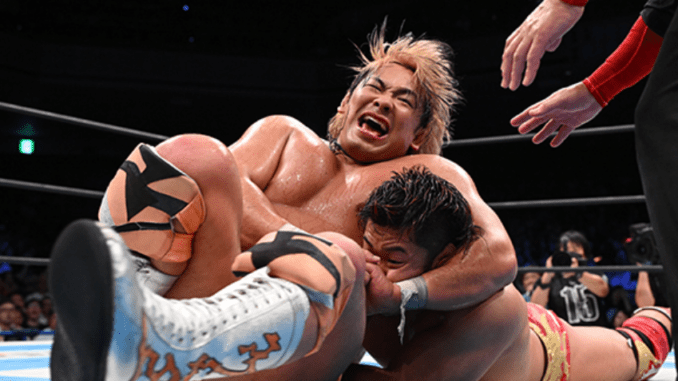
Few would have singled out Oiwa as a favorite in the G1 going back as recently as June. The 27-year-old went through the “play-in” round to qualify for one of the final spots and entered the tournament with a simple story of establishing the side headlock as the most dangerous submission among the participants. It escalated once the maneuver was taught and accepted as a finisher with submissions of SANADA and Hirooki Goto. By the finale, there was no warming up required as it was Oiwa’s “go to” from the start and the audience responded vociferously.
The initiative yielded results with a total attendance of approximately 50,400 over nineteen events or 2,652 per show. The total attendance was a healthy 17% increase from 2025. Of the final two nights at Ryogoku Kokugikan, clearly it was Hiroyoshi Tenzan’s retirement that carried a lot of weight, outdrawing the final night by several hundred and placed in the main event spot on Saturday.
At full usage of the venue, Sumo Hall can accommodate just over 10,000 with four people per box (most sections under the smaller configuration limit to two per box). It was down from the previous finales with 8,283 in 2024 and 8,056 in 2023 at Ryogoku. Last year’s final shows aired from Ariake Arena with 4,458 and 6,870, respectively.
To hyperfocus on attendance would be missing the larger point that New Japan placed itself into a position where it comes out of the G1 with more viable players than it began. Oiwa leads the pack with a class of Tsuji and Uemura as the “big three” Japanese stars. Had he not suffered a concussion, you would imagine Shota Umino would have been included in that mix and leaves a “what if?” regarding his role in the tournament and if it would have turned a corner in his perception.
Inevitably, New Japan is going to have to wake up to the hangover effect that it is not the top destination for every star. It has lost ground in the arms race between WWE and AEW, and even CMLL has taken its role as the hot international product over the past years. Talent will receive big offers from the major companies, and when those promotions are willing to spend considerably more and offer talents the chance to “make it” in America, it’s a hard offer to pass. New Japan cannot operate with the mentality that certain talents will inevitably leave. It’s like dating a partner with the understanding you’ll break up. The relationship is doomed.
But what it maintains is a prestigious brand in both the G1 Climax and Wrestle Kingdom as cornerstones of the fan’s calendar and can still represent a tool of elevation when booked correctly, and the pieces fit. Fans still see the tournament as one of, if not the, most prestigious. Headlining Wrestle Kingdom still matters, even though Oiwa will buck the tradition as his previous two predecessors have, cashing in his title match in October.
Youth is on its side with a core of talent that has yet to hit their thirty-fifth birthdays. Callum Newman (23), Ryohei Oiwa (27), Shota Umino (29), Yuto-Ice (29), Aaron Wolf (30), Yuya Uemura (31), Yota Tsuji (32), Boltin Oleg (33), and HENARE (33) are an embarrassment of riches at this stage of their careers and could be top stars for the next decade.
Many will be belaboring the loss of the last generation of stars because it represented a rebuilding period and the end of an era. In many ways, the decision to let Tetsuya Naito go was the best possible decision. It signaled to the audience that New Japan was not hanging on to the bygone era but embracing the next one. It is always tougher for the next set of stars to get over when the previous set are still present. The closest link to the previous era in a strong role is Hirooki Goto, who fits as both an elder statesman who can go at a high level and isn’t blocking anyone’s ascension.
To paint the picture that New Japan is on the cusp of a renaissance would be naïve and, in a month, perhaps a lot of this goodwill will be tossed aside. But it feels like the players fans have been clamoring for are in the proper positions to run the plays on a philosophy of youth, excitement, talent, and fresh directions. Anything that interferes with that ethos needs to be flagged.
This year, New Japan has had two significant “wins”. The first was Hiroshi Tanahashi’s retirement legitimately selling out the Tokyo Dome and producing one of the great sendoffs in pro wrestling history and a home run at the box office. The other is this past weekend’s G1 Climax final where Ryohei Oiwa and Yuya Uemura captured the zeitgeist for thirty-five minutes and gave the audience something counter to the general formula of a big match. The difference is that the Tokyo Dome show was about looking back and saying goodbye while the G1 was about looking forward and introducing something new.
New Japan has a compelling hand of cards, and over the next six months it is up to the promotion to play those cards as the fan base places its faith in the house finally winning a hand.
