
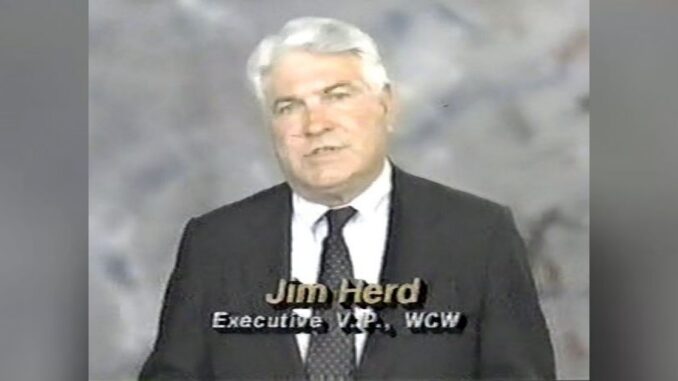
Former WCW executive Jim Herd recently died, with the news shared by Conrad Thompson of his passing last month.
Herd was a controversial leader in WCW’s history, often blamed for many poor ideas and wild gimmicks during a declining period in the company’s history.
Herd was a very successful executive at Pizza Hut and served as station manager at KPLR-TV during the heyday of Wrestling at the Chase in St. Louis.
He was hired by WCW in late 1988 right after the sale to Ted Turner and coincided with Dusty Rhodes’ exit from the company. During his tenure, Herd helped land several notable sponsorships with Budweiser and Roos and market its talent through trading cards and its action figures to find various revenue streams to complement ticket and pay-per-view sales.
Attempts over the years to compete with the WWF fell short, including failed tries to lure talent such as Randy Savage and Roddy Piper during Herd’s era. In 1989, the promotion would stage a free special on TBS against WrestleMania 5 after WWF’s showdown with the cable companies over their share of the pay-per-view revenue. To retaliate, WCW was instructed to run its own pay-per-view that day, but once the sides reached a deal, they didn’t want two pay-per-views that day, so they allowed WCW to run their special on cable. The show bombed at the Louisiana Superdome and was the catalyst for George Scott’s dismissal as booker in WCW.
From a critical standpoint, WCW had a great year in 1989 around Ric Flair and Ricky Steamboat’s feud and straight into Flair and Terry Funk. Financially, Herd didn’t manage any profitable years, which was his job to balance the books. WCW rallied around Sting as its star for the next decade, but his coronation was delayed after a serious knee injury in early 1990. Flair held onto the championship, and Sting was crowned at the Great American Bash in July, although it wasn’t an immediate hit. During Sting’s injury, Ole Anderson was named head booker and orchestrated the dreaded “Black Scorpion” story, with the masked man revealed at Starrcade as Flair, who regained the title from Sting.
Herd’s most significant part of his WCW legacy was his power play with Ric Flair in 1991. At 42, they viewed Flair as the star of the ‘80s and not the answer. An attempt was made to cut salary, and he was pitched on portraying a “Spartacus” type of character by cutting his hair.
The problem was Flair was still champion, and Herd decided to fire the performer before he had dropped the belt. When Herd realized the need to have lineage of the championship preserved and have Flair “do the honors”, it forced him to go back to increase his offer. Flair balked and had made an agreement with the WWF and was bound for Titan Sports.
The result was a black eye for WCW as Flair did not appear at the Great American Bash that month, and Lex Luger won the vacated championship by defeating Barry Windham as the Baltimore Arena chanted, “We Want Flair” throughout.
Herd’s tenure at WCW expired months later when he was asked to move divisions, but they ceased ties and resigned in January 1992.
Herd has received plenty of criticism over the years, especially over his creative ideas as witnessed by the likes of Ric Flair, Jim Ross, and Jim Cornette.
Conrad Thompson reported that Herd died last month in his weekly column on the Uncrowned website. He was 87 years old.
We will have more on Jim Herd this week.
