
Selected recent coverage of the WWE merger shareholder lawsuit by POST Wrestling:
- Dec. 29, 2025: “I will be your greatest partner”: How Vince McMahon’s 2022 WWE comeback was anticipated by Endeavor executives
- Mar. 19, 2026: Tony Khan bid for WWE in 2023 sale process ultimately won by Endeavor to create TKO
- Apr. 7, 2026: Paul Levesque-Nick Khan texts show friction between Vince McMahon and Levesque over WWE creative in 2023
- Apr. 23, 2026: Mark Shapiro’s testimony contradicts WWE’s SEC account on how Vince McMahon got lifetime role in TKO
- May 7, 2026: Nick Khan testified that DOJ investigated sex trafficking, undermining Vince McMahon’s “minor accounting errors” statement
- May 27, 2026: Vince McMahon and Nick Khan sanctioned by judge in WWE merger lawsuit, heightening their burden to prevail at trial
When is the trial? It starts next Monday, June 8. It continues each weekday, except for Thursday, and concludes on Friday, June 12. Many witnesses will take the stand, but after the trial, a judgment is not expected from the judge until some months after the trial week.
What’s at stake? A lot of money. The plaintiffs in their expert report calculated hundreds of millions of dollars in damages they say they’re owed. By one of their calculations, shareholders are owed almost $1 billion.
To be clear, this is a civil lawsuit, so no one is in any kind of criminal jeopardy in this case. Federal investigations into Vince McMahon’s conduct are mentioned in parts of the case but are entirely separate from this case. Those investigations did not yield any criminal charges against McMahon or anyone else.
Consequences beyond requiring the defendants to pay would be surprising. The judge does have the authority to order some remedies other than monetary awards. Certain governance changes could be ordered for TKO’s board. In theory, the court could order that the TKO merger has to be unwound (“rescission”), but that would definitely be unexpected and undoubtedly appealed. The plaintiffs’ complaint indicates they’re only asking for monetary damages.
Who are the plaintiffs? In short, shareholders who held WWE stock at the time of the merger. Two similar lawsuits were filed in November 2023, and one more in April 2024. Those three cases were consolidated into this one case.
This consolidation led to early litigation over which party would be the lead plaintiff. The unconsolidated plaintiffs were:
- Dennis Palkon. He appears to be a professor at Florida Atlantic University. He’s been a plaintiff in other shareholder class action cases, including a federal case a few years ago against WWE. (That case alleged executives misled investors about their Middle East North Africa media rights deal. A related case was settled in 2020 and resulted in $39 million going to shareholders.)
- An Ohio pension fund. The pension fund’s full name is the Laborers’ District Council and Contractors’ Pension Fund of Ohio.
- A retirement fund from Pontiac, Michigan, whose full name is the City of Pontiac Reestablished General Employees’ Retirement System.
Ultimately, the Palkon and Ohio pension fund combined to become co-plaintiffs and won the right over the Pontiac plaintiffs to become the lead plaintiffs.
The judge found that both sets of plaintiffs were well-qualified, but that attorneys for the Palkon group had stronger experience in litigating sexual misconduct cases. McMahon resigned from WWE in 2022 under allegations of sexual misconduct from multiple women formerly employed by WWE.
Palkon also filed an earlier action in January 2023, the month that McMahon came out of retirement and returned to WWE. Palkon’s earlier case did not seek money but demanded certain records, including meeting minutes from WWE’s board meetings. Inspecting certain records is a right shareholders have under Delaware law. Records extracted in that case were referenced in the eventual shareholder lawsuit at hand.
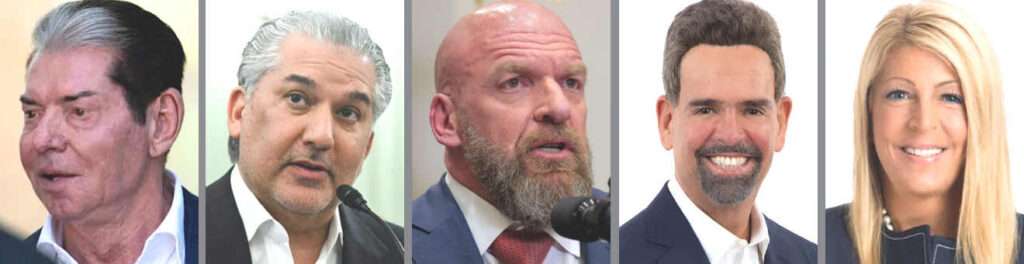
Who are the defendants? Vince McMahon, Nick Khan, Paul Levesque, George Barrios, and Michelle Wilson. Notably, not the companies, TKO or WWE, which we’ll explain later.
Vince McMahon. Needs no introduction for most readers. The chief executive of WWE, who oversaw the company’s success from its booms in the 1980s and 1990s, to its continued growth as a publicly-traded company throughout the 21st century. He resigned — for the first time — in July 2022 amid allegations of sexual misconduct and related NDA payments. Then in January 2023, he returned to WWE and immediately announced an M&A shopping process at issue in this lawsuit.
Nick Khan. WWE’s current President has been with the company since August 2020, when he left a top spot with CAA. The former agent to numerous major sports media personalities is best known for making lucrative media rights deals. Like each of the other defendants here, he was a member of WWE’s Board of Directors when the TKO deal was executed, and is accused of breaching his fiduciary duties.
Paul Levesque. WWE’s current Chief Content Officer and head of creative. He joined the company as a talent in 1995 and, as Triple H, became a main eventer during WWE’s cultural height. He’s been an executive with WWE since at least 2010.
George Barrios and Michelle Wilson. Leading executives and eventually co-presidents at WWE until January 2020, when they were suddenly terminated by McMahon. They oversaw the launch of the WWE Network in 2014. Barrios and Wilson have continued to work in other business ventures together. McMahon brought them back as WWE board members when he returned to the company in January 2023.
Earlier in the case, former WWE board members Frank Riddick and Steve Koonin were named as defendants, but they were dropped in October 2024.
Where is this case being litigated? The Delaware Court of Chancery. The trial will take place in a courthouse in Wilmington, Delaware. The Chancery Court constantly deals with complex corporate lawsuits, often including litigation related to mergers and acquisitions of highly valuable companies.
You may have heard, Delaware has more business entities registered in it than it has human citizens. Corporations are attracted to Delaware for its lack of corporate income tax on out-of-state business activity, but also for this specialized court itself and the system of specialized law firms that have emerged around it.
It’s notable that the Chancery Court is a court of equity. That means the trial will be decided by the judge. There will be no jury involved in this case.
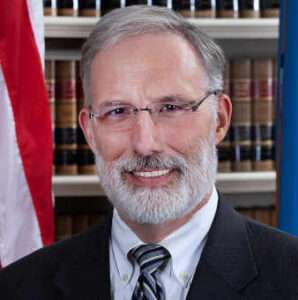
Who’s the judge? Vice Chancellor J. Travis Laster. He’s been on the court since 2009. Before becoming a judge, he practiced law in Delaware and also founded his own firm. After getting his law degree from the University of Virginia, he clerked for a judge in the Third Circuit Court of Appeals.
In a 2023 Bloomberg Law profile, Laster was described as a “monkish scholar of Delaware law,” who “expects that attorneys come to his courtroom highly prepared — even if only to see him make quick work of their arguments.”
He’s written many scholarly articles pertinent to this lawsuit, on subjects such as fiduciary duties and controlling stockholders.
Laster’s most significant decision so far in the case was his 40-page opinion ruling that McMahon and Khan will go into the case with certain adverse inferences assumed against them because of their failure to preserve evidence, including messages sent over the auto-deleting messaging app Signal.
What do the plaintiffs allege? That the defendants breached their fiduciary duties. Mainly, they allege that McMahon predetermined the merger of WWE with UFC and prevented a fair and competitive sale process from happening. The plaintiffs claim McMahon wanted a deal that would preserve a position for him in the new entity, and that was only going to happen if he made a deal with his longtime friend, Ari Emanuel, the CEO of Endeavor. Other bidders were less likely to retain McMahon and would have viewed him as toxic, they say.
Among other allegations, the plaintiffs claim WWE’s advisors on the deal were conflicted. One was the Raine Group, which had a long history as an advisor to Endeavor on many of its business deals.
The plaintiffs also point to evidence showing McMahon and Emanuel were in contact months before a formal sale process was announced.
If the process was fair, WWE allegedly would have sold for a higher price than it did; shareholders would have gotten greater monetary value. The other defendants are alleged to have breached their fiduciary duties also by cooperating with McMahon’s alleged scheme. The defendants deny these allegations.
What is a board of directors? Being a member of a board of directors is a different duty from being an executive. Most directors (“directors” and “board members” in this context, I’ll use interchangeably), including in WWE’s case in 2023, are not full-time executives with the company. WWE’s board had executive members — who did work full-time with the company, like Khan and Levesque. And there were independent members, who don’t work for the company day-to-day, but have expertise in relevant backgrounds.
All board members have a responsibility to protect shareholders’ interests, which is a kind of legal responsibility called a fiduciary duty. The alleged violations of those duties are largely what this case is about.
Board members also, in theory, have the ability to make major decisions such as hire and fire the CEO and approve a sale of the company. However, in WWE’s case, McMahon was the controlling shareholder, which meant he basically could change board membership at will. He held about 36% of WWE shares. But he held special McMahon-only super-voting stock, which gave him about 80% of the voting power. With that control, he was able to unilaterally re-add himself to the board in January 2023, through an instrument called Written Consent. It’s also through that mechanism that he approved the TKO merger, rather than putting the deal up to a “majority-of-the-minority” vote, which sometimes happens in M&A transactions.
Why are WWE and TKO, the companies themselves, not defendants? This is a case in which directors are alleged to have violated their fiduciary duties. Under Delaware law, companies themselves don’t independently owe shareholders those duties; only the directors do.
However, WWE and TKO are involved in defending this case in all but name. McMahon has separate counsel from the rest of the defendants, the latter of whom are referred to as the D&O (Director & Officer) Defendants. WWE and/or TKO are almost certainly covering the legal defense of those latter defendants. And the directors, including McMahon, are almost certainly covered by WWE’s director and officer liability insurance: policies that publicly-traded companies hold to financially protect themselves in the event they have to pay out massive judgments in cases like this.
However, whether McMahon will ultimately be covered by any such insurance, should he be ordered to pay monetary damages, is an open question since the plaintiffs here allege McMahon dealt himself a benefit (a role in the surviving entity) that other shareholders could not share.
Who pays monetary damages if the plaintiffs win? WWE’s insurance would likely pay at least part of that judgment. It would be surprising if the non-Vince defendants have their personal finances exposed in any way.
As mentioned, though, D&O insurance generally does not cover McMahon’s alleged self-dealing. If the court finds that’s what happened, McMahon’s personal finances could be at stake. Given his wealth and continued TKO-derived income, though, he may be in a position to withstand even hundreds of millions of dollars in damages.
Since the closing of the TKO merger alone, SEC records show he liquidated $1.7 billion in stock. In addition to that, the special one-time dividend paid to shareholders at the close of the deal in September 2023 gave McMahon another $111 million. TKO continues to pay a quarterly dividend of 78 cents per share. Even after his transactions, the latest public records show McMahon still holds 6,442,325 TKO shares. That means he’s getting just over $5 million every three months in dividends, or more than $20 million per year from the company he briefly served as Executive Chairman before his resignation in January 2024 following the filing of Janel Grant’s sex trafficking lawsuit against him and the company.
Are lawsuits over mergers and acquisitions like this rare? When companies as valuable as WWE and UFC combine, it tends to attract legal scrutiny from law firms that may see an opportunity to extract many millions if they can prove the deal was unfair. The merged company was announced in 2023 as being worth $21 billion. The WWE portion of that was valued at more than $9 billion. A few percentage points in an unfair deal can result in hundreds of millions of dollars in damages.
This is one important reason why directors and officers, such as the defendants, are directed by their legal departments to preserve their records amid major M&A processes. So that when the foreseeable lawsuit arrives, if it gets to discovery (where evidence is exchanged), the companies can show they did nothing wrong, and can show that they didn’t destroy evidence to cover up wrongdoing. Because if they don’t preserve all of their written communications, for example, that can result in adverse inferences — where the judge decides that, because certain evidence is missing, such evidence would have been unfavorable to the person who lost the evidence.
And that’s exactly what’s happened in this case with regard to Vince McMahon and Nick Khan’s use of Signal, which they used to auto-delete messages.
Does it matter that TKO shares have roughly doubled in value since the merger was finalized in September 2023? Probably not. This litigation centers around what WWE sold for and doesn’t necessarily concern what the price of the stock became after WWE converted into TKO shares on September 12, 2023.
WWE’s financial performance within TKO has been strong. But the plaintiffs don’t necessarily need to argue that a bidder other than Endeavor should have won the process. Instead, they argue that WWE wasn’t properly valued; they claim WWE should’ve been assessed as more valuable than UFC, rather than the other way around, as in the actual deal.
Formula One parent Liberty Media and private equity firm KKR were other suitors who made comparable bids to Endeavor. But the lawsuit doesn’t say that those parties should have won. The plaintiffs’ case alleges that those parties weren’t given a full chance to bid, which could’ve run the price up for WWE. Perhaps Endeavor still could have won, but it should have paid a greater price, they say. In that scenario, TKO still could have been created and achieved the stock price it has today.
Will the trial be televised or otherwise recorded? Video and audio recording are not allowed. Photos are also not allowed in the courthouse. A transcript of the trial will eventually be available. Like courtrooms generally, though, the trial is open to the public.
I plan to be in the courtroom each day, covering the trial with written coverage, published at the end of each day for free here at POSTWrestling.com. For subscribers of both Wrestlenomics on Patreon and POST Wrestling on Patreon, John Pollock and I will record a daily audio discussion about what happened in the courtroom.
Who will testify in the trial? Each of the defendants, the top two executives in TKO, and many others.
The plaintiffs or defendants (or both) plan to call these live witnesses:
- Vince McMahon, then-WWE/TKO Executive Chairman
- Ari Emanuel, TKO CEO & Chairman, and then-Endeavor CEO
- Mark Shapiro, TKO President & COO, Endeavor President
- Nick Khan, WWE President and then-board member
- Paul Levesque, WWE Chief Content Officer, then-WWE board member and executive
- Michelle Wilson, then-WWE board member and former WWE executive
- George Barrios, then-WWE board member and former WWE executive
- Jeffrey Sine, Raine banker
- Frank Riddick, then-WWE Chief Financial Officer and board member
- Steve Koonin, TKO board member, then-WWE board member
- Andrew Schleimer, TKO CFO and then-UFC CFO
- Mark Zhu, TKO Chief Strategy Officer and then-Endeavor executive
- Brad Blum, former WWE executive
- Matthew Archer, shareholder plaintiff
- Dennis Palkon, shareholder plaintiff
- Brendan Houlihan, expert witness
- James Canessa, expert witness
- Daniel Lee, Moelis Managing Director (an advisor in the process)
- Paul Finger, JP Morgan Managing Director (advisor)
- Doug Perlman, expert witness
- Professor Steven Salaga, expert witness
- Professor David C. Smith, expert witness
The plaintiffs have indicated they may call these witnesses live or they may simply refer to their depositions:
- Stephanie McMahon, then-WWE executive and board member
- Jeffrey Speed, then-WWE board member
- Marty Patterson, Liberty Media Broadband President & CEO
- Steve Pamon, then-WWE board member
Who are the attorneys? The law firms handling this case are some of the most high-powered offices in Delaware and in the country.
As mentioned earlier, McMahon has separate attorneys from the rest of the defendants. His lead counsel consists of lawyers from Kirkland & Ellis. His local Delaware counsel are from Potter Anderson.
The WWE D&O defendants are represented by lead attorneys from Latham & Watkins, a firm that has a long relationship with Endeavor. Local counsel for these defendants are with Morris Nichols.
The defendants’ two lead law firms were #1 and #2 in revenue nationwide, according to a recent Law.com ranking.
The plaintiffs are represented by attorneys from two law firms: Block & Leviton and Bernstein Litowitz Berger & Grossmann.
Numerous attorneys have filed appearances in this case, but it’s not yet clear which from these firms will be most involved at trial.
