
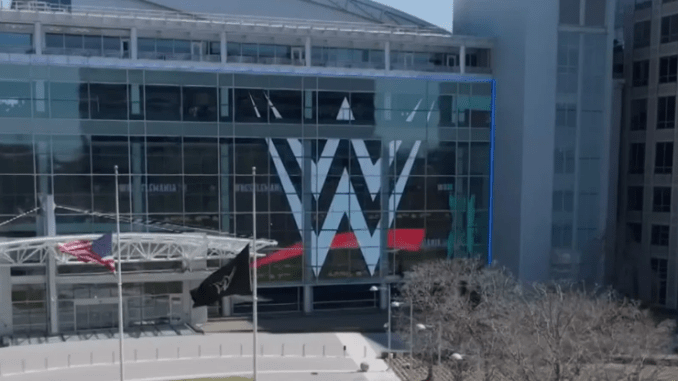
It came down to the wire, but in the end, the defendants in the WWE shareholder lawsuit mitigated further damage by avoiding a trial in Delaware.
Since the merger of WWE and UFC in 2023, questions have surrounded Endeavor swooping in and leading to multiple lawsuits being consolidated into a single case, which was hours away from commencing in the Delaware Court of Chancery.
At present, a formal settlement has not been disclosed, but the parties have agreed to one in principle for an unknown amount. Vice Chancellor Travis Laster was set to oversee the four-day trial and came out with a strongly worded opinion, sanctioning two of the five defendants, Vince McMahon and Nick Khan.
McMahon and Khan joined Paul Levesque and former co-presidents George Barrios and Michelle Wilson as defendants, but it was the first two who were found to have spoliated information despite legal warnings. Multiple accusations were going to be assumed to be truthful heading into the trial, and placing a bullseye on the heads of McMahon and Khan to prove otherwise. The plaintiffs’ experts deemed damages to be well into the nine figures and approaching $1 billion.
On the surface, TKO avoided a messy trial in which unflattering evidence would undoubtedly be introduced, attracting further attention to the questionable tactics of key executives throughout the merger process. More damaging was the potential inclusion of aspects related to the Janel Grant case, which is the nucleus of so many of these issues and McMahon’s actions related to and from his relationship with the former employee.
TKO hardly comes out unscathed as hundreds of documents have been released, mainly from the efforts of Brandon Thurston (of this site), who made a pair of challenges to unseal various documents and audio files. It has provided an astounding level of detail regarding the merger process and placed several current and former executives under depositions, including McMahon, Ari Emanuel, Nick Khan, Paul Levesque, Brad Blum, and Stephanie McMahon.
The case forced another examination of the time period involving the knowledge of McMahon’s relationship with Grant, her exit from the company, and an accompanying hush money payment signed in 2022. The board of directors received the first of three anonymous emails on March 30 that year (days before WrestleMania 38), alerting them to the relationship and link to John Laurinaitis before being paid millions of dollars “to shut up”.
The real fallout occurred after June 15, when the Wall Street Journal reported on the hush money payments for the first time in a series of articles outlining McMahon’s payments to women over the years, which ultimately were deemed to have gone unreported as company expenses and forced a faux retirement in July. On the same day as his “retirement” tweet, McMahon was on the phone with Ari Emanuel and meeting with the mogul on August 10 alongside Khan and Stephanie McMahon at a New York steakhouse.
McMahon remained the controlling shareholder of WWE, and while informally exploring a sale or merger is not against company bylaws, McMahon was alleged to have acted in his own self-interest rather than in the interests of all shareholders. It appeared McMahon was getting his ducks in a row during this perceived retirement and was aiming for a return before the end of 2022. It was delayed, and the board pushed back on his intentions, citing ongoing government investigations, but they were overruled in a situation where McMahon didn’t have to ask, only demand, and he was reinstalled as executive chairman and with a spot on the board.
Acting as a protective cover for a radioactive figure, McMahon returned with the intention to “explore strategic alternatives” to offset any downturn in the company’s stock upon his return. The street responded well to this news of a possible sale, and no one could argue that McMahon’s return damaged the stock or the company.
It appeared McMahon had orchestrated a return to a near flawless execution, but many more shoes were set to drop. In February 2023, believing his non-disclosure agreement with Grant had been violated, he opted not to pay the required annual installment of $500,000. It would be the costliest half million that McMahon never spent, reneging on a payment and not going to arbitration as their agreement stipulated all disputes would be convened under.
In January 2024, Grant filed her lawsuit, naming McMahon, Laurinaitis, and WWE as defendants, ending with McMahon’s very real resignation within 48 hours of the suit’s filing.
It is impossible to adjudicate the WWE shareholders’ arguments without invoking Grant’s grievances and accusations, because they argue that it forced McMahon to operate singularly in a role that required the best outcome for the company at large. The case was not going to be determined on the present-day health of TKO, which exceeds $200 per share, record profits and revenue, and astronomical media rights and product deals. It was argued whether the transaction was conducted under fair market conditions and whether other bidders had a reasonable chance to acquire the company.
As expected, the sides reached dramatically different conclusions about the overall value of WWE at the time of the merger. The plaintiffs believed that WWE should have been the majority stakeholder over Endeavor’s UFC, but due to financial covenants and cost triggers, Endeavor accepting a minority stake was a “red line” it refused to cross. The open-ended question was whether a company other than Endeavor was a “red line” McMahon refused to cross.
Bidders Liberty Media, KKR, and Base 10 (Tony Khan’s group) showed no indication it would retain McMahon, whose reputation had been greatly damaged, not to mention a noticeable uptick in business when he was truly removed from the creative process at WWE.
We will never know how Laster would have ruled and what unknowns may have seen the light of day in this trial, but it would be incorrect to state this process was a waste of time or wasn’t enlightening in so many areas of TKO’s modus operandi.
Front and center was the brazen nature of McMahon and, especially, Nick Khan, to ignore warnings from WWE’s legal department regarding preservation of communications. Their actions may have been the difference in the defendants’ willingness to roll the dice at trial versus paying out a large payment to make it disappear.
The reputation of McMahon has remained unchanged; many have put their opinions of the former chairman down in ink and underlined those conclusions over the past four years. For Nick Khan, this was not a pleasant exercise for his reputation. Even those casually following the case, the takeaway was his aversion to any wrongdoing in his deposition despite mounds of evidence showing the changing of Signal delete settings on a constant basis and falling to the Richard Nixon doctrine, where the cover-up is worse than the crime. The opinion written by Laster supported this conclusion and signaled an unfavorable hill to climb for the two.
In cases such as these, it was a case of money that ended with money exchanged. In the interim, there was a bright light that was momentarily shone on the DNA of the current administration at TKO, warts and all, and unlike its favorite messaging app, it will be hard to delete from the public record.
