
“I don’t believe that the person who died is there anyway. Funerals are for the living, not for the dead.” – Bill Watts
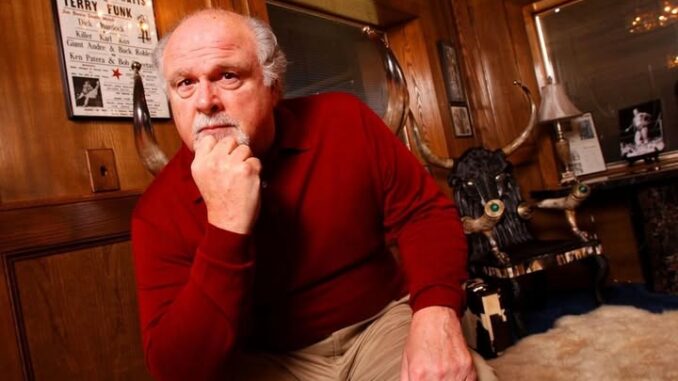
The life of Bill Watts has come to an end after eighty-seven years, and in assessing his legacy, it’s a tough process for the living to try and understand the dead.
Watts is among the important figures of the territorial era, from a headlining star in many of the largest regions of the country, a tremendous booker, and an operator of Mid-South Wrestling. If luck and timing had “zigged” instead of “zagged”, Watts could have been positioned as Vince McMahon’s strongest adversary into the ‘90s or his right-hand man as he was groomed for.
If you’re learning about Watts for the first time this week, the reality of this man’s words and beliefs will strike you like a cold shower. No contextualization of Watts is possible without confronting the racism and homophobia espoused, most famously, in a 1991 interview with Wade Keller of the Pro Wrestling Torch. It was not isolated, as allegations of racism and antisemitic comments followed him. Whenever a figure with a troubled legacy passes away, many shy away from the uglier sides, but as Watts himself alludes, these types of remembrances are for the living, not for the dead.
It’s both depressing but a reality that many of your favorites populated an industry rife with bigoted behavior and debauchery that was often celebrated before the fanbase woke up to the realities of a problem culture that existed. Most conducted their sins in private, but Watts’ horrific language and beliefs were in plain sight, forcing his ardent supporters to either confront, minimize, or dismiss those words.
Watts was born May 5, 1939, in Oklahoma City, to parents whom he would state in his book were abusive and a mother who suffered from depression.
Watts was the definition of the stereotypical “jock”, excelling at wrestling and football to earn a scholarship to Bud Wilkinson’s football program at the University of Oklahoma and wrestling in the off-season. He graced a wrestling program that included future junior heavyweight star Danny Hodge, two-time NCAA champion Dale Lewis, and 115-pound NCAA champion Dick Delgado. On the gridiron, he shared the field with Wahoo McDaniel, who played an instrumental role in Watts’ adaptation of careers.
Watts suffered a near-fatal accident while playing in Oklahoma when his car was struck by a train. Watts said he was “unconscious for a couple of weeks” and fell from 245 to less than 200 pounds. It was a long and arduous recovery and, in the era when weightlifting was frowned upon for athletes reaching optimal performance, Watts bucked that trend and attacked the weight room to enhance himself to 315 pounds while forcefully denying ever touching steroids. He was an excellent collegiate player and strong enough to make Jim Thorpe’s “All-Time Greats of Oklahoma” list for the team covering the ‘50s.
After OU, he signed on with the Houston Oilers of the AFL but didn’t last with the team. He transferred to the Indianapolis Warriors of the UFL, and it was here that he began to moonlight with professional wrestling. The story from Watts was spotting a payoff belonging to Wahoo McDaniel for $500 and asking if that was McDaniel’s takeaway from a week of wrestling. McDaniel responded, “No”; it was for one match. Suddenly, pro wrestling looked like a hell of an offramp for a fading football career that wasn’t going to materialize into a role with any of the pro teams.
Indianapolis is where Watts got his start in 1962 and was thrown into the deep end with several of his first matches against Joe Blanchard and Don Leo Jonathan. He was sent to Texas for seasoning when Morris Sigel was the top promoter, and Ed McLemore oversaw Dallas.
His ties to football ended for good after the Minnesota Vikings showed interest in Watts while he was wrestling for Verne Gagne. Watts was making more in wrestling than football, although it’s disputed whether he was actually qualified to make the team.
The ascension to headlining star occurred when he transferred to the WWWF in 1964 at the urging of “Wild” Red Berry, who pushed Vince McMahon Sr. and Toots Mondt to look at the standout athlete. His first match at Madison Square Garden on March 16 saw him face Luke Graham underneath Bruno Sammartino vs. Jerry Graham. During the year, he appeared at The Garden against Magnificent Maurice, Killer Kowalski, Gorilla Monsoon, The Golden Terror, and teamed with Don McClarity.
It set the stage for 1965 and teaming with Sammartino against Gene Kiniski & Waldo Von Erich on January 25 in the main event at The Garden. Over twenty-five minutes, the major spot saw an errant dropkick thrown by the WWWF champion and hitting Watts by mistake. The turn happened about a week later, and they were off to the races with one of Sammartino’s best drawing opponents.
The pair met on February 22 at The Garden and drew 19,101 and an incredible gate figure of $61,384, one of the biggest in the history of the building up until that point. Sammartino retained the championship by disqualification, and they returned on March 29 with another 19,600 and a $61,000 gate, with another disqualification ending. The second match was billed as “No DQ,” but Watts used a low blow, and they still disqualified him and took some of the air out of the sails, as would be seen when they returned with the match again.
Before the climactic match, Watts won the WWWF tag titles with Gorilla Monsoon on April 8 from Kiniski & Waldo Von Erich and held them until August, when they were taken by Bill & Dan Miller.
The formula for Sammartino and Watts didn’t work as the third match on May 17 fell to 12,984 and $39,000, with Watts unable to continue after 22:08 as Sammartino retained the gold. The two had one more main event on October 20 before Watts left the territory.
He headed to the West Coast and wrestled for Roy Shire in Northern California and hailed the promoter as a “genius”. Watts unseated Kinji Shibuya as the area’s U.S. champion on February 19, 1966, at the Cow Palace for an extended run of thirteen months as champion. Under Shire, he got to work with all the area’s top stars, including Pat Patterson & Ray Stevens, who drew acclaim as the top working tag team in the industry. Watts was in a featured spot in the territory for his year as champion, losing the belt to Stevens on March 11, 1967, in San Francisco.
Watts made his first trek to Japan that year, wrestling for the JWA when Giant Baba and Antonio Inoki were the two stars being groomed for success before branching out five years later. Watts toured with the group in October, securing the NWA Int’l tag titles on October 6 with Tarzan Tyler from Giant Baba & Michiaki Yoshimura for a three-week run before dropping the belts to Baba & Inoki in Osaka on October 31. It was significant as it was Baba & Inoki’s first title reign together as B-I Cannon, the titles they would hold four times through the end of 1971 before the splintering and launch of their promotions the following year.
Watts’ next chapter was a significant move to Verne Gagne’s AWA in late 1967, and he would spend the next two years in the Midwest. It was in the AWA that he began teaming with Ole Anderson, someone who would be a significant player in the industry, and Watts and their paths would cross in future years. The AWA was loaded with talent and talkers during its peak with Gagne, Larry Hennig, Harley Race, Mad Dog Vachon, Red Bastien, Dr. X (Dick Beyer), and The Crusher.
However, Watts would ascend to the top of the promotion as a near-equal babyface to Verne Gagne, creating a dream match scenario for April 19, 1969, at the Met Sports Center in Bloomington. The match was booked for two-of-three falls, with Watts securing the first fall but the match ending due to a cut to Watts. Naturally, the fans clamored for a rematch, but Gagne stated, “There are other contenders.” It endeared Watts to the audience as the rightful next challenger, but made the fanbase wait.
Watts ran through all the heels over the next two months to receive his rematch on July 26 at the International Amphitheatre in Chicago. This time, Gagne escaped the two-of-three falls affair with a count-out in the final fall after Larry Hennig attacked Gagne, once again leaving the program open-ended and the audience believing Watts could unseat the AWA champion. They took the match to Milwaukee and Denver before the culmination on November 8 in Minneapolis, where Gagne finally beat Watts, followed by rematches in December before Watts left the territory after a very successful tenure as a top babyface.
In 1969, Watts named was linked to the candidates under considering for the NWA World Heavyweight Championship when Gene Kiniski was looking to drop the belt after three years on top. Watts didn’t receive the support, with Dory Funk Jr. getting the nod and the better-suited candidate for the role the champion held in that era.
The decade of the ‘70s for Watts saw the evolution of his business acumen after eight years under his belt and learning from the various promoters he worked under.
Leroy McGuirk was an NCAA champion at Oklahoma A&M (now Oklahoma State) and transitioned into a top junior heavyweight pro wrestler before shifting to promoting after losing his sight. He operated Oklahoma, Louisiana, Arkansas, and parts of Texas, Missouri, and Mississippi, covering a wide space and a grueling territory for the travel. The territory was divided into two, with crew in the North hitting Tulsa, Springfield & Joplin (Missouri), North Little Rock & Fort Smith (Arkansas), Wichita Falls, and television in Shreveport. The Southern part of the territory encompassed Shreveport for television, New Orleans, Baton Rouge, Lafayette, Houma, Greenville, and Jackson (Mississippi), along with some smaller towns. Jackson was a very hot city under local promoter George Culkin, and it wasn’t uncommon for Watts to be paid $1,000 on top.
Watts was willing to join, but not without the incentive of points in the territory and seeing the value. McGuirk cut Watts into the ownership with a 17% stake and added Verne Gagne and Fritz Von Erich to the mix for talent supply, each receiving 20%. It was Watts’ first stake in a territory but not his last as the decade ensued with major roles in Georgia and Florida.
Watts held the North American Championship and defended against Dr. X (Beyer), Dale Lewis (his former wrestling teammate), The Spoiler Don Jardine, Jerry Brown, and Sputnik Monroe. The big matches in the territory occurred when Dory Funk Jr. came to town to defend the NWA Championship, including several with Watts in 1972. They had back-to-back matches on February 20 & 21 in Shreveport and Tulsa with referee stoppages and climaxed with a July 24 bout in front of 11,000 in Tulsa where Watts won by disqualification.
In late 1972, the NWA was facing opposition in Georgia from Ray Gunkel’s widow, Ann. On August 1, Ray was wrestling Ox Baker in Savannah and died of a heart attack after the match. Ann was left with Ray’s stock in the territory, and there are varied stories of how this went down. Many believe Ray was already on the outs with Lester Welch and was plotting a separation, with Ann simply carrying out those plans in lieu. Ann’s side was that she was being iced out of the territorial rights she inherited. There was immense loyalty to the Gunkels, and Ann was able to raid most of the NWA-affiliated talent to launch All South Wrestling on Thanksgiving night, including booker Tom Renesto. Only Bob Armstrong and Darrell Cochran refused to jump ship and caused a civil war in Georgia and one of the nastiest promotional battles.
Ted Turner was in the middle of this as the NWA group had a one-hour slot on WTCG (later WTBS) and Turner gave Gunkel her own hour to follow GCW. The two-hour block on Saturdays would become a staple of WTBS all the way until 2000, when WCW Saturday Night was dropped.
Jim Barnett bought into the territory in 1973 and arrived as an operator behind the scenes and knew all the dirty tricks necessary to fight Gunkel. He bought out Lester & Roy Welch’s shares and wanted Bill Watts as his booker and a top star. In exchange, Watts received a 10% stake in the territory.
As an incentive, various stars received points in the territory, including Eddie Graham and Jack Brisco receiving 5% each and cutting Buddy Colt and Tim Woods into the ownership circle as well.
All South Wrestling didn’t lay over and die, drawing approximately 600,000 fans in 1973, but it was too large a tidal wave to fight, and the little engine that could ran out of steam by 1974.
Georgia Championship Wrestling would only increase its footprint in the upcoming years, getting national exposure in 1976 when WTCG became available nationwide through satellite technology and was the first beneficiary of the cable revolution in professional wrestling. Watts was a sponge and understood the value of exposure, and if there is a constant, it’s that Watts was an aggressive learner, and it was all a dress rehearsal for his own promotional enterprise once he struck out on his own at the end of the decade.
Before returning to McGuirk after the Atlanta War, he headed to Championship Wrestling from Florida to book and wrestle for Eddie Graham. In 1974, he held the Florida heavyweight gold three times after taking the strap from Robert Fuller and trading it back-and-forth with Dusty Rhodes before dropping it to Bob Roop.
Watts’ contributions as booker in Florida are best identified by the turn of Dusty Rhodes into the area’s biggest babyface and soon-to-be a national phenom. The turn occurred in May 1974 when Dusty was teaming with Pak Song against Eddie & Mike Graham. Song accidentally chopped Dusty when Eddie got out of the way. Later, Song attacked Eddie and Dusty came to the rescue as the place went wild for the two rivals to shake hands and led to a huge run of sell-outs. Graham was heavily running the territory, although Watts publicly took credit for this turn, and he was certainly influential at the very least in the turn. It set Florida on fire, and Dusty was the constant for nearly a decade before leaving for Jim Crockett Promotions in 1984.
Watts also had many matches with Jack Brisco for the NWA Championship throughout 1974 and remained a top player in the area.
In early 1975, he returned to the Tri-State area with McGuirk and was essentially his home base for the remainder of his promotional and wrestling career for the next twelve years. It was around this period that Verne Gagne and Fritz Von Erich had their shares bought out, and it became a two-man operation with McGuirk and Watts.
In August that year, the Louisiana Superdome opened in New Orleans and became the stadium synonymous with Watts’ major cards, which he promoted with McGuirk before their divorce. The first ran the stadium on July 17, 1976, promoted around Bill Watts going for Terry Funk’s NWA gold and attracting 17,000 and a gate of $75,000, where Watts fell short due to blood loss. The show was aided by Dick Murdoch facing Killer Karl Kox in a “Jim Bowie Death Match” (Blindfold Match), Andre the Giant teaming with Buck Robley, and Dick the Bruiser against Abdullah the Butcher in top matches. They wouldn’t return to the Superdome until 1978, but after Watts took over the region, they were running 3-4 shows per year in the venue.
Watts helped cultivate New Orleans into the top city in the territory, above Tulsa, while airing on WGNO in the city.
After a pair of strong gates for their return to the Louisiana Superdome in 1978, the split was unavoidable as tension between McGuirk and Watts escalated. The next year, the two would split up the major areas, with Watts taking Louisiana and Mississippi (working with local promoters, the Culkins) and McGuirk having Oklahoma, Arkansas, and parts of Missouri & Texas. Mid-South was officially formed in September 1979, and the two sides fought for control. McGuirk tried to compete but faded and was bought out by Watts in 1982 as he took over his towns.
Watts put a lot of his promotional acumen acquired across his various stomping grounds into action and was hungry and savvy for control of the area. His biggest star was the Junkyard Dog (Sylvester Ritter), who arrived in the summer of 1979. The next year, the push of JYD began after beating Ernie Ladd for the Louisiana State Championship in Shreveport, then beating Bull Ramos for the Mississippi State belt, winning the tag belts with Buck Robley from the Freebirds. The promotion was regularly drawing anywhere from 5-8,000 weekly at the Downtown Municipal Auditorium off the back of JYD’s popularity.
The angle remembered to this day was the blinding of JYD by Michael Hayes using the “Freebird Hair Removing Cream”. JYD was unable to see, confined to his house and not allowed to be seen out and about in town. It was accentuated by the birth of his daughter and the claim that Hayes’ actions cost Ritter the ability to see his newborn child. It was a recipe for box office dynamite and delivered on August 20, 1980, with an attendance of 26,000 paid and approximately $183,000 at the gate for the JYD vs. Hayes showdown in a steel cage. The card included Dusty Rhodes & Buck Robley facing Terry Gordy & Buddy Roberts, and Vince McMahon Sr. sending Andre the Giant and Hulk Hogan for a match.
Mid-South was powered by syndication and grew its network through “jack of all trades” Jim Ross, who was the head of marketing while also serving as an on-screen broadcaster as he learned under Watts. Its secondary program, Power Pro Wrestling, gained cable distribution on upstart Tempo Television in the mid-’80s and was eventually purchased by NBC and rebranded as CNBC in 1989. Tempo also broadcast Mario Savoldi’s ICW, All Japan Women, and Texas All-Star Wrestling.
Watts entrenched himself getting exposure on network affiliate KJRH on Saturdays at Noon as its in a red-hot stage in the early ‘80s.
JYD headlined all three Superdome shows in 1981 ranging in attendance from 18-22,000 per show; he headlined another four in 1982 (never falling below 18,000), and three in 1983. These shows encompassed feuds with Ted DiBiase and The Rat Pack, Butch Reed, and Paul Orndorff among the high points. Toward the end of Watts’ in-ring career, he formed a team with JYD before hanging up his boots in 1981.
In late 1983, Mid-South were the beneficiaries of a talent swap with Jerry Jarrett in Tennessee, providing Watts with Bobby Eaton, Dennis Condrey, Jim Cornette, the Rock ‘N’ Roll Express, Terry Taylor, and Bill Dundee (who became a booker for the territory). Watts paired Eaton & Condrey together as the Midnight Express alongside loudmouth Jim Cornette, where they had their first match together as a team on November 23.
In 1984, Mid-South had a banner year, led by the “Last Stampede” series of shows. In a famous angle, a retired Bill Watts sent Cornette’s face into a cake and humiliated him on television. The Midnight Express attacked Watts with a flapjack, forcing Watts to come out of retirement but needing a partner. The Junkyard Dog had just lost a “Loser Leaves Town” match to Mr. Wrestling II on March 12 and headed to Mid-Atlantic for several weeks. Watts couldn’t bring back JYD and dishonor the stipulation, so they put JYD under a mask as “Stagger Lee” for the Lights Out match with the Midnights at the Louisiana Superdome on April 7.
The Superdome was a giant success with 23,000 in attendance and a gate of $176,000. Despite Watts tearing his hamstring in the opening minutes, he completed the match and did a run of follow-up matches in all the markets, with an estimate that the series of matches generated over $800,000 across the region for the matches.
The return to the Superdome on July 16 provided another $166,000 gate as Butch Reed defeated Junkyard Dog in a “Ghetto Street Fight,” and while the foundation of Mid-South felt rock solid in the summer of 1984, an unsuspecting blow was about to land with JYD’s unannounced exit to the WWF.
Watts was at the center of the national war for control led by Vince McMahon and a battle among Watts, Jim Crockett, and Verne Gagne to see who could keep their head above water and play in the deep end. This was no longer a regional territorial battle. It was a national fight due to the emergence of cable television, territorial divides falling apart, and an arms race for the top talent.
In the second part, we will explore how Watts combated the loss of the Junkyard Dog, the fall of Mid-South/UWF, and his reemergence in WCW.
Several notes courtesy of:
– The Cowboy and the Cross by Bill Watts and Scott Williams
– Between the Sheets – THAT Bill Watts Torch Talk
– Wrestling in the Garden, Vol. 2 by Scott Teal and J Michael Kenyon
– Pro Wrestling History – Louisiana Superdome
– Minnesota’s Golden Age of Wrestling by George Schire
– The King of New Orleans by Greg Klein
– Death of the Territories by Tim Hornbaker
– Wrestling Observer Newsletter
