
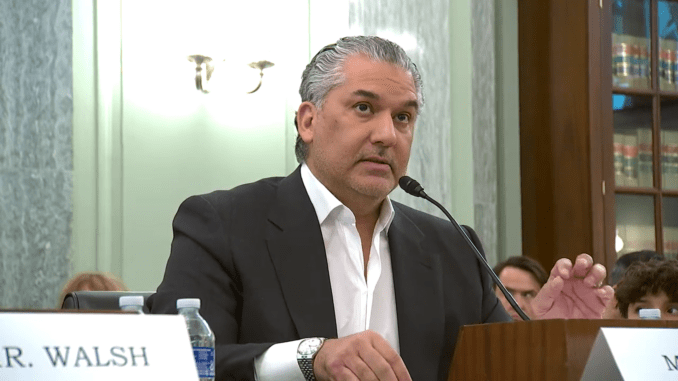
The United States Senator held a hearing about the Muhammad Ali American Boxing Revival Act.
Senator Ted Cruz of Texas, who is the chairman of the Senate Committee on Commerce, Science, and Transportation; Senator Jacky Rosen of Nevada; Golden Boy Promotions chairman Oscar De La Hoya; executive director of the Florida Athletic Commission Timothy Shipman; boxer and grandson of Muhammad Ali, Nico Ali Walsh; and WWE president and Zuffa Boxing promoter Nick Khan appeared at the hearing.
De La Hoya spoke against the current state of the bill, which was passed by the House of Representatives, saying it takes boxing in the “wrong direction.”
The Ali Act addresses real problems, including conflicts of interest, lack of transparency and the exploitation of fighters.
He claimed that a Unified Boxing Organization would not solve these issues and would not be subjected to the new provisions of the bill, but a promoter like him would. The boxing legend noted that the model would be similar to UFC and highlighted the $375 million settlement between the UFC and TKO and the fighters.
Shipman offered his perspective on working in Florida and how the health regulations and protocols would benefit boxing.
Walsh said that the current form of the Ali Revival Act would not give fighters a choice and would allow one entity to control everything. He highlighted how UFC fighters receive less than 20% of the company’s revenue, while boxers receive up to 80%.
Boxing is not broken. If it were, UFC champions at the height of their careers would not be actively targeting boxing fights because of the fair pay.
Walsh added that speaking up would have consequences, but silence is part of the system, noting that his grandfather also took a stand against the U.S. government 55 years ago.
If this bill is passed in its current form, it should not have my grandfather’s name on it, as it would betray the principles his act was created to protect. He fought for dignity outside of the ring. This is about dignity inside it. Fighters should not have to choose between their careers and their rights.
Khan went in-depth on how boxing was the top sport in the United States and how embedded in the culture it was. He spoke about the benefits of the bill and helped Cruz’s argument that there is no single champion, unlike in the NFL and NBA.
De La Hoya and Khan pushed back against each other over how long it takes to make superfights compared to the past and how boxing is no longer on a major network like ABC or FOX. Khan took the opportunity to discuss the promotion behind the Canelo Álvarez vs. Terence Crawford fight and how the fighters benefited from other financial opportunities, such as merchandise. That was part of his case for younger fighters.
If you want a chance to be something bigger over a shorter period of time on a platform, we were able to secure a deal with Paramount, as I said on a Platform that has almost 80 million subscribers worldwide and has a network partner in CBS. If you want that exposure, if you want trading card deals, if you want merchandise deals, if you want video game deals, of which the fighters would all participate financially. If you want all of that, plus some more, come this way. If you don’t, that’s your choice.
De La Hoya and Walsh later went back and forth about who benefits from sanction fees and the corporate nature of Zuffa boxing.
Cruz ended the hearing by saying he would introduce a Senate version of the Ali Act and that he was open to bipartisan suggestions for modifications of the bill.
