
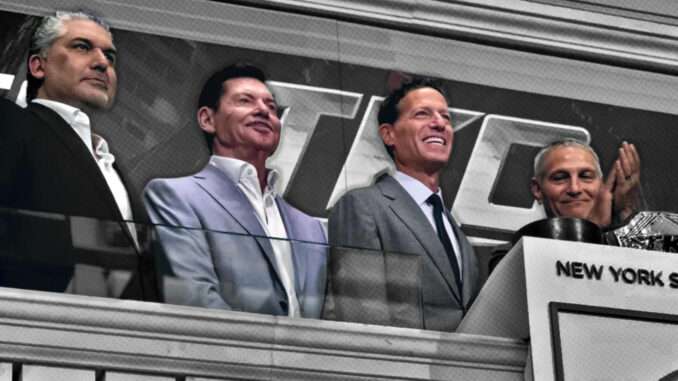
Ari Emanuel — the Endeavor and now TKO top executive who combined UFC and WWE — claimed in 2023 that he would’ve “body-slammed” Vince McMahon if he hadn’t joined the merged company after the transaction. WWE’s filings with the Securities and Exchange Commission seemed to corroborate that Endeavor insisted on keeping McMahon. But Emanuel’s number-two, Mark Shapiro, contradicted that story under oath more recently.
WWE’s S-4 filing with the SEC told the public and investors a detailed narrative: Endeavor so coveted McMahon that the talent agency that owned UFC conditioned giving WWE six extra percentage points of the combined company — worth approximately $1 billion in enterprise value — on McMahon receiving a lifetime appointment as Executive Chairman, board nomination rights, and veto power over certain transactions.
Just after the $21 billion deal was signed, WWE wrote in that regulatory filing that Endeavor — and presumably its CEO Ari Emanuel — held the belief that McMahon’s continued leadership “would be critical to the value creation driving Endeavor’s desire to engage in the Potential Transaction.” The filing further stated that McMahon “had not, and was not, requesting or proposing such rights.” According to WWE’s narrative, guaranteeing McMahon’s continued role was key to Endeavor agreeing to raise WWE’s split of the combined company from 43% to 49%.
However, when Shapiro was asked in a deposition this past December whether he personally viewed McMahon remaining in the Executive Chair role as a necessary condition for the success of the combined company, Shapiro agreed he did not see it as necessary.
“You personally didn’t view Vince being in the executive chair role as a necessary condition for the future success of the combined company; right?” an attorney for the plaintiffs asked Shapiro.
“Correct, especially with all the baggage,” Shapiro said.
“But at the end of the day, Vince is [sic] remaining with the company was a Vince goal, not an Endeavor goal; right?” the examining attorney followed up.
“Wasn’t a goal of ours, no, no, it was not,” Shapiro responded.
The plaintiffs’ attorney conducting the deposition, Edward Timlin, also alluded to a discussion in the Shapiro deposition that McMahon was interested in being CEO of the new company, which didn’t happen.
Shapiro and Emanuel now serve as the top two executives for TKO, overseeing WWE and UFC.
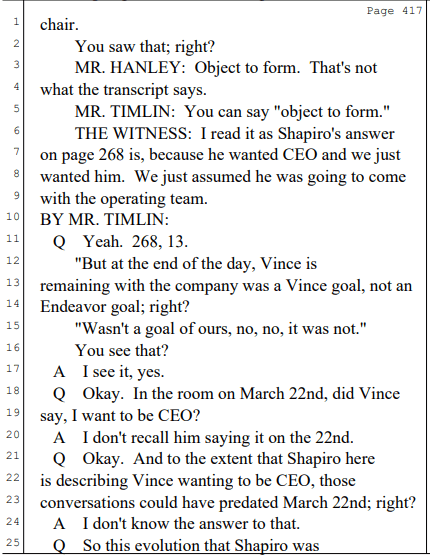
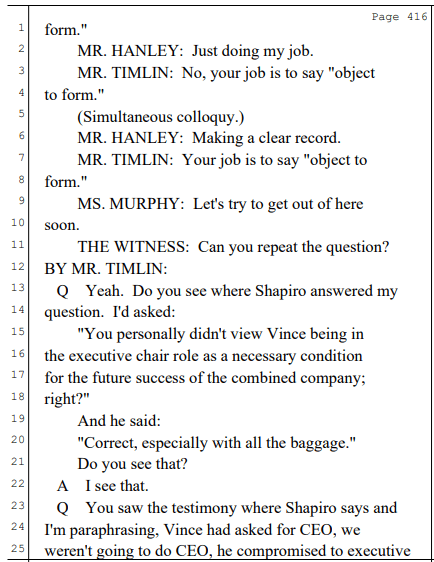
Above: Transcript pages from the deposition of Nick Khan as part of the WWE merger shareholder lawsuit. “THE WITNESS” and “A” indicate Khan’s responses. “Q” indicates questions from plaintiffs’ attorney Edward Timlin. “Mr. Hanley” refers to Brandon Hanley, an attorney for Vince McMahon, who is represented separately from the rest of the defendants.
That testimony is part of the ongoing Delaware Court of Chancery shareholder litigation arising from the merger, and was read into the record during the deposition of WWE President Nick Khan, also in December. The lawsuit alleges that McMahon predetermined a deal with Endeavor to assure his position in the new company, rather than pursuing a more competitive process that might have run up the bid price for WWE. The defendants — who are McMahon and other WWE board members, Khan, Paul Levesque, George Barrios, and Michelle Wilson — have denied the central allegations of the suit.
Testimony from Shapiro results in a conflicting public record. Both sides of the transaction that created TKO seemingly disclaim responsibility for the governance structure that resulted in McMahon’s guaranteed role as Executive Chairman.
WWE’s filing described how Endeavor went from offering WWE 43% of the merged company to 49%, as told to the WWE board by its legal and financial advisors who were involved in negotiations. The filing stated:
Endeavor had conditioned the proposed increase in valuation upon Mr. McMahon serving as Executive Chair of the newly formed public company until his death, resignation or incapacity, having the right to nominate the five WWE representatives to serve among the 11 total directors on the newly formed public company board of directors and having a veto right over certain transactions, in each case until he sold down a to-be-agreed percentage of his equity or he no longer served as Executive Chair. The WWE advisors discussed with the WWE Board that Endeavor had stated that these governance changes were fundamental to Endeavor’s thesis for pursuing the potential transaction in light of, among other things, Endeavor’s belief that Mr. McMahon’s continued leadership as contemplated by the March 23 Endeavor Proposal would be critical to the value creation driving Endeavor’s desire to engage in the Potential Transaction.
Ann Lipton, a professor of corporate and securities law at the University of Colorado, said the testimony points toward a specific legal theory.
“The issue here is if McMahon really was believed to add value, or whether he insisted on remaining as a condition of the deal,” Lipton told POST Wrestling by email, while noting she wasn’t familiar with the case itself before our inquiry. “If the latter, it could be construed as functionally a payoff to him personally to get him to agree to sell. That means that WWE shareholders could claim that they received less for their shares than they might have otherwise — maybe he’d have fought for a higher payout to shareholders if he wasn’t negotiating for himself.”
That theory is at the center of what WWE shareholders are already litigating. McMahon had returned to WWE just three months before the deal was agreed to. He unilaterally returned to the WWE board after resigning in the summer of 2022 amid multiple allegations of sexual misconduct. At the time, he held approximately 81% of WWE’s voting power and delivered the written stockholder consent that approved the transaction. At the time of the strategic review, there was significant public skepticism that McMahon was using the M&A process to entrench himself.
Representatives for WWE and TKO did not respond to a request for comment from POST Wrestling for this story. Vince McMahon’s representatives also did not return an inquiry.
On the morning the deal was announced in April 2023, Ari Emanuel appeared on CNBC alongside McMahon and was emphatic about keeping McMahon. Asked whether he had wanted McMahon to stay, Emanuel said: “Oh my god, yes, oh my god.” He added that he “would have body-slammed” McMahon if he had tried to leave. That interview was not under oath, though; a transcript of the television appearance was important enough to also be filed by Endeavor with the SEC.
Emanuel and McMahon were also deposed as part of the lawsuit. What they may have said about this subject, however, isn’t currently public.
The related dialogue that aired on CNBC on April 3, 2023, was the following:
Ari: …I would have body-slammed him if he [Vince McMahon] thought he was going to leave, because as I said to you before, here’s a man who has seen around the corners at every beat over the last 40 years of this business and has a vision for where this business, way before a lot of people see it. Him now being able to utilize what we have built in our flywheel, I’m the luckiest guy in the world, because I got Vince McMahon, a visionary, that sees around corners. I got Dana White, and what we’ve built, that is pretty unstoppable.
Scott: So, you wanted him to stay?
Ari: Oh my god yes, oh my god.
Scott [Wapner of CNBC]: Did he have to convince you to stay?
Vince: Not that much. I love what I do, I love building WWE. All my life is my passion, and to have an opportunity to have it grow like this in an exponential standpoint, can’t be better than that.
Scott: It’s an interesting plot twist, because not a lot of people saw this coming in fact, your own CEO, Nick Khan, told our David Faber just back in February, “Vince has to declare to the board, to me, to other upper management, he is 100% open to a transaction where he’s not included in the company moving forward.”
Vince: Sure.
Scott: You were ready to walk away?
Vince: Absolutely.
Ari: I wasn’t going to let him. And let me tell you, we have a relationship for 23 years. There’s a trust. There’s a friendship. When you’re going into business and going forward, I think that’s important I’m glad he chose us, because it was a very competitive situation. But for us, it’s an honor and also, we’re so lucky because of his vision about where the business is and where it’s going.
Despite his lifetime role with TKO, McMahon later resigned in January 2024, just after former employee Janel Grant filed a federal sex trafficking lawsuit against him and WWE. That case is ongoing, and McMahon denies the allegations against him in that case as well.
As a result of the merger, McMahon gave up his controlling position, which would prevent him from making a unilateral return to WWE in the manner he did in January 2023.
Lipton also noted potential implications under the federal securities laws if the S-4 was misleading, though she observed that the current litigation is based on Delaware rather than federal claims.
Under Delaware law, McMahon’s voting control means that in a lawsuit, if this case reaches a trial, the WWE transaction may be subject to an entire fairness review — a higher standard that puts the burden on the defendants to prove both a fair process and a fair price.
The merger lawsuit is scheduled to go to trial in June.
