
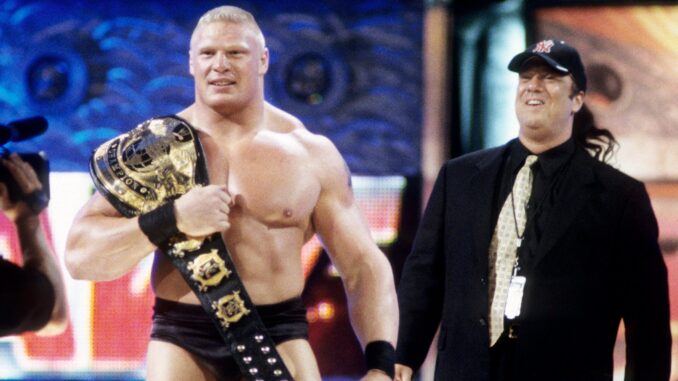

It was the summer of 2002, and WWE was in its most vulnerable state since its resurgence in the Attitude Era.
You can insert whatever cliché, but if WWE was a sports franchise, it was coming off a losing season and reliant on draft picks to build its future. But as always, patience for those picks to mature and become difference makers was required and easily mortgaged for the quick fix.
In the wake of Steve Austin’s exit in June, a short-term injury to Triple H, a limited run by The Rock, the addition of blue-chip prospect Brock Lesnar, and a nascent brand split, WWE somehow got the summer of 2002 so right.
In early 2002, the “future” of WWE certainly didn’t feel like a priority; in fact, the opposite. Skeptics questioned the decision to hire Hulk Hogan, Scott Hall, and Kevin Nash and turn back the clock. Hall would flame out spectacularly, fired within three months as part of incidents on the May 2002 plane excursion from Europe. Nash blew out his quadriceps in July and would be out for the rest of the year.
However, Hogan, on his best behavior, put forth one of his most memorable performances with The Rock, with enough momentum for Vince McMahon to blow up plans and give him a championship title run. It was the lone blemish of an otherwise surprisingly well-booked period for Hogan. Placing the title on Hogan at 48 was too much. It dragged the main event scene down and was quickly taken off him. Then, Hogan engaged in a program with Kurt Angle and put him over clean, teamed with Edge for a fun tag detour, and then put his real estate into establishing Brock Lesnar as the new monster in the company and setting the table for SummerSlam.
But monumental change was afoot. At WrestleMania, Vince McMahon had the three biggest stars of his promotional career at his disposal: Austin, Rock, and Hogan. All three would be leaving throughout the year, and building new stars was imperative, but unforeseen circumstances forced the company to exercise discipline.
All are aware of Austin’s departure, a scenario brewing for months with breadcrumbs left scattered after a disappearance post-WrestleMania, quickly resolved, and he was back two weeks later. The leader of the company’s surge, taking its programming to ratings nirvana, a merchandise juggernaut, and leading WWE into a publicly traded entity, there was a lot that Austin could rightly take credit for. For the first time since 1996, he felt like just another name on the card at WrestleMania in a mild and skippable match with Scott Hall. The wares of his 2001 output were coming due with aggravating neck and knee problems amid a creative malaise and Austin’s reputation as one of its most demanding performers in that era.
It exploded on a memorable interview on the WWE web show “Byte This”, lambasting the creative as “piss poor” and opting to play a game of chicken with the powers that be and see who would blink first. In advance of a June 10 episode of Raw, he was programmed to lose a King of the Ring qualifying match against Brock Lesnar in a baffling booking decision. Austin, rightly, questioned why he would be losing to Lesnar in a throwaway match on television when, properly promoted, he could headline any pay-per-view that year and be the crowning achievement of Lesnar’s rookie run. It was a power play, and Austin would not acquiesce and forced fans to endure the painful metaphor that he “took his ball and went home.”
McMahon hit the panic button, abruptly killing the dueling General Manager story and beating Ric Flair on television to relegate the legend to becoming just another active wrestler and McMahon temporarily running Raw and SmackDown. A month later, Eric Bischoff and Stephanie McMahon were installed to revive the brand versus brand story.
Austin was out of the picture. Triple H would need surgery after June’s King of the Ring event, and Hogan would go on sabbatical after putting over Lesnar in August.
The table was looking bare and, in the interest of desperation, placed all chips on the broad shoulders of Lesnar as their chosen pick for main event status. Thus, “The Summer of Brock” was put into motion.
It cannot be overstated how these circumstances forced WWE’s hand. It is always easy to run a pat hand when things are “fine,” but the perceived floor was falling out underneath the company, and panic and desperation brought out its promotional strengths.
As recently as 1997, the WWF lost Bret Hart and Shawn Michaels within months of each other. It didn’t matter one iota and only cleared the deck for the inevitable ascent of Steve Austin and opened spots to be occupied by The Rock, Triple H, and Mick Foley, with the previous star’s exodus providing room for fresh blood. It was similar in 2002, with Austin gone for the foreseeable future, The Rock’s full-time availability evaporating as Hollywood came calling, and an injury-riddled Triple H creating a lane for a new star.
One could choose to make a laundry list of criticisms that Lesnar was not ready for the spot. He was exceptionally green after his March 2002 debut. He could not cut a promo, and “hadn’t paid his dues”. None of this mattered because they needed a star. He was booked on live events, worked against talent above his experience level, and the difference in his performances from June to October was staggering. He was paired with Paul Heyman, creating a career-long allegiance both in front and behind the camera, and with this full-throated promotional effort, the holes in his game slowly evaporated, and by August 25, 2002, they had their star.
Lesnar ran through the King of the Ring tournament, disposing of Rob Van Dam in a forgettable finale on June 23 but came back a month later with a stronger rematch. They instituted the stipulation that the KOTR winner would headline SummerSlam for the championship, thus providing an eight-week promotional build around Lesnar and was the featured promotion of the summer. His dance partner for the big August pay-per-view would be The Rock – back several weeks earlier than expected due to Austin’s leave.
It was a marquee main event for the promotion’s third largest pay-per-view on the calendar and required the efforts of many, but none larger than the stars of WrestleMania that year, The Rock and Hogan.
Both would put Lesnar over clean within the span of three weeks. The August 8 episode of SmackDown was a memorable showdown as a bloodied Hogan succumbed to the 25-year-old phenom as the bloody ‘80s icon was ragdolled and fell to a bear hug of all maneuvers, providing Lesnar with another tool to his limited war chest.
Hogan was a forgotten portion of this summer build-up for Lesnar, but he was consequential, and regardless of his motives (a pitch to avenge his loss and beat Lesnar later that year, which was denied), he did business and capped off a surprisingly excellent six-month return.
The pathway for the incoming star was molded by Hogan but cemented by Rock at SummerSlam. In front of an anti-Rock crowd at the Nassau Coliseum, Rock put Lesnar over in the utmost fashion by allowing a Rock Bottom kickout, having his signature People’s Elbow thwarted, and succumbing to the F-5 as the audience roared in approval, witnessing the coronation.
SummerSlam became one of the most celebrated events of the era for WWE audiences and the proper mix of nostalgia through Shawn Michaels, but the dominating message was that Brock Lesnar had arrived. It threw out the notion that creating a star somehow required a multi-year arduous process. Lesnar was champion six months after his main roster debut and would have a career-defining performance in October in a Hell in a Cell match with The Undertaker and headlining WrestleMania a year after his call-up.
Viewed inside a vacuum, this was a disciplined company, understanding of its plight and subscribing to a belief that creating new stars was paramount to success. Things are never that easy, and when immediate results were not discovered, the impatience forced its hand. It encapsulated WWE’s reactionary tendencies to week-to-week television numbers because of their immediacy compared to measured assessments over a longer sample period to see if a star is getting over beyond the whims of a quarter-hour pattern or one-week anomaly. This, at a time when television revenue was a minuscule amount of its overall revenue, with a heavy reliance on pay-per-view and tickets sold.
One week after SummerSlam, the Undisputed Championship bestowed on Lesnar was fractured through the creation of a World Heavyweight Championship handed off to Triple H and watering down Lesnar’s version. The evolution from the Attitude Era to WWE’s new phase took a U-Turn through Hot Lesbian Action and necrophilia on Raw as WWE became desperate for a reaction, even a negative one.
Vince McMahon returned to TV as a prominent character in early 2003 and became a focal point of WrestleMania opposite a returning Hulk Hogan and the reintroduction of Roddy Piper to anchor SmackDown programming. The future was now competing with the past as WWE wanted its new boom period now. It was going to get much worse before it got better, as 2003 & 2004 would be painful years full of unrealized potential and stars failing to break through.
In the summer of 2002, WWE got it so right, but SummerSlam was a snapshot rather than a turning point.
WWE SummerSlam 2002 is the subject of Rewind-A-Wai #218 with John Pollock & Wai Ting
