
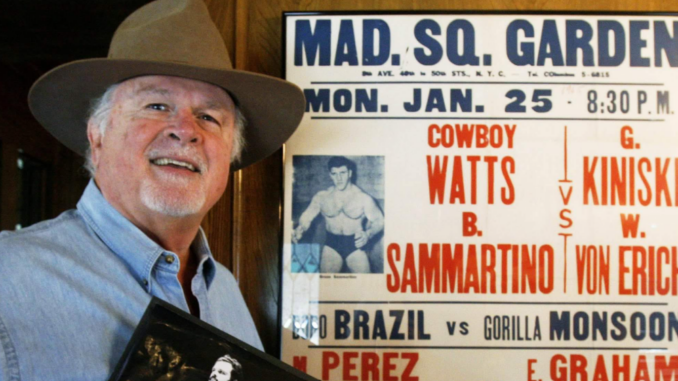

Part 1 of The Life & Career of “Cowboy” Bill Watts
The summer of 1984 saw a battlefield forming across the United States where the winners would require market share, talent, and distribution.
Vince McMahon, 40, was expanding his father’s Northeast region through television deals across the country with varying degrees of success in those markets. In many, he was paying, sometimes outbidding the existing promoter, for his programming to gain clearance. It was a hefty bill that was accumulating with no guarantee of a return on investment. By the end of 1984, they were in nearly 100 markets, ranging from barter agreements to spending six figures on some deals.
This included a slot on WNOL in New Orleans for its newly launched Superstars of Wrestling program and a shot toward Mid-South Wrestling that every region of the country was on McMahon’s radar. But a trend was forming that the regions with the most entrenched promotions were the toughest areas for McMahon to penetrate.
McMahon was assembling a war chest of talent, signing away top stars from various territories and using them to lure the fanbase over. There was no bigger “get” in the Mid-South territory than 31-year-old Sylvester Ritter, a.k.a. Junkyard Dog, the star of the region.
The JYD had built Mid-South and the Louisiana Superdome on his back as a cultural touchstone. He was embedded within the culture as a representative to Black audiences of an aspirational figure. It was an era when Bill Watts was cultivating a multi-generational attachment to the territory, one that is still romanticized today. The idea of a Black star and a Black booker in Ernie Ladd spoke volumes in 1984 and even louder today when there are fewer examples of Black representation in booking and writing capacities. It makes this era more complex when unraveling the words and beliefs of Bill Watts that have served as an albatross on his legacy when he was such a champion of Black representation.
Off the success of the Last Stampede series, where Watts and Stagger Lee (JYD) drew phenomenal business with the Midnight Express and Jim Cornette, JYD was ready to jump to McMahon’s rocket ship. The iconic babyface left Watts without notice and dates he was advertised for, leaving a sour taste among those in the territory. A story shared by Dog with confidants over the years makes it more believable that he didn’t feel any loyalty to Watts despite their business magic.
As shared by Teddy Long in a 2023 episode of Dark Side of the Ring, Ritter’s account was that he was in a bathroom stall overhearing Watts with right-hand man Grizzly Smith and referred to Dog using the “n-word”; it’s a story that Ritter apparently shared with others but most prominently broadcast in the VICE TV special three years ago. Watts was contacted by the producers, who denied the story and called it “complete fiction”.
On August 1, Sylvester Ritter wrestled for the last time for Mid-South Wrestling at the Irish McNeil Boys Club, and nine days later, he was in the Kiel Auditorium and was positioned among the top babyfaces in the expanding World Wrestling Federation. By year’s end, Sgt. Slaughter left the WWF, and Ritter was arguably the #2 babyface behind Hulk Hogan.
However, signing Ritter wasn’t providing McMahon with the keys to the Mid-South territory. The WWF’s debut in Oklahoma occurred on November 29, 1984, with JYD returning to his stomping ground in the main event against Paul Orndorff and only drawing 1,500. It would be an exceptionally difficult task to knock out the incumbent promoter; even by June 1985, a Hulk Hogan vs. Big John Studd and JYD vs. Greg Valentine combo only managed 2,400. In September 1985, they entered Tulsa for the first time with 1,200 attending for a headliner between JYD and Terry Funk.
Watts wasn’t going to “sell” the loss of JYD on television. Instead, he minimized the loss, stating that the “pressure” imposed by rival Butch Reed forced JYD to “crack” and that JYD couldn’t hang with the competition. His words were one thing, his actions another. Watts was in search of his next Black superstar, with Reed among the attempts and joined by George Welles, Savannah Jack and The Snowman (Eddie Lee Crawford).
Business for Mid-South Wrestling grew in 1985 as the territory still possessed a loyal fanbase, a loaded roster of athletes and personalities, a strong syndication package, and a partnership with Fritz Von Erich in Tulsa and Oklahoma City, allowing access to the WCCW stars lasting until 1985.
The crown jewel was its weekly television, which was state-of-the-art. Beyond the athletic presentation that held up against any other territory was the dramatic episodic nature of the weekly program. Its guide was Bill Watts, not only as the show’s producer, but also calling the show alongside Boyd Pierce or Jim Ross. Watts was obsessed with the stories making sense and going to great lengths to explain minute details that even the world’s largest skeptic of pro wrestling could accept.
Mid-South Wrestling was cultivating the use of music videos in its presentation through the work of Bill’s son, Joel, and television director Bob Von Gyurcsy.
After JYD’s exit, they returned to the Louisiana Superdome on November 22, attracting 14,000 fans and a gate of $104,000, for Magnum T.A. challenging Ernie Ladd for the North American title, The Rock ‘N’ Roll Express vs. The Midnight Express, and Jim Duggan & Butch Reed vs. Ted DiBiase & “Dr. Death” Steve Williams. They ran the stadium four times in 1985, with attendance staying strong in a range of 9,500 to approximately 16,000 in August and November.
One of McMahon’s larger moves in 1984 was acquiring majority control of Georgia Championship Wrestling and its two prime slots on WTBS, allowing McMahon to have national attention on his product across the Superstation, USA Network, his expanding syndication package, MTV specials, and soon add NBC in the forthcoming year. McMahon’s $750,000 for a controlling interest through the stock of Jack & Jerry Brisco, Jim Oates, and Paul Jones did not provide McMahon with exclusivity. Fans feeling “betrayed” by its loss of the Georgia Championship Wrestling product they were accustomed to received a bonus wrestling program with the creation of Championship Wrestling from Georgia being added to the Superstation.
It didn’t stop there, as Watts was able to curry enough interest for his own slot on WTBS on Sunday nights as a lead-in for McMahon’s Championship Wrestling. It silenced any doubt about the national appeal of Watts’ product, as it immediately generated audience engagement when launching in March 1985 and averaging a 5.3 rating over thirteen weeks. The level of commitment by Turner toward Watts’ product has been debated. Watts has maintained that Turner gave them a verbal agreement that he was going to get behind the promotion for a national expansion and become the marquee wrestling product on the station and would cancel his programming with McMahon.
In 2015, Jim Ross spoke with David Bixenspan about his understanding of the arrangement in Fighting Spirit Magazine: “I think that there was a verbal agreement made,” Jim Ross recalled to FSM. “And I think at the end of the day, the bottom line is that Turner and his administrative people went back on their word; they changed their mind. Ted was, I guess, convinced it was a conflict of interest to do this. There was an agreement made in principle, and before contracts could be put to paper, the change of mind occurred.”
The marriage between Turner and McMahon had soured, and it made plenty of sense that Turner would rather be in business with Watts and replace one with the other. However, McMahon still had his agreement in place, and the wild card was Jim Barnett getting interest from Jim Crockett regarding purchasing McMahon’s time slots. Crockett was intrigued and willing to front $1 million for the Saturday & Sunday slots. It allowed McMahon a face-saving business move rather than being cancelled, and came when the WWF needed an infusion of cash preparing for WrestleMania 1 and would make a nice $250,000 profit on the original deal. Crockett was wise enough to demand exclusivity and left Watts as the odd man out, and his programming ceased in May 1985 on the WTBS.
How history would have differed if Watts got the national boost from Turner, instead of Crockett, is a question mark. Mid South Wrestling was still going to go down, and exposure on WTBS probably doesn’t change that significantly. Perhaps Turner buys them in 1987, and it’s Crockett that goes out of business that year, instead of the other way around. It’s unanswerable, but Watts needed a “Plan B,” and going national became imperative. The question in 1986 was whether it was too late.
The real national expansion for Mid-South begins in early 1986 and comes with a transformation into the Universal Wrestling Federation (UWF), moving out of the Irish McNeil Boys Club to the Tulsa Convention Center, and eyeing outside markets to tour.
The expansion also brought in new booker Ken Mantell, who left World Class and lured The Freebirds, Chris Adams, Iceman King Parsons, Sunshine, John Tatum, and Missy Hyatt to join. It created a major rift with Fritz Von Erich, who was seeing Mantell and talent exit for the expanding UWF, Watts opening an office in Dallas, and concern that Watts was after his territory as his next conquest. Watts would go a step further, beginning bi-weekly shows at the Cowtown Coliseum in Fort Worth, Texas, and getting clearance to air its television on KTVT, which was the home of World Class’ programming. This complemented a partnership that Watts already had in Houston with Paul Boesch.
There were three Superdome cards in 1986, including the combined effort with Jim Crockett Promotions presenting the Crockett Cup and follow-ups with Bill Watts, Dusty Rhodes & Dr. Death facing The Russians after the heels had buried Watts underneath its flag, and a Thanksgiving card promoted around Dr. Death and Michael Hayes in a steel cage.
The foundation of the promotion appeared strong from the outside given the expanding syndication network it constructed, a strong talent roster, and the logical booking. As Bixenspan noted in his Fighting Spirit Magazine article, the UWF syndication network consisted of more than 78 markets with an average rating of 4.53 and 16.6 share.
But it was a case of “too little and too late” because the world was changing and Vince McMahon was dictating the direction. The territories were slowly withering away, and 1984 felt like a lifetime ago. Despite strong television ratings in outside markets, the company didn’t reap those successes when touring. The financial crunch was seen firsthand when Jim Duggan and The Fantastics opted to exit in early 1987.
A major oil collapse expedited the fall in 1986 as the cost of oil dropped to around $10 per barrel (down from a peak of $35 in 1980) and the Mid-South region was dramatically affected. Watts often cites it, but it ignores other signs in the territory, including declining television numbers, which wouldn’t be a byproduct of the oil crash.
The final Watts-promoted Superdome show on April 11, 1987, managed a meager 3,000 fans showing up. It would be more than a decade before a promotion drew at the venue and took a WrestleMania in 2014 to break the attendance and gate record set by JYD and Michael Hayes in 1980.
The fate of the UWF was not looking pretty, but the company put on a strong face to the public and to those within the company. Quietly, Jim Ross had Watts’ blessing to explore a sale to Jim Crockett, and a deal was agreed upon amid massive weekly losses the company was eating. Crockett, seeing the value of a strong syndication network between both promotions, agreed to a $4 million price tag. It was a blow to the industry and to those within the UWF as the race for wrestling supremacy had just lost another major player.
The Charlotte Observer outlined Crockett’s plans with the purchase, establishing “The Wrestling Network” for syndication. “The acquisition of Mid-South Sports Inc. of Bixby, Okla. [by Jim Crockett Promotions] is a key factor in understanding the firm’s national stature. Announced earlier this month, the Mid-South acquisition added 98 stations to Crockett’s stable of TV stations carrying one or more of the half dozen hour-long wrestling programs he now controls. The combined operation has been dubbed The Wrestling Network and will appear on 227 stations”.
Like that, Watts was out of the business. He was only paid a fraction of the agreed price but never had any negativity espoused publicly toward Crockett. It would be less than two years before Crockett himself faced a similar conflict and had to sell to Turner Broadcasting.
Jim Ross was instrumental in the sale and landed on his feet with a prominent spot at Jim Crockett Promotions; his son, Joel Watts, would strike a deal to join McMahon, and the UWF would be integrated into JCP programming. It was a squandered opportunity,y as the UWF talents were immediately diminished and treated as opening acts to the real stars. The legacy of the sale rests in the fact that it shut down a major promotional office and served as a bridge for Sting to enter JCP/WCW and become its franchise player.
Watts left the scene with a halo effect, similar to Paul Heyman in 2001 when the collapse of their promotions was not held against their creative genius and often touted by fans and analysts as the “savior” for a struggling company. In late 1988, Dusty Rhodes and the new Turner ownership mixed like oil and water, with Jim Herd installed to oversee the new entity. Many thought Watts would be a perfect replacement for Rhodes, but instead, Herd went after Blackjack Mulligan and quickly pivoted to George Scott. Watts booking WCW in 1989 is one of those interesting “what if?” scenarios,s but Watts’ ability to assimilate into a corporate culture at Turner seemed like a tough pill to swallow.
In the spring of 1992, after WCW had gone through Herd and Kip Frey, they extended the offer to Watts and, at 53, he entered WCW as its new Executive Vice President. He was tasked with a mandate of slashing costs. It was a bumpy ride for many of the talents that were sent into a time machine with rules and regulations on who you could travel with, when you could leave the arena, what you could do in your match, what you couldn’t, and instead of moving forward, it felt like going back to what worked in a different era. It wasn’t 1984, and famously, Dave Meltzer has shared his experience speaking with Watts for two hours on the phone the day he was hired and seeing that five years away from the business may as well be a lifetime, and his pulse was not on the industry like it once was.
Watts analyzed the books and was stunned to see Paul Heyman making $250,000 per year as manager and Brian Pillman at $225,000. In the case of Pillman, he offered him a big push if he accepted the lesser amount of $156,000, but the former football player balked. Watts and Heyman had a contentious relationship, as Heyman later shared an account of their introductory meeting where Watts made an antisemitic remark.
Watts didn’t have a magic wand as pay-per-view buys, TV ratings, and attendance depleted under his eight-month stay. Some promising signings were made, but 1992 was not a great year for WCW beyond Watts bragging right that he dramatically reduced costs as he was hired for. He brought in Chris Benoit, Rob Van Dam, and 2 Cold Scorpio, added Smokey Mountain Wrestling as a developmental territory, and put the Hollywood Blonds of Steve Austin & Brian Pillman together.
In early 1993, he was negotiating for Ric Flair’s return as his time as a top player in the WWF was wrapping up, but Watts would not be there for Flair’s return.
The Torch Talk Interview of 1991
It’s the portion of Watts’ legacy that is the toughest for his supporters to stomach and grapple with. A summer 1991 interview with Wade Keller spread out over two issues of the Pro Wrestling Torch with an additional portion saved for its Summer Annual issue.
If you want a business and you put money in, why shouldn’t you be able to discriminate? It’s your business.
That’s why I went into business, so that I could discriminate.
I can’t tell a f** to get the fuck out. I should have the right to not associate with a f** if I don’t want to. I mean, why should I have to hire a fuckin’ f**, if I don’t like f**s? F**s discriminate against us, don’t they? Sure they do.
Who’s killed more blacks than anyone? The fuckin’ blacks. But they want to blame that bullshit Roots that came on the air. That Roots was so bullshit. All you have to do if you want slaves is to hand beads to the chiefs, and they gave you slaves. What is the best thing that has ever happened to the black race? That they were brought to this country. No matter how they got here. You know why? Because they intermarried and got educated. They’re the ones running the black race.
Lester Maddox was right. If I don’t want to sell fried chicken to blacks, I shouldn’t have to. It’s my restaurant. Hell, at least I respect him for his stand.
It was these paragraphs that followed Watts to his grave, and no amount of explaining, walking back, or past actions could eliminate the hatred spewed in this Torch Talk interview.
The question of whether Turner executives were aware of the interview remains open-ended. There was a belief that this same interview helped Watts land the job, as the bulk of the wrestling talk was earmarked for the regular issues (of which those in the front office were among its subscribers). Did they not read the Summer Annual? Did they not care?
After the interview, Wade Keller called Dave Meltzer and played the audio of the racist and homophobic remarks. It did not become a story in wrestling or anywhere else in 1991. Today, the quotes would have been front-and-center, and Watts would have been radioactive.
In 1993, a series of events led to the house of Watts crumbling down.
Cincinnati Reds owner Marge Schott was being sanctioned by Major League Baseball after her racist and antisemitic comments and views came to the forefront, leading to a $250,000 fine and a one-year suspension from day-to-day operations of her team. She remained owner of the Reds for six more years before selling her interest in the team. Hall of Famer Hank Aaron, working for Turner Broadcasting as a VP of Community Relations, spoke out about Schott and said that MLB wasn’t being hard enough on Schott. His public comments about Schott, while also appearing on a September 1992 edition of Clash of the Champions shaking hands with Watts, raised the ire of Torch columnist Mark Madden.
Madden couldn’t believe the hypocrisy of Aaron and assumed the baseball legend knew of Watts’ comments from 1991 and faxed the interview on February 9 to Aaron for a reaction to the double standard. To Madden’s surprise, Aaron wasn’t aware of the comments by Watts and was appalled, going to executive Terry McGuirk and setting in motion the exit of Watts from his executive post.
Watts would state that he was not fired by TBS but chose to resign. Before the issue over the Torch, TBS was already losing faith in Watts, and his power was being reduced.
From the Pro Wrestling Torch one week before Watts was let go:
Bill Watts’s power in WCW was significantly reduced last week, and Jim Ross was removed from his television announcing duties among several other changes in WCW’s front office. A meeting Friday, Jan. 29 with WCW management, including Bob Dhue, Bill Shaw, and Bill Watts, led to Watts being dismissed from his position of total control over WCW. Sources say initially the meeting was to inform Watts of his dismissal entirely. Low ratings, low attendance, and low buy rates, along with overall discontent with Watts’s style of running WCW,
apparently led to the decision to make major changes. Ross’s situation is less clear, although according to sources close to the situation, Watts was negative toward Ross during his meetings with Dhue and Shaw, and combined with a bad review for Ross by a consulting firm hired by WCW, the decision was made to go with a new look.
If it wasn’t Mark Madden, the Torch interview comments were still coming out, as the same newsletter reported that the Atlanta Journal-Constitution and New York Post were working on stories.
Watts would address the comments over the years, including in the 2006 book that he wrote with Scott Williams:
I was saying that I was against racism in the interview, and that if Lester Maddux felt strongly that he shouldn’t have to serve blacks, then at least I respected the stand he took by closing his restaurant instead of following the government’s equality laws. Did I agree with his politics or how he was doing his business? No! I never said his politics or his morals were ethical or right, because I was (and still am) against racism. The only respect I had for Lester Maddux was that he believed so strongly in his right to discriminate that, rather than bow to the legislature, he closed his business. His convictions were wrong, but at least he had convictions and believed in them. I just wished that his discrimination had cost him economically to the point where the market would have put him out of business instead of it having to be legislated into our culture. But, looking back, integration has been so important that I’m glad it was legislated – anything to get our cultural conscience to have to deal with it. I hate that our nation is at a point where we have to legislate against racism or to legislate morality. I believe in free enterprise and think that the market ought to determine what businesses do. If a businessman is abusing the market, then free enterprise ought to dictate that he goes out of business. Unfortunately, it doesn’t work that way. I’ve come to realize that we have to legislate morality. The laws against murder and theft are moral. We also have to legislate against racism. The funny thing about that interview was how people used it to make me out as a racist. I was the one guy in the wrestling business who had used black bookers and a black man as the top star in my territory. Heck, in wcw I promoted a black woman, Brenda, to the post of office manager, and not because of any racial consideration at all. I did it because she was sharp, the best one for the job. So I find it ironic that I could get a “racist” label after that, not to mention my history with my own company, MidSouth Sports. And I can’t even tell you that I’m 100 percent not a racist, because, unfortunately, I think everyone in America grows up learning to think racially.
Anything you don’t understand, you learn to fear. If you haven’t been around any black people, the first time you see them,m you’re going to be afraid because they “appear different.” The same thing’s true for a black person who grows up never seeing a white person. It’s inherent.
In 2009, Paul Heyman was interviewed by SLAM Wrestling and shared his first interaction with Watts in 1992 as :
“I’d never met Watts before,” Heyman recalled with a terse lip. “The first time I met him was when he became the head of WCW. We weren’t two minutes into our conversation when he asked me where my beanie was [referring in an offensive way to a yarmulke]. He then started comparing me to a manager back in the day called Izzy Slapowitz.”
Heyman half-laughed, “I could see we were really going to get along just great!”
According to Heyman, this was the first of numerous anti-Semitic remarks he had to endure while working for Watts.
“After a televised wrestling show, the ratings came in, and Watts was livid,” Heyman remembered. “This was during the storyline with Madusa [Miceli]. Our segment was the highest-rated segment of that program … and Watts says — in front of a room full of people — how pissed off it makes him that a Jew and a c— drew the highest rating of the show. He felt it was the downfall of the wrestling business.”
The comment about Heyman and Madusa didn’t line up with the ratings pattern of that Clash of the Champions show he was referencing. It was very close to a similar remark Watts made about falling PPV buys when interviewed by John Clark in the Wrestling Flyer after leaving WCW:
Well, the first two (pay-per-views) were already booked when I got there. The first one that was mine was Halloween Havoc, that did a 0.96. We did a great job on it. The reason they dropped after that was that we had such a shitty performance. But God almighty, you figure if you can market something and get it there, you could at least perform. All the main events didn’t perform. The match with The Steiners and Doc and Gordy was the shits, and Gordy didn’t show up. Jake and Sting was the shits. We were scared Jake wouldn’t even be at the show and didn’t know that Gordy wasn’t going to be there until the night before. The match with Rude and Chono was the shits. When Paul E. and Madusa can be the highlight of the show, you’re hurting.
It is hard for many to read these words from Watts and also hear these reflections on Ernie Ladd, which Watts had written for his WWE Hall of Fame speech in 2009:
Ernie (Ladd) later would impact my career and my life in such a huge way as we “became brothers in our connection with each other”…and also later in our faith…and when he died…I cried for 4 days…because Ernie taught me so much “about being black”…and the struggle blacks had…and how racism affected them…
“And years later in my company…Mid-South Sports…and the UWF…together…Ernie and I built some wonderful black stars…and he infused in me even deeper my hatred of racism – which I consider is something built by ignorance and fostered by ignorant people…and promoted by fear…and by NOT KNOWING the person…but labeling them – anyone – by the color of their skin is an abomination and later…I not only “broke the color line” in Louisiana who would NOT allow a black wrestler to wrestle a white wrestler with Tom Jones wrestling a white wrestler in Monroe, LA. in the early ’70’s…
“Years later I was able to guide Ron Simmons to become the first black World’s Champion of a major wrestling promotion at WCW…and of course to…guide the early career of the Junkyard Dog…who became my biggest star in Mid-South Wrestling…and I got to work with Thunderbolt Patterson…Rocky Johnson…Tony Atlas…Ray Candy…Koko B. Ware…Bad Leroy Brown…Tiger Conway, Sr. and Tiger Conway, Jr. and many other great black wrestlers…
Watts final role with a major company occurred in 1995 when he was hired by the World Wrestling Federation and groomed for a position as Vince McMahon’s right-hand man with the pending retirement of Pat Patterson. Watts arrived with assurances he would have “final say” on creative directions, with McMahon informing the locker room of that chain of command. It only took three months as Watts concluded, “There is only one Titan in Titan Sports,” and it wasn’t him.
Bret Hart remembers in his book, “It got back to me that Watts quit over Vince putting the belt on Shawn (the plan for the next year’s WrestleMania). He thought Shawn was too damn scrawny and that belt should stay with me. Vince brought Pat (Patterson) back to work with him on booking, but lessened his load by putting Jerry Brisco in charge of all the wrestlers.”
It is another interesting “what if?”: had Watts accepted a lieutenant role under McMahon and courted influence instead of mandating it. It is not an unreasonable outcome where Watts becomes a powerful figure during the Monday Night War and a key part of the creative staff.
Watts never worked again in professional wrestling, opting to go into various business endeavors over the years while remaining adjacent to the industry. He released his book in 2006, entered the WWE Hall of Fame in 2009, and did sporadic interviews and appearances.
We use the term “complicated,” and it minimizes the act of deconstructing a person at the most vulnerable time: their death. Watts was both a champion of Black figures within pro wrestling, yet possessed contemptible views that he was more than willing to volunteer in a public setting.
His homophobia isn’t even a debate, as he wrote in 1996, and edited for his website six years later, “They have created the term “homophobic“ to “type” those of us against their lifestyle. But, I do not “fear” them——as indicated by their terminology (phobia) and naming of us, I am just against their lifestyle, and do not “like them” or knowingly “socialize with them.”
Watts was aggressively open about his views and history in his website commentaries, including an encounter as a young man when he received oral sex: “In my youth, as I reached that age of puberty, and hormonal rages, and sexual exploration——and worse, even allowing myself to be gratified by this homosexual for financial reward—–as many of us “young athletes did as we were preyed upon by this influential and wealthy pervert in our youth——which does not in any way excuse me in this abomination”.
There isn’t a simple sentence or paragraph to summarize Bill Watts. For those to speak in his favor, you can draw on his business acumen and success across multiple territories and the lessons implemented from Eddie Graham and Roy Shire. Watts would say he never wanted to “fill a television program”; he wanted to “cram it” and never waste a second of the audience’s time. He was willing to learn and embraced the emerging coverage of newsletters, speaking with wrestling media, and absorbing constructive feedback. He championed so many Black performers and helped create a cultural icon in the Junkyard Dog and spent the rest of his career trying to recreate that magic. One can listen to Watts speak for hours on the business and come away further educated as he went on his lengthy monologues.
Watts was also a bully and indicative of a culture of torture and violence for those trying to break in. His views have been lambasted for decades, rightfully so. There is a reality to confront: the greater your success, popularity, and contribution to one’s fandom – the greater leeway that person will receive when assessing their sins. If Bill Watts had been a small-time promoter with minimal success, the comments made in 1991 would have sunk his memory and never been given a second thought. Because of Watts’ role in many fans’ formative memories and the talent he cultivated with a state-of-the-art wrestling program, he will have many defenders and those willing to “minimize” the bad and “maximize” the good.
Life isn’t so easy, and neither are legacies. For some, Watts represents a period in wrestling history they desperately want back. For many others, it’s a reminder of how far the business has evolved and never want those aspects to return.
When Bill Watts said that “funerals are for the living, not for the dead”, so are legacies. They are about the living trying to understand the dead.
Bill Watts came to grips with who he was; it’s time for us to do the same.
I wanted to extend a “thank you” to David Bixenspan for his incredible assistance on this story through various archival access covering Bill Watts and greatly enhancing this story
