
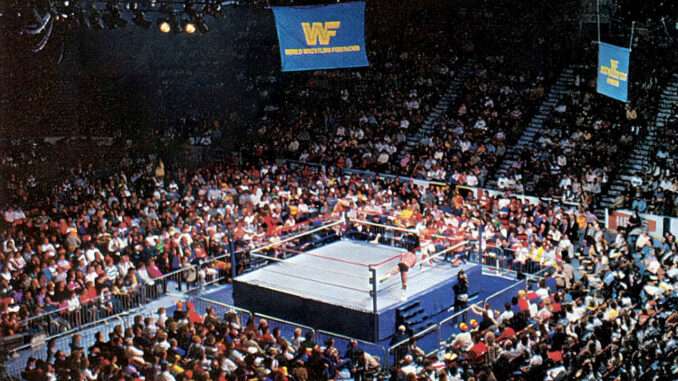
The men who allege they were sexually abused as children while working WWE events in the 1980s and early 1990s will continue to be known to the public under their “John Doe” pseudonyms, at least for now. Judge James K. Bredar ruled on Thursday, rejecting defendants Vince McMahon and U.S. Secretary of Education Linda McMahon’s efforts to require those plaintiffs to put their real names into the public record. WWE and TKO, which are also defendants in the case, had not taken a position on the ring boys’ motion to stay anonymous.
The judge found that while there is some risk for the defendants in allowing the plaintiffs to proceed anonymously, those risks are not great enough to outweigh the risk to the plaintiffs of having their identities known to the public.
The ruling, filed in federal court in Maryland, means the ring boys’ names will remain known to the defendants — to whom those identities have been disclosed since early on in the case — but unknown to the public through the pretrial phase. The anonymity issue may be litigated again just before the case goes to trial, should this case advance to that point.
The ring boys allege that when they were teens, they were sexually abused by former WWF ring announcer Mel Phillips after being recruited by him to help set up rings at wrestling events. One of the plaintiffs alleges he was sexually abused by then-WWF executive Pat Patterson. Both Phillips and Patterson are deceased. The McMahons and the company they formerly led are being sued for negligence. The plaintiffs allege the defendants knew or should have known the ring boys would be harmed.
Last December, seven of the eight ring boys’ allegations survived the defendants’ motions to dismiss the case early, sending the case into the discovery phase, where the sides collect evidence from one another and conduct depositions of witnesses.
The McMahons, who are maritally separated and represented by different attorneys, argued that allowing the plaintiffs to remain anonymous would be unfair. They said doing so would give the plaintiffs an unequal advantage in finding witnesses. They pointed out that the publicity around the lawsuit had already led to three additional former ring boys joining the case, while the defendants had no comparable ability to find witnesses who might help their defense.
Bredar acknowledged that finding witnesses with knowledge damaging to the plaintiffs’ cases might be harder to find, but in his eleven-page order, the judge determined that the disadvantage was less severe than the McMahons argued.
Courts in the Fourth Circuit, within which the U.S. District Court for the District of Maryland is organized, use a five-factor test for anonymity questions, which Bredar walked through in his order.
He found that the two factors that weighed most heavily were in favor of the plaintiffs. The subject matter of this case — allegations of childhood sexual abuse — “are particularly sensitive and personal even beyond other allegations of sexual abuse.” Secondly, the judge agreed that the plaintiffs would be at risk of significant harm if their names were known to the public. Bredar was persuaded by the ring boys’ attorneys’ assertion that “there is a significant risk of subjecting Plaintiffs to re-traumatization if they are forced to publicly reveal their identities, making them permanently available on the Internet.” Their attorneys stated that many of the people closest to these men have not even been informed of the childhood trauma they allege they were subjected to.
Vince McMahon’s attorneys had earlier asked for a series of specific conditions if the court allowed pseudonyms to continue. The judge directed the opposing parties to discuss and jointly submit a protective order within 30 days that accepts some of those conditions. To be included in that order is the allowance that the plaintiffs’ identities may be shared with witnesses and investigators without requiring those individuals to formally agree to the protective order’s terms, which Vince McMahon’s attorneys argued would otherwise present an unfeasible burden to their ability to build a defense.
Bredar, however, rejected Vince McMahon’s request to bar the plaintiffs and their attorneys from making public statements while the case plays out.
“Defendants complain that Plaintiffs themselves have generated some of [the widespread] media attention [this case has received], but the Court finds that this is not the sole explanation [for that attention],” the judge wrote. “Defendants are public figures, whose counsel, like Plaintiffs’ counsel, have made statements about the case to press, and the case relates to [quoting from the plaintiffs’ earlier filing] an ‘ongoing national conversation about sexual misconduct against minors and involving people with fame.'”
But Bredar noted that if the plaintiffs make statements that actually or effectively reveal their identities, they may lose their right to anonymity in the case.
He also made clear that any witnesses should only be given as much identifying information as that witness “reasonably needs to know” and that “disclosure shall never be made to the media or press.” The latter may be read as an explicit instruction that the defendants leaking any John Doe’s name to the press would be a violation of the order the judge is instructing them to submit within a month for his approval.
