
On Saturday night at the T-Mobile Arena in Las Vegas, Conor McGregor is due to walk to the Octagon for the first time in five years.
UFC 329, streaming on Paramount+ in the United States, matches him with Max Holloway in a welterweight rematch that comes almost exactly 13 years after McGregor outpointed a young Holloway in Boston when the two were featherweights.
McGregor turns 38 three days after the fight. He has not won a fight since he stopped Donald Cerrone in 40 seconds in January 2020, and he has not competed at all since breaking his leg against Dustin Poirier at UFC 264 in July 2021. However, none of that has troubled the American comeback machine.
Follow the story across the Atlantic, though, and it reads very differently. To American sports and celebrity media, McGregor remains a prodigal superstar: complicated, controversial, but fundamentally bankable.
In Ireland, the country whose flag he still drapes over his shoulders, the standard vocabulary of “bad boy celebrity” no longer covers him. Measured by polling, by politics, by the judgments of its courts and the decisions of retailers, he stands among the most thoroughly rejected public figures in the modern history of the state.
Five Years Away
It is worth being precise about why he has been away so long, because the promotional version tends to soften five years into a vague injury layoff. The broken leg accounts for the first stretch. A planned return against Michael Chandler in 2024 collapsed when McGregor withdrew, citing a toe injury.
Then the anti-doping system caught up with him. In October 2025, Combat Sports Anti-Doping suspended him for 18 months over three missed tests in 2024. The ban was reduced from 24 months for cooperation and backdated to September 20, 2024, making him eligible to compete again on March 20.
The timing mattered because McGregor had spent months circling the most political event in the promotion’s history: UFC Freedom 250, the June 14 card staged on the South Lawn of the White House as part of Donald Trump’s America 250 celebrations.
In the end, his absence from that show was a simple booking decision, not any distance from Trump World, which had opened its doors to him long before.
On St. Patrick’s Day 2025, McGregor was a guest at the White House, where he appeared in the press briefing room, posed with the president in the Oval Office and used the occasion to declare that an “illegal immigration racket” was ravaging Ireland. The Irish government rejected the remarks at once; Taoiseach Micheál Martin, Ireland’s prime minister, said they reflected neither the spirit of the holiday nor the views of the Irish people, and called them, simply, “wrong.”
The Verdict
American television, for its part, has kept its hand extended. On June 17, McGregor sat on the couch of ‘The Tonight Show’ while Jimmy Fallon reminisced about the two of them going out drinking after an earlier appearance. McGregor gave Fallon a cigar, and Fallon gave McGregor the one thing every troubled celebrity wants from late night, which is the appearance of normality.
The conversation never touched on the reason so many people in Ireland can no longer stand the sight of him.
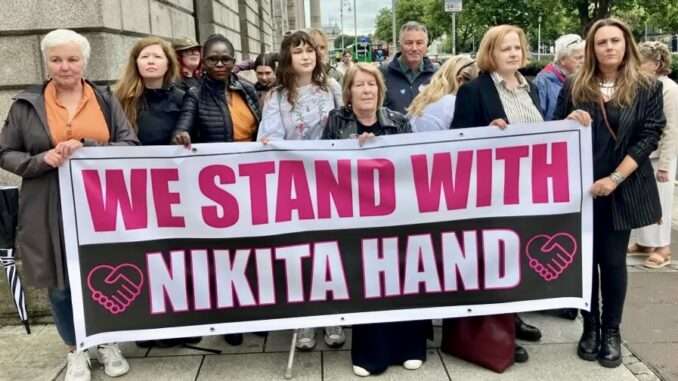
In November 2024, a civil jury at Ireland’s High Court found that McGregor had assaulted Nikita Hand, a Dublin hair colorist who alleged that he raped her at the city’s Beacon Hotel in December 2018, and awarded her €248,603.60 in damages. McGregor has denied the allegation throughout and maintains the encounter was consensual. Ireland’s Director of Public Prosecutions had earlier declined to bring criminal charges, citing difficulties in securing a conviction, which is why the case proceeded as a civil matter.
The testimony was harrowing. Hand told the court that McGregor pinned her down, choked her, and raped her. The Irish Times reported her evidence that a tampon lodged inside her body had to be removed with forceps, without anesthetic, at Dublin’s Rotunda Hospital the following day. The Journal’s account of the trial described extensive bruising and missing acrylic nails, and a paramedic who examined Hand testified that she had rarely seen bruising of such severity.
The verdict did not end the litigation. McGregor tried to overturn it, and in July 2025 Ireland’s Court of Appeal dismissed his appeal in its entirety. The judges were especially scathing about “fresh evidence” his side had introduced and then abandoned, awarding Hand costs at the highest level available and declaring that she had been completely vindicated. His public attacks on the verdict and on Hand’s testimony, the court added, deserved to be marked by its formal displeasure and disapproval. In December 2025, the Supreme Court refused to hear a further appeal, finding no issue of general public importance to justify one. Hand had won at trial, prevailed on appeal, and outlasted the final attempt to reopen the case.
That is the record American television has chosen to avoid. Hand publicly welcomed the criticism that greeted Fallon’s booking, including from the singer Pink, and the actress Christina Ricci amplified the objections. Nor was Fallon an isolated case. CBS Sports gave McGregor a standard comeback interview built around whether he had lost and rediscovered his love of fighting, and the online sportsbook 1xBet announced him as a global brand ambassador.
Ireland’s Answer
The answer at home has been of a different order, and it can be measured. The Hand case ran on front pages and led television bulletins for weeks. In April 2025, a poll for the Irish Independent found that just 7 percent of the public would vote for McGregor for president. His support has not evaporated altogether; a very small constituency remains for the anti-establishment, anti-immigration, anti-media pitch, and Ireland is not immune to those politics. It is, however, a constituency so small that it has no political representation at any meaningful level.
Irish commerce moved within days of the Nikita Hand decision. McGregor-linked brands were pulled from more than 1,000 outlets across Ireland. Tesco, Musgrave, BWG Foods and the Barry Group confirmed they would stop selling or distributing his alcohol lines, including Proper No. Twelve Whiskey and Forged Irish Stout, and Proximo Spirits, which owns the whiskey, said it would drop his name and likeness from its marketing.
The rejection reached even the places where he was once publicly adored. When Fred Durst saluted McGregor from the stage of a Limp Bizkit show at Dublin’s 3Arena in March 2025, the crowd booed.
Then there was the presidency. McGregor spent much of last year teasing a run for the office, a largely ceremonial post whose candidates must be nominated by 20 members of the Oireachtas, Ireland’s parliament, or by four local councils.
When Sky News surveyed parliamentarians on whether they would nominate him, all 134 who responded, from government and opposition alike, said no. The answers ranged from “not a hope in hell” to one politician’s description of him as a “tacky, moronic vulgarian.” Another representative was blunter still: “He’s a misogynist and a thug. On behalf of the women of Ireland he can fuck off.”
McGregor launched an online petition complaining that the nomination rules were undemocratic, then withdrew from the race in September, shortly before local councils were due to meet and reject his candidacy. The office he pretended to covet for a foreign audience went the following month to Catherine Connolly, who won it in a landslide.
The Politics
To understand how thoroughly McGregor burned his standing at home, go back to November 23, 2023, when Dublin was on edge after a knife attack outside a school on Parnell Square injured three children and a woman. As The Guardian reported, misinformation about the attacker spread within hours, far-right agitators mobilized, buses and a tram were set alight, shops were looted, and more than 400 police officers were deployed to restore order. The Garda Commissioner blamed a “lunatic, hooligan faction driven by far-right ideology.”
McGregor’s contribution to that atmosphere was direct enough that police examined his social media posts from the period, in which he attacked government policy on immigration and declared, “Ireland, we are at war.” He later said he did not condone the riots but that he understood the frustrations behind them and that change was needed.
To be clear, there is a small audience in Ireland for that message, but at the ballot box, it has amounted to nothing. In the general election of November 2024, held a year after the riots and days after the Hand verdict, far-right candidates failed to win a single seat in the Irish Parliament, the Dáil.
On the other side of the Atlantic, MAGA reads McGregor as speaking the movement’s language — contempt for institutions, grievance dressed up as patriotism, the belief that accountability equals a witch hunt — and so his anti-immigrant turn registers as courage, while a civil finding of sexual assault becomes an inconvenience or, more often, a subject to be completely ignored.
Saturday Night
None of this will be much of a factor on Saturday night. The arena will roar, the broadcast will be slick, and the promo packages will know exactly which images to run and which facts to leave outside the Octagon.
The record deserves restating anyway. Nikita Hand endured a seven-year legal ordeal and prevailed at every level available to her: a jury of ordinary Irish citizens believed her, the Court of Appeal vindicated her, and the Supreme Court ended the argument. Irish retailers cleared McGregor’s products from their shelves. Irish parliamentarians refused to put his name on a ballot. Irish voters have passed on the politics he tried to import from Trump’s America and sell back to them.
Plenty of American fans know exactly who they are watching; the backlash to the Fallon booking showed as much. But the organizations with the power to return McGregor to the mainstream have made their profit-and-loss calculations, and the machine has resumed its work with a promotion to book him, a network to host him, a sportsbook to pay him, and, come Saturday, an arena to cheer him.
In America, Saturday night is being sold as a comeback. In Ireland, the verdict came in long ago.
