
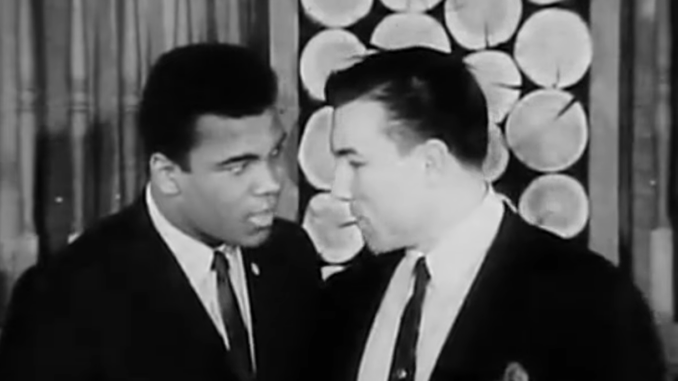
The life of Canadian boxing legend George Chuvalo ended on Saturday, and despite never wrestling professionally, he traveled a parallel path with several intersections between the industries.
Chuvalo died on his 89th birthday this past Saturday, ending a life that had celebratory highs and devastating lows that no individual should have to bear. He lost three of his sons to suicide and drugs, and his first wife took her life due to the grief it inflicted. For many, his life would be viewed as the ultimate tragedy, but somehow, the resiliency of Chuvalo was truly demonstrated by putting his life back together rather than his reputation of never being knocked down in 93 professional fights.
The cleanest link to professional wrestling occurred in Chuvalo’s early career, going pro in 1956 and winning a one-night tournament promoted by Frank Tunney and Deacon Allen in Toronto. In a head-shaking stat, Chuvalo fought and stopped four opponents in one night under the auspices of Tunney, who promoted boxing concurrently with professional wrestling but found greater success in the latter. Tunney’s biggest undertaking was as promoter of the famed March 1966 fight pitting Chuvalo against Muhammad Ali at Maple Leaf Gardens.
Ali had resisted service in the Vietnam War and declared himself a “conscientious objector”. He famously said, “Man, I ain’t got no quarrel with them Viet-cong,” and became public enemy number one and persona non grata in most states across the U.S. A scheduled fight with Ernie Terrell on March 29 was pulled by the state of Illinois when Attorney General William Clark argued that the fight violated state law. Commissions across the country were not interested in staging a fight with Ali, and Tunney took the risk and opened Toronto as a destination. However, Terrell wasn’t going to participate, and Chuvalo was the replacement.
It’s a famous fight in Canadian boxing history, with the legend of Chuvalo lasting fifteen rounds with the heavyweight champion and never going down. The fight is a direct adaptation of the first Rocky film, with Chuvalo in the role of Rocky Balboa and going the distance with Apollo Creed. Sensing Chuvalo’s inability to promote the fight with his mouth, Tunney enlisted Gene Kiniski as his mouthpiece, a similar strategy used years later when Freddie Blassie helped Antonio Inoki in the same role against Ali.
Throughout fight week, Ali held public workouts at Sully’s Gym, the same gym where Chuvalo trained. The gym was run by Earl Sullivan and often housed many professional wrestlers who mingled and trained with the area’s boxers under the banner, “It’s Better to Build Boys, Than to Mend Men”. It was a meeting point for Chuvalo and Sweet Daddy Siki. Later, Siki and Ron Hutchison would oversee the pro wrestling training at Sully’s and help develop future stars Adam Copeland, Christian Cage, Trish Stratus, and Tiger Ali Singh.
Chuvalo was among the top-ranked heavyweights in the world from 1963 through 1970, fighting the era’s best. The Canadian heavyweight fought Yvon Durrell in November 1959, Floyd Patterson in Feb. 1965, Joe Frazier in July 1967, Buster Mathis in Feb. 1969, Jerry Quarry in Dec. 1969, and a rematch with Ali shortly after returning from a 3 ½ year suspension in May 1972, going another twelve rounds.
His career ended after 1978, ending his 22-year career with a record of 73-18-2 and the haunting distinction of never being knocked down throughout his career, but obviously leaving a sizable portion of himself in those rings across the world.
In August 1996, the World Wrestling Federation staged its first show at the new Molson Center and promoted a “boxing fight” between Raymond Rougeau and Owen Hart. Rougeau had Chuvalo in his corner and after stopping Hart in the bout, Chuvalo got the requisite spot of arguing with Hart and decking him with a punch. Months later in January 1997, Chuvalo was on hand at Toronto’s SkyDome for a press conference to announce the WWF’s signing of Tiger Ali Singh in conjunction with a house show at the stadium.
The real damage was not incurred in those many fights but instead in personal tragedy that is only comparable to the story of the Adkisson/Von Erich family. Chuvalo and his first wife Lynne had five children, and three of them would die by 1996.
Son Jesse became addicted to heroin and took his life in 1985 at the young age of twenty.
George Chuvalo Jr. would follow his father’s pathway into boxing but was riddled with his own drug issues and found himself sentenced to prison, alongside brother Steven Chuvalo. The brothers were convicted of robbery and possession of weapons, with Steven sentenced to 14 months and George to 22 months.
George Jr. died of a heroin overdose in October 1993, and four days later, riddled with grief and depression, Lynne Chuvalo would take her life. Three years later, Steven overdosed and died.
Son Mitch Chuvalo and daughter Vanessa were the surviving children as George attempted to reassemble his shattered life in the mid ‘90s and the loss of four members of his family over eleven years.
Chuvalo opted to go public, engaging in speeches and tutorials as a warning about the dangers of drug abuse, and remarried right after, in January 1994, to Joanne O’Hara. Since 2017, Chuvalo’s health has significantly declined, as outlined by son Mitch on the Toronto Mike podcast. This was coupled with Chuvalo battling COVID during the pandemic and a nasty legal battle between Joanne and Chuvalo’s children regarding their father’s mental capacity.
In the interview, Mitch spoke of the concerns about boxing as an exploitative industry and understanding the price his father paid. While many celebrate his legendary toughness, it may have been that same toughness in the ring that altered the final years of his life, when he was largely bedridden and in a near state of “comatose”, according to Mitch.
Until getting sick, Chuvalo was a constant presence in the Toronto scene, often appearing at galas, fights, screenings, and serving as the local legend who fought some of the legends of the sport. In the Junction community, the George Chuvalo Community Center was named in his honor, and he has been awarded the Order of Canada, a spot on the Canadian Walk of Fame, and inducted into every conceivable sports Hall of Fame in the province and country.
Several notes from Muhammad Ali: His Life and Times by Thomas Hauser
