
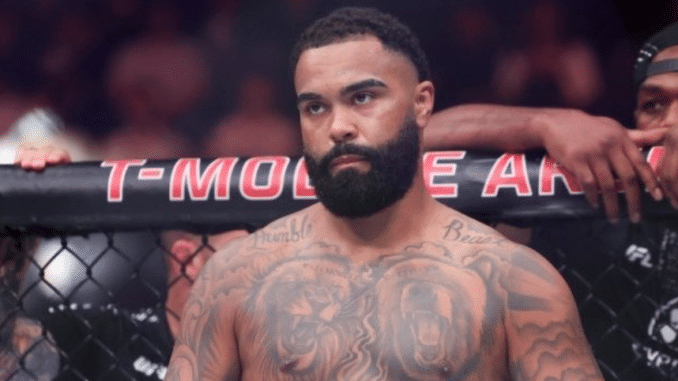
Did anyone have a worse week than Gable Steveson?
The 26-year-old Olympic gold medalist was expected to cruise to his second win inside the UFC against a less-than-threatening 4-2 heavyweight, who had two losses on his UFC resume. The elimination of a fight between Brian Ortega and Renato Moicano thrust the heavyweights onto the UFC 331 main card and thus, slots at Thursday’s press conference.
“Nobody likes a rapist. This guy raped a woman in 2019, and that’s why everyone is booing him. You can’t do that shit. That’s wrong”
– Sean Sharaf at the UFC 331 press conference last Thursday
It was on a dais with a rabid audience in Los Angeles where Sean Sharaf held Gable Steveson to account for his alleged sexual misconduct seven years prior. It was here that the audience watched in real time as the carefully presented image of Steveson unwound, at a loss for a defense, resorting to jokes, and promising to put Sharaf to sleep.
As much as the audience and media focused on the damning words by Sharaf, it was even more jarring what Steveson opted NOT to say. Such as, “That’s not true,” or mounting any type of response you would expect from someone accused of one of the vilest actions. It was not until days later that Steveson felt compelled to address the case from 2019 and put out a statement, denying what has been alleged.
Regardless of how it was aired in public, the dark cloud of 2019 hung over Steveson’s head in the hours leading into UFC 331.
But why now?
This is a seven-year-old story and is hardly surfacing for the first time. It was a non-story in advance of his UFC debut in July, when it felt as though the case was tucked away in the corner in a box that no one asks about or wants to know what is inside.
Then, the knockout. In a mere twelve seconds, Sean Sharaf pulled off the largest upset from an oddsmaker’s perspective in UFC history. The +1100 underdog landed a left hand that put Steveson to sleep as the greater public seemed to awaken to the realities of the allegations against him. With near uniformity, the MMA audience celebrated Sharaf’s win by exposing Steveson in a public setting, first with his words and then his fist.
If one had Gable Steveson in their stock portfolio, they could not sell quick enough after Saturday with little return for the heavy investment. Punctuating the humiliation was Steveson opting to exit the cage before Bruce Buffer could announce the result – a decision owned by Jon Jones, who stated it was his call to seek attention to a potentially concussed Steveson.
In a few short weeks, we have gone from the anointment of Steveson as the next heavyweight phenom to a possibly failed prospect that is not UFC-worthy.
It begs a discussion about the public’s willingness to forgive, forget, or simply not care about outside indiscretions. If the fighter delivers the product, they will go along for the ride as long as it lasts. On Saturday, it came to a screeching halt.
You would be hard-pressed to see the allegations that Steveson sexually assaulted a woman with a college teammate brought to the fighter’s attention to defend or confront, much less impede his rise within MMA. The trade-off was a heavyweight star in waiting, and fans were willing to get on the ride and experience the ascent. The moment the roller coaster broke down without the desired payoff, the ride was over, and suddenly, the box in the corner had a light shining on it, and they could not wait to unpack it.
It’s not MMA-specific, but an observation of celebrity and sports culture where one’s entertainment derives from a problematic figure is every bit part of the equation of what is tolerated. It is much easier to cut ties and take a moral stance on someone you don’t consume, listen to, watch, or benefit from.
In Steveson’s defense, he was never convicted, and the case didn’t proceed. Regardless of the law in Minnesota, that is an accurate statement. What if there was a fighter who was found civilly liable by a jury of their peers? Would that represent a line that audiences would draw in the sand?
Conor McGregor’s return at UFC 329 averages 6.1 million viewers in the U.S.
Look no further than McGregor’s comeback in July (sharing the same card with Steveson), where he was given a “pass” for the Nikita Hand case, where he was found civilly liable and essentially laughed out of court on appeal.
McGregor was welcomed back into U.S. mainstream entertainment by Jimmy Fallon, sold out the T-Mobile Arena, and the fanbase was matchmaking a McGregor comeback tour.
Instead of taking any stand toward the star, fans transported themselves back a decade in hopes of the nostalgic “Conor McGregor Fight Week Experience”, providing UFC with an all-time gate record, only to wake up with a hangover after the fight ended in the opening seconds due to injury.
The opposing viewpoint will state that purchasing a ticket, supporting an athlete/musician/actor isn’t an endorsement of their illegalities. It is transactional: provide me the entertainment I seek from you, and there will be no strings attached. It’s a simpler philosophy but one that leans on the notion that “if you don’t stand for anything, you will fall for everything.” These industries calculate and rely on an inability for the larger population to tackle complex issues and items when it’s so much simpler to turn your brain off and ignore the moral quandaries.
In a case such as Steveson’s, the prevailing view was that justice was not administered because of a previously existing law in Minnesota regarding one’s ability to give consent even when intoxicated. That “loophole” has since been closed, but in 2019, the evidence in the case was deemed “insufficient” to proceed, and Steveson resumed wrestling at the University of Minnesota, won a gold medal in Tokyo, and was welcomed by the WWE, Buffalo Bills, and UFC with open arms.
Sharaf even nicknamed Steveson “loophole,” and Steveson joked back, “That’s a good nickname, isn’t it?”
The strongest defenders of Steveson could argue he was caught off guard by Sharaf’s comments in front of an audience. Thus, he was flustered and didn’t adequately address the charge. So, he was asked again during a pre-fight interview with Aaron Bronsteter of Sportsnet.
We can’t let a little something that may have occurred, probably didn’t occur, or whatever happened and whatever people think that happened, just slow us down.
In a less pressure-filled, one-on-one interview situation, this response was even worse. “May have occurred, probably didn’t occur” is not going to quell any assumptions, even among those on Steveson’s side. It took until Tuesday for Steveson to convey his stance on the matter:
I want to be clear: I did not do anything alleged. I was never charged with a crime, and the matter was ultimately dropped by the district attorney.
There were no criminal charges, no conviction, and no finding of responsibility against me. The matter was closed, and there is no pending legal issue involving me. My own attorney did their own investigation and stated on the record that even if the law was changed, I would have the same outcome, which now speaks for itself.
Make no mistake that a role reversal of Saturday’s fight, with Steveson administering a knockout in seconds, would have muted most discourse from the press conference. Instead, the train would be rolling, fans would be invested in the ride with matchmaking ideas, and Steveson’s stock would be propelled to the heap of the heavyweight mix.
Instead, reality came crashing down. Not just for Steveson, but the wider public.
In Sean Sharaf’s words, “No one likes a rapist”, but everyone loves a winner.
Gable Steveson came out a loser, and the public turned. The question of his 2019 case is whether they really cared to begin with, or if the episode just served as extra ammunition against a fighter who failed on the largest stage.
For those who really do care, Nikita Hand’s memoir is available now.
