
A Delaware judge on Friday ordered the WWE directors and officers sued over the TKO merger to turn over documents related to federal investigations into Vince McMahon’s conduct. The court rejected arguments from attorneys for the defendants, including WWE President Nick Khan and Chief Content Officer Paul Levesque, that the material was irrelevant, already produced, or requested too late.
The judge, Vice Chancellor J. Travis Laster of the Delaware Court of Chancery, ruled that WWE executives and TKO must produce documents and communications previously provided by them or their agents to the U.S. Department of Justice and the Securities and Exchange Commission during those investigations. Those inquiries followed the revelation of multimillion-dollar nondisclosure agreements McMahon signed with women formerly employed by the company that came to light in 2022.
Why the plaintiffs want these documents
The plaintiffs, representing a class of shareholders who held WWE stock at the time of the merger, argue that the federal investigations into McMahon are central to understanding why WWE merged with Endeavor’s UFC in 2023. The lawsuit alleges that, rather than genuinely shopping WWE to maximize shareholder value, McMahon predetermined the transaction with Endeavor to secure his continued role at the company in light of the sexual misconduct scandal surrounding him. McMahon’s personal relationship with then-Endeavor CEO and now-TKO CEO and Chairman Ari Emanuel assured he would remain with the company, the plaintiffs claim. McMahon has denied the allegations.
What the judge decided
“The relevance of the investigations to McMahon’s motivations is obvious,” Laster wrote. “The nexus not only exists but is tight and direct.”
The shareholder lawsuit, filed in late 2023, is now well into discovery. Document production disputes are common at this stage of litigation. The dispute focused on whether WWE must produce documents it provided to the DOJ or SEC concerning alleged sexual misconduct and related payments.
McMahon is represented in this case by counsel separate from the WWE defendants, who are Khan, Levesque, and former WWE executives George Barrios and Michelle Wilson, all of whom were board members at the time the TKO deal was made. The WWE defendants responded that the requests were unnecessary, overly broad, or were requested too late in the process. They also claimed that responsive documents had already been produced or that the materials were not within their control.
The plaintiffs say the federal investigations were a major factor in McMahon’s decisions surrounding his early 2023 return to the company. Immediately after his return, WWE announced it was exploring a sale or other company transaction. The plaintiffs argue that those materials are relevant because they may show how McMahon’s personal legal exposure influenced the timing and direction of the merger process. Attorneys for the defendants say they conducted a search and found about 30 additional responsive communications that had not already been turned over. The defendants said they would produce them “shortly,” and that the plaintiffs had filed their motion prematurely, before those documents could be produced.
The dispute also encompasses documents that may not be in WWE’s immediate possession. Court filings do not specify who might currently hold those materials, but outside firms, including Vestry Laight, participated in the company’s internal investigation into McMahon’s conduct, and outside advisory firms like The Raine Group were involved in the merger process.
“The record reflects that the D&O Defendants [Khan, Levesque, Barrios, and Wilson] and TKO did not communicate directly with the DOJ or the SEC,” the defendants’ attorneys wrote in their opposition.
Laster’s order filed on Friday directs WWE to turn over related records in the company’s direct possession and to obtain any other relevant materials from their agents. If WWE’s advisors have the records, WWE has to retrieve them and provide them to the plaintiffs.
“If agents made some of the communications, or if agents currently possess or control access to them, then the defendants must collect and produce those communications,” Laster wrote, “in addition to the communications they themselves possess.”
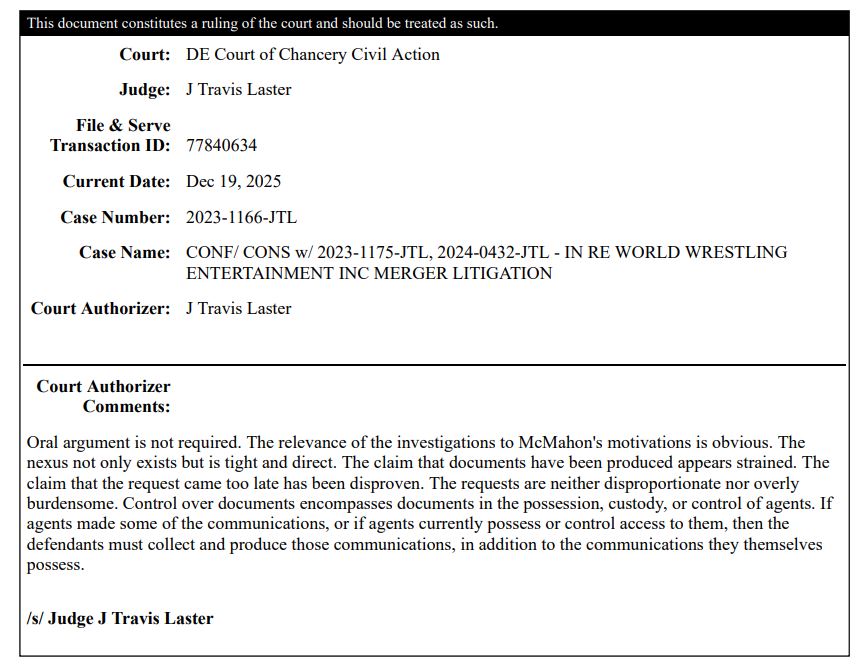
Laster said that the WWE defendants’ claim that the documents had already been produced “appears strained,” that the argument that the requests came too late “has been disproven,” and that the scope of the requests was “neither disproportionate nor overly burdensome.”
A request for comment sent to press contacts for WWE and TKO was not returned.
What’s next in this case
The ruling does not resolve the last of the discovery disputes between the parties. Separately, the plaintiffs have raised concerns about potential spoliation, the deletion or loss of relevant communications records, including the directors’ use of the messaging app Signal, which features an auto-delete function. In that motion, the plaintiffs have asked the judge to order Khan, Levesque, Emanuel, and McMahon-aligned former WWE executive Brad Blum to take screenshots showing how Signal was used on their devices and to produce those screenshots, to determine what records may no longer exist.
Last June, Laster resolved an earlier discovery dispute. He ordered McMahon to produce additional documents related to the sexual misconduct allegations, which are not being litigated here but form part of the case’s background. McMahon had argued that related document requests from the plaintiffs were irrelevant and overly intrusive. The plaintiffs contended that those records were important to understanding McMahon’s motivations leading up to the merger. The judge found that those materials are relevant to the case.
The lawsuit is currently scheduled to go to trial in June 2026. If the plaintiffs succeed, the court could find that McMahon, and by extension, Khan, Levesque, Barrios, and Wilson breached their fiduciary duties by directing the merger toward Endeavor under conflicted conditions. Such an outcome could lead to shareholders recovering monetary damages or other remedies. In addition to being WWE’s top executive, Khan is a director on the TKO board. Wilson is a director with Turtle Beach Corp, also a publicly-traded company.
Many filings in the case are sealed or partly redacted. Earlier this month, this reporter filed a challenge which, under the court’s rules, requires the parties to justify the confidential treatment of those documents. The parties are scheduled to submit public versions of sealed documents by December 23 and are expected by December 30 to file arguments in favor of preserving the confidentiality of certain materials.
As a result of the SEC investigation, McMahon agreed to repay WWE $1.3 million and paid a $400,000 fine to the government. The DOJ investigation, reportedly into allegations of sexual misconduct connected to the NDAs, has not resulted in any charges being filed. McMahon has denied any allegations of sexual abuse and his representatives said earlier this year that the investigation had been dropped.
Former employee Janel Grant was the counterparty to one of the NDAs. Her civil lawsuit against McMahon and WWE is still pending in federal court in Connecticut. Grant accuses McMahon of sex trafficking and the company of enabling his conduct, among other claims. The Grant case is awaiting a decision from the court on whether she will be permitted to request evidence related to the arbitration clause in the NDA, part of a wider dispute in that case about whether the matter will stay in public court.
