
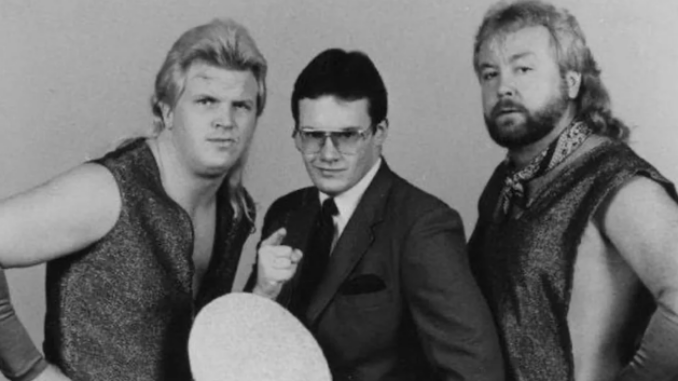

Audio version available for POST Wrestling Café members
When the “art” of tag team wrestling is described, it’s not long before the name Dennis Condrey enters the conversation.
He was the founding member of the Midnight Express, which preceded his partnering with Bobby Eaton, joining forces with multiple teammates throughout his career, and paints a picture of a tag team genius.
Condrey died this past Friday at the age of seventy-six, with the news released by David Harwood a.k.a. ‘Dax Harwood’ of FTR, who was a disciple of Condrey’s. The former star led a secluded post-wrestling existence, with occasional pop-ups from infrequent Midnight Express reunions and the odd match throughout the 2000s, while keeping quiet about a cancer battle that affected his voice.
The details of his death were tragic as Jim Cornette disclosed that he was home by himself, suffering a major fall, and broke his neck. Condrey’s routine of picking up his wife, Theresa, from work did not happen that day, causing her to contact a neighbor and enter the home where a still-breathing Condrey was discovered. He had suffered a horrific injury and was paralyzed and would die shortly thereafter.
His legacy has been elevated by video, which keeps the earliest incarnations of the Midnights alive, his long-time association with Jim Cornette, and the fact that so many of today’s stars draw on the chemistry Condrey showcased as a learning tool. He did so without a WWE run or even a courtesy Hall of Fame induction, but did benefit from WWE’s acquisition of various video libraries.
It could be argued that he left so much on the table when he vanished in March 1987 during the height of the Midnight’s run in Jim Crockett Promotions. Condrey was only thirty-five when he left the group, which would be akin to Dax Harwood walking away after his WWE career and never joining AEW with partner Cash Wheeler. The exit by Condrey opened the door for Stan Lane, creating wrestling’s version of “The Godfather” as fans today argue whether the sequel exceeded the original.
He was a native of Florence, Alabama, and unlike future partner Bobby Eaton, the business found Condrey rather than vice versa. Condrey played football in high school and wrestled in the off-season, and by sheer luck, it was his sister who brought professional wrestling into the Condrey family. She married Joe Turner, who was a mainstay for Jim Crockett Sr. in Mid-Atlantic as “Joe Sky” and recruited the athletic Condrey for the tried-and-true open challenge proposal from Olympic wrestler Bob Roop.
Condrey was enlisted to enter the ring and shoot with Roop without any smartening in advance. The future tag star was pinned, earning a moral victory by not being submitted in the time allotment, and caught the attention of Crockett Sr., who installed Condrey as a referee to learn on the job and begin his education in the industry he would dedicate his life to.
With brother-in-law Turner, the duo assumed the identities of Mephisto and Dante for Leroy McGuirk in Louisiana.
Beginning in 1975, Condrey allied with Phil Hickerson as The Bicentennial Kings and was his first successful tag unit. The duo went through managers Al Costello, Rock Hunter, and Ron Wright while becoming the team to watch in Tennessee. Together, they won multiple tag titles across the Memphis and Knoxville territories, including the NWA Southern tag titles, Southeastern tag belts, Mid-America belts, and NWA world six-man titles with Al Greene.
Their feuds include ones with Jackie Fargo & Jerry Jarrett, Jackie & Don Fargo, Bill Dundee & Tojo Yamamoto, Dundee & Tommy Rich, and a big program with Ricky & Robert Gibson. The latter would be a staple of Condrey’s career, but in 1977, they fought over the Mid-America Southern tag titles, climaxing in a “Steel Cage Texas Death Losers Leave Town” match, drawing over 6,100 fans at the Mid-South Coliseum underneath Jerry Lawler vs. Paul Orndorff. Condrey & Hickerson won the blowoff contest and turned around to win another “Losers Leave Town” stipulation match in June against Tommy Gilbert & Tommy Rich.
While wrestling in Memphis, a young photographer named Jim Cornette would be snapping shots of his future client, and little did Condrey know that the sixteen-year-old would take his career to another level through his talking ability. Another building block in Memphis was Norvell Austin, a frequent opponent of the Bicentennials, but he would align with Condrey in Southeastern Championship Wrestling.
In early 1979, the team was shattered when Hickerson was forced to undergo knee surgery, missing a full year of action, and would not resume a full-time career for years. The pair teamed one last time on January 8, dropping the Southern tag titles to Koko Ware & Bill Dundee and ending Condrey’s first successful team.
Condrey shuffled partners with Don Carson and Don Fargo before a singles run throughout the year for Ron Fuller’s Southeastern territory. The run included an NWA World Heavyweight Championship match with Harley Race in Chattanooga in September 1979 while holding the Mid-America heavyweight title from June until October. That same year, Condrey feuded with Bobby Eaton, another instrumental figure in years to come.
He returned to a tag run, forming an alliance with Dr. D David Schutlz in Memphis after Jerry Jarrett had taken over the region following the territorial split a few years prior. The pair won tag titles for Jarrett and Fuller, which were Condrey’s main booking offices throughout the first period of his career, and where he became seasoned. While the team with Schultz isn’t going to be the first or second team Condrey is remembered for, it was a short run where the two played off each other well and placed Condrey back into his sweet spot of tag wrestling.
The ‘80s kicked off with Condrey working for Continental and expanding into Georgia Championship Wrestling and getting exposure on WTBS. He beat Steve Keirn for the Georgia Heavyweight title in September for a short reign, ending the next month at the hands of Tony Atlas.
It was in this period that Randy Rose came into the picture, and the original Midnight Express took form with the two joined by Norvell Austin, and became a three-man force with interchangeable parts like the Fabulous Freebirds. The name was inspired by the 1978 film, which received multiple Oscar nominations, including best score for Giorgio Moroder’s “Chase”, which would become their signature theme years later.
They spent their time in Continental and Southeastern becoming the dominant team in the regions. In 1982, there were several eight-man tags where Condrey & Austin teamed with Sweet Brown Sugar and Bobby Eaton, and it would be the first instance of Condrey and Eaton on the same team after feuding years earlier. Their first matches together as a proper tag team wouldn’t occur until venturing to Mid-South.
If there was a demarcation point in Condrey’s career, late 1983 was the area to pinpoint. Bill Watts was concerned with a downturn in business and leaned on Jerry Jarrett for his advice. After observing Mid South’s crowd, Jarrett concluded they were not attracting female fans with their roster makeup, and the sides put their cards on the table for a “trade”, excluding its prime talent of Jerry Lawler and Junkyard Dog. Watts made out like a bandit as he gained access to Condrey, Eaton, the Rock ‘n’ Roll Express, Terry Taylor, Jim Cornette, and incoming booker Bill Dundee to replace Ernie Ladd.
Watts was the one to see Condrey and Eaton as a pairing and assigned Cornette to the duo in his first breakout role as a manager after playing understudy to Jimmy Hart in Memphis.
On November 23, 1983, Condrey & Eaton worked a pair of squash matches at the television tapings inside the Irish McNeil Boys Club. Their first tag match together was against Rick “Not Yet Ravishing” Roode and “Action” Mike Jackson, who literally just wrestled on television for TNA last week at 76.
They were not slowly acclimated as they were immediately programmed with Magnum T.A. and Mr. Wrestling II for the area’s tag belts. It involved a heavy angle where the Midnights “tarred and feathered” their opponents and drew immediately in the towns.
February 24, 1984, was a notable date as it featured the first match between this version of the Midnight Express and the Rock ‘n’ Roll Express, Ricky Morton & Robert Gibson. While Condrey and Gibson had extensive histories, it was among these four, and later Stan Lane, that the vast majority learned and studied these teams and their many classics.
Mid-South did its all-time run in the spring of 1984 with the Midnights in the role of the top heels alongside Cornette. In March, they shot an angle where a birthday cake was brought out, resulting in Cornette taking the dive into the cake, and Bill Watts was so amused that he replayed the footage. The Midnights responded at the same taping by attacking Watts with a flapjack and causing the legendary figure to come out of retirement for the famous “Last Stampede” series.
Watts required a partner, and with area legend Junkyard Dog having just lost a match and forced to leave for ninety days, they got around the stipulation with JYD wrestling as the masked Stagger Lee. They did gangbuster business, led by approximately 25,000 fans attending the Louisiana Superdome on April 7 and drawing a $176,000 gate (over half a million dollars today). Despite Watts injuring his hamstring right away, they worked the tag match in all the towns, generating over $800,000 across fifteen events and over $1 million if you total all the Mid-South events during that stretch. The Midnights were “made men” as proven draws, and it was a major high point in the history of the territory.
The Midnights were coming up on a year in Mid-South and assessing their options with eyes on Jim Crockett Promotions, which was booming under the booking of Dusty Rhodes, the rise of Starrcade, and about to go on WTBS the next year. Instead, they were persuaded to head to World Class Championship Wrestling and wrapped up in Mid-South with a series of scaffold matches, putting over Morton & Gibson.
They arrived in Dallas in late 1984 to start working with The Fantastics, Bobby Fulton & Tommy Rogers, and worked the Christmas Star Wars event. The territory had been set on fire two years earlier after the famous steel cage bout between Ric Flair and Kerry Von Erich, but was reeling less than a year after the death of David Von Erich in Japan.
WCCW was not one of the Midnight’s big runs, winning the promotion’s tag belts in January and continuing to feud with the Fantastics. On May 5, the teams wrestled in a Two Ring, No Disqualification match at Texas Stadium on the 2nd Von Erich Memorial Parade of Champions card. They had less than ten minutes, and Cornette was unhappy with the treatment.
When JCP came knocking again, the Midnights and Cornette answered, and in June, they made the voyage to the Carolinas and the scene of their biggest moments. It was perfect timing as the territory was really hot in 1985, and with the Rock ‘n’ Roll Express about to join, they had their famous rivals.
The duos feuded over the tag titles in 1986, with the Midnights becoming champs in February and becoming a centerpiece of the company.
Within a year of joining JCP, the WWF came calling, and a meeting was set up involving the Midnights and Cornette with Vince McMahon. The pitch by McMahon focused on the merchandising opportunities and the money to be made. Cornette and Eaton felt it was the wrong move when they were making great money and having the best matches in the country, which was part of the appeal of the group. It was believed that Condrey was the dissenting point of view, believing WWF was the move to make, and this would contribute to his disappearance months later. Years later, he said differently, including to Greg Oliver and Steven Johnson in the Pro Wrestling Hall of Fame: The Tag Teams, “We were making plenty of money where we were, so we didn’t need to go anywhere.”
After Morton & Gibson, they started to work with the Road Warriors. Road Warrior Animal & Hawk were the biggest team in the country and had begun wrestling for All Japan Pro Wrestling earlier that year, so they were exploding in that country, too.
The Midnights and Road Warriors were a significant part of that year’s Starrcade promotion, airing from both the Greensboro Coliseum and the Omni in Atlanta. The two had a scaffold match with the event marketed as “Night of the Skywalkers” and were featured on the Greensboro portion, drawing 16,000 and an additional 4,500 next door on closed circuit for a $377,000 gate, along with $300,000 at the Omni.
The scaffold match was memorable for the frightening bump absorbed by Cornette, who hung from the scaffold with Big Bubba Rogers positioned to catch his fall. The momentum took Cornette straight down and destroyed his knees on impact as Rogers couldn’t get a hold of him before the crash. JCP marketed the match extensively on television to generate home video sales and was a very popular match for its era.
The move that caught everyone off guard was in March 1987, after a show in Fayetteville, North Carolina, where Condrey worked against Brad Armstrong, and Eaton lost to Ron Garvin in a steel cage match. They had the next day off to travel to San Francisco, and Condrey said he would see them then, but never showed up and disappeared. Over the years, many theories have been posited from the WWF’s offer to burnout, but it was the end of a legendary tag team.
Historian Tony Richards cited an ongoing paternity suit in his obit on Condrey:
The Condrey walk-out was the subject of mystery and speculation for decades. One night after a spot show, Eaton and Cornette dropped him off at his apartment. He said, “See you tomorrow” — and they didn’t see or hear from him again for roughly 1.5–2 years. The real reason was personal/domestic problems at home. He was facing a paternity suit (child support/legal issues) and was in the middle of (or heading into) a messy divorce. This matches what Condrey himself later admitted in a shoot interview: he took off to Colorado to dodge the legal mess and get away from the situation.
Arn Anderson, who was a JCP coworker at the time, and best friends with Eaton later said on a podcast that Condrey “had some problems going on at home” that led to him going through a divorce. Burnout from the insane road schedule going back to 1984 during the Mid-South days and continuing into JCP was also a big factor, according to Condrey.
Eaton would pivot and, on April 4, begin teaming with Stan Lane, and the Midnights didn’t skip a beat with the updated version.
Condrey didn’t disappear for long, heading to the AWA to reunite with Randy Rose, with Paul E. Dangerously becoming their mouthpiece. The pair won the AWA tag belts from Jerry Lawler & Bill Dundee in October and held them until the end of 1987 before losing to The Midnight Rockers of Shawn Michaels & Marty Jannetty.
It was inevitable that the fractured parts of the Midnights would come together with money to be made, and so was the case in late 1988 in a famous angle on WTBS. The original Midnight Express of Condrey & Rose stormed the studio, attacking Eaton & Lane and Cornette, being busted open, and cutting an amazing promo to set up the showdown at Starrcade 1988.
Timing was not of the essence with Crockett just completing its sale to Turner and Dusty Rhodes in his last days as booker. The transition from Rhodes to George Scott didn’t bode well for the program, which was building toward a tag match at the Chi-Town Rumble in February 1989 between the two teams, and the loser of the fall would leave the company.
Condrey skipped out on the match, being replaced by Jack Victory, and Rose took the fall, putting an end to the Midnights vs. Midnights.
His career started to wind down, wrestling in Alabama in 1989, and he became Continental’s heavyweight champion by beating Tom Prichard and forming the Lethal Weapons with Doug Gilbert.
In 2004, he came out of retirement for a series of nostalgia matches teaming with Eaton and rekindling their rivalries with The Fantastics and Rock ‘n’ Roll Express. Condrey assumed an active independent schedule through 2011, creating unique matches where Condrey shared the ring with Team 3-D, Jeff Hardy, New Age Outlaws, The Steiner Brothers, and even a singles match with Elix Skipper in Alabama. There were even a few unique pairings where the trio of Condrey, Eaton & Lane teamed at a pair of WrestleReunion shows and a 6:05 Reunion show in Orlando in 2006.
Condrey’s latter years were a major struggle as he fought cancer, with one bout affecting his voice box and altering his speech. Through the convincing of Cornette, he began attending autograph sessions and reunion specials for the Midnight Express, not realizing the legacy he had crafted and being remembered all those years later.
While he never received the WWE historical treatment of a Hall of Fame induction or Midnight Express DVD project, a lot of his work survived on video through the WWE Network. Between Jim Crockett Promotions, AWA, and Mid-South, a lot of his work is accounted for, and thankfully, Memphis is a territory that has thrived online. Cornette was influential in the WWE’s system, running Ohio Valley Wrestling and assigning tape study to the future stars of WWE. No doubt, many stars of the last generation were introduced to Condrey early in their careers, and one only must examine the tributes from performers to see the role he played.
The preservation of the Midnight’s history was documented in the group’s 25th Anniversary scrapbook, released in 2009 by Cornette and Tim Ash. It is one of the most detailed rundowns of any career, featuring anecdotes, daily schedules, payoff receipts, and Cornette’s notes along the way. The release of the book coincided with their election into the Wrestling Observer Newsletter Hall of Fame.
In 2017, the Rock ‘n’ Roll Express received an induction into the WWE Hall of Fame, with Cornette summoned to induct the pair. It seemed like a layup to follow with the Midnights receiving their own induction in a future class, but the decision was never made.
Eaton passed away in August 2021 at the age of sixty-two.
Condrey’s legacy will be tied to the Midnight Express, but his death has revealed that the scope of his generation of performers, without WWE exposure, is still vast. TMZ, People, and the New York Post were a sample of outlets covering his death, and it’s never been easier to document and study performers of yesteryear. Not all performers have the blessing of their best moments and matches being documented, but Condrey had far more than most of that generation, and his tag work holds up to a modern audience and performers who can study and learn.
It might be the work alongside Eaton and Cornette that draws people in, but if that leads to further discovery of existing material with Phil Hickerson, Dr. D David Schultz, Randy Rose, and Norvell Austin, then that person will be better informed about the richer picture of Dennis Condrey’s extraordinary career.
A GoFundMe campaign has been launched to assist Dennis’s widow, Theresa
Several notes courtesy:
- The Midnight Express and Jim Cornette: 25th Anniversary Scrapbook
- RIP: The Life and Career of “Loverboy” Dennis Condrey by Tony Richards
- The Pro Wrestling Hall of Fame: The Tag Teams by Greg Oliver & Steven Johnson
- Wrestling Observer Newsletter
- Dennis Condrey’s Cagematch profile
