
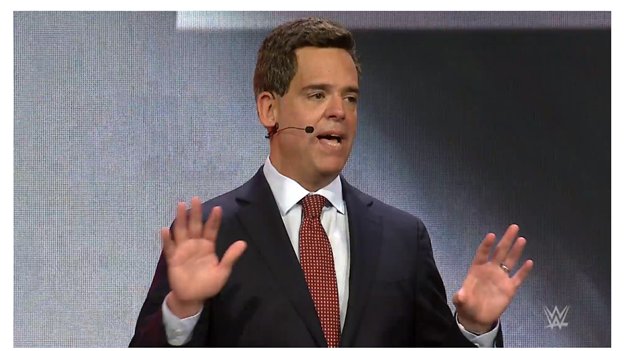
Former WWE co-president George Barrios says Vince McMahon feared he was “betting the company” in moving forward with Crown Jewel in Saudi Arabia weeks after the murder of Jamal Khashoggi.
Barrios spoke with POST Wrestling’s John Pollock while promoting his new book, Sometimes Wrong But Never in Doubt: How a Cuban Kid from Queens Transformed WWE, and reflected on the most sensitive negotiation of his WWE tenure.
WWE’s relationship with Saudi Arabia began in 2018 with a 10-year strategic multiplatform partnership tied to the country’s Vision 2030 program.
Barrios and Michelle Wilson had been promoted to co-presidents one month earlier, with WWE touting their roles in transforming the company into a stronger multiplatform business.
Barrios said the Saudi deal fit into WWE’s broader move away from a more volatile business dependent on live events and pay-per-view sales, toward contractual revenue, media rights, and major international agreements.
Barrios said:
If you’re going to be a global business, you have to get comfortable that not every region of the world is similar to the West. You have to get comfortable with that or not, or decide you’re not. Now, I’m not saying that your morals are compromised. I’m not saying that. You shouldn’t do that. But the world is different.
WWE announced Crown Jewel for Riyadh on September 18, 2018. Two weeks later, Khashoggi, a Washington Post columnist and critic of the Saudi government, was killed inside the Saudi consulate in Istanbul.
A later U.S. intelligence assessment stated that Saudi Crown Prince Mohammed bin Salman approved an operation to capture or kill Khashoggi.
The timing placed WWE’s new Saudi partnership under intense scrutiny. Barrios said the killing changed the tenor of the negotiations immediately:
As we’re talking about doing this deal, Khashoggi is killed. And so that now creates this different context. And internally, it becomes a difficult decision. I remember Vince looking Michelle and I in the eye, it was late one night, and saying, “This is the most difficult decision I’ve ever made. I feel like we could be betting the company.”
WWE confirmed on its October 25 earnings call that Crown Jewel would proceed, calling Khashoggi’s killing a “heinous crime” but stating that the company would uphold its contractual obligations. The company also noted that its full-year 2018 guidance depended on staging the Riyadh event as scheduled.
Barrios told Pollock that the economics were part of the decision, but not the only factor”
There is no doubt that as someone running a business, you’re incentivized to do deals that are accretive to the business. So is there an incentive to do the deal? Yes. Does that mean you’re going to do whatever — and back to the question that you’re putting your morals aside? No, it does not. But it goes into the decision-making.
He said WWE also discussed whether the show would damage the company’s reputation and how the company should approach business in countries whose values differed from those in the West:
What went into the decision was, yeah, of course the economics went in. Then also went in, is this the right thing? Also went in, are we damaging the reputation of the company by doing this over the long term? Also that went in is how do we think about generally, not just in this situation, doing business in countries where we may not 100% agree. That was the debate.
Barrios described the final stage of negotiations, with WWE needing to decide whether to complete the deal. He said McMahon “kind of looked away” when the question arose of who would fly to Saudi Arabia, while Wilson was not eager to make the trip.
“So I said, ‘No, I’ll go,’” Barrios recalled. “We had an earnings call the next day. So this is midnight. We got an earnings call the next day at 11. Usually, we’re preparing for that, not having this conversation.”
After the call, Barrios flew to Riyadh:
I got on a G6, I think it was, after the earnings call and flew to Riyadh. Even the negotiation there in Riyadh had its own theatrical elements. But yeah, it was one of the most interesting times in my career. Certainly the most interesting negotiation I had done up to that point.
WWE continued its Saudi events in 2019, including Super ShowDown and Crown Jewel.
Barrios remained in place until January 30, 2020, when WWE announced that he and Wilson would depart immediately and leave the board, with McMahon citing “different views” on the company’s strategic priorities.
Barrios said the public announcement was abrupt, but the underlying split was not. He told Pollock that he had approached Wilson the previous summer to say he planned to resign, only for Wilson to tell him she was considering the same move.
“I want to go find a thing,” Barrios recalled telling Wilson. “I want to be the one guy, not the co-guy. And I don’t want to do that while I’m still here.”
The two then approached McMahon with what Barrios described as a transition plan. Instead, the conversation became emotional.
“He said one of the nicest things anybody’s ever said,” Barrios said. “He said, ‘I built this business for 30 years, and I had to pull everybody along. For the last 10 years, you guys have been pulling me along.’”
Barrios said the relationship worsened as the parties tried to find a workable structure that would give him and Wilson more autonomy while keeping McMahon close to the product:
Everybody started just getting pissed off at each other. The relationship changed. Everybody got a little shorter with each other, snippier, a little more edge in the commentary. I can speak for myself. I definitely did that.
By late January 2020, Barrios said he intended to stay through WWE’s next earnings call. McMahon chose to end the arrangement immediately:
Vince calls me into his office. He’s like, “Yeah, this isn’t working.” I’m like, “I agree, so why don’t we just figure out a plan, go back to the original thing, six months?” He goes, “No, we’re doing it today.”
Barrios said he warned McMahon that an immediate exit would be bad for employees, partners, and investors. McMahon, he said, preferred a clean break:
It’s one of the things I admire about him. He’s like, “George, when you make a decision, you got to pull the Band-Aid.” And so he pulled the Band-Aid. And the rest is history.
