
Over the years, much has been written about Hulk Hogan. In fact, much has been written about Hulk Hogan by.. Hulk Hogan. His 2002 memoir, released during his initial WWE comeback, is often the subject of ridicule given its exaggerations and outright lies surrounding his life and career. His 2010 release, My Life Outside the Ring, continued the trend in consistently dancing on the line between fact and fiction, but by that point, people had learned to take much of what was said with a grain of salt. At some point, the line between Terry Bollea and Hulk Hogan had not so much blurred as it had been completely eradicated.
Following his unexpected death in July of 2025, much had been written about the man and his career. However, I think we are all still looking for that one true definitive book chronicling the man’s life and career. In the past few years, Tim Hornbaker put forth an excellent effort on Ric Flair with 2023’s The Last Real World Champion, and Jon Finkel tackled the legacy of Randy Savage with 2024’s The Untamed, Unbelievable Life of Randy Savage. Even Vince McMahon’s complex legacy was embarked upon with Josephine Riesman’s Ringmaster. By all accounts, we are living in a golden age of pro wrestling biographies, so where is that Hogan book?
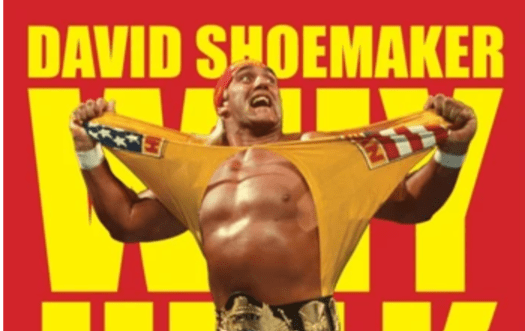
David Shoemaker is the first to kick down the door with Why Hulk Hogan Matters – not so much a definitive chronicling of the man’s career, but a sort of essay trying to answer its title statement.
It’s safe to say that Hogan is a giant of the industry and unarguably the most popular wrestler of Vince McMahon’s Rock and Wrestling boom period. Without him, it’s entirely possible Vince McMahon could not create, launch, and hold the control over the industry that he desperately craved. Concerning the book’s title, I don’t believe anyone is questioning why Hulk Hogan matters, as it’s quite clear he does. Perhaps given the controversial nature of his final years, he has become deeply unpopular among wrestling fans, but his legacy still stands given his historical significance and his contributions to McMahon’s empire.
Is it possible to distill Hogan’s entire life and career into 176 pages? It’s hard to say. Shoemaker does hit all the major hallmarks of Hogan’s time in the ring between his early days training under Hiro Matsuda, his first stint in the WWWF, his time in both Japan and the AWA, his return to WWF and subsequent popularity explosion during the 1980s before fading and moving over to WCW. There is also time devoted to the steroid trial and his venture into Hollywood, but not much time is really spent on any one topic to get into the weeds, so to speak. With regards to WCW, his time there is covered up to January of 1999 before shooting ahead 3 years to his WWE return, leaving so much overlooked. As this happens later in the book, it leaves only one chapter to cover his time in TNA, the controversy surrounding his sex tape and coinciding racist remarks, the Gawker trial, as well as several of his post-in-ring career ventures. So, it’s a bit of a speedrun at the end.
I would be remiss if I did not mention some of the major errors in the book that had somehow made it through to the final copy. This isn’t an attempt to nitpick, but a few things that were glaring inaccuracies included an entire chapter written around the labeling of Hogan and The Ultimate Warrior by Gorilla Monsoon as “The Irresistible Force vs. The Immovable Object”, the distinction of which belongs to Hogan and Andre’s legendary 1987 program. This error is also paired with Shoemaker writing that Hogan and Warrior first faced off at the 1992 Royal Rumble, which is incorrect. That happened at the 1990 Rumble. Later on, Shoemaker states that Hogan debuted in WCW on a 1994 edition of Monday Nitro – Nitro had not premiered until mid-1995. There is also a point earlier speaking of Hogan dropping the title to Yokozuna in Japan, which occurred at the King of the Ring pay-per-view in Dayton, Ohio.
Honestly, I would struggle to recommend this to anyone. While there still isn’t that definitive Hogan book out there, given his enormous impact on the industry, there are other books where he is a central figure that have led to much of his career being chronicled. Guy Evans’ tremendous duology on the rise and fall of WCW (NITRO and Beyond Nitro) is one, and Tim Hornbaker’s Death of the Territories is another. I would give this a pass, brother.
