
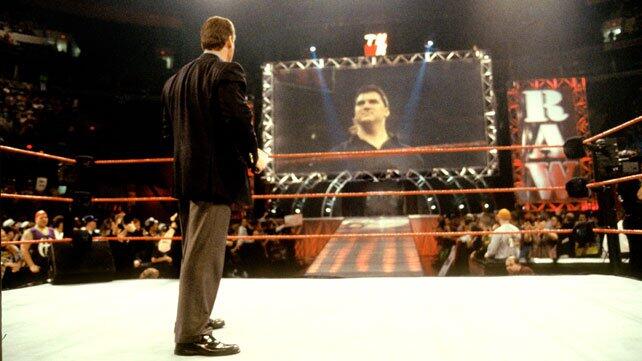

REWIND-A-WAI #217: WWF SummerSlam 2001
The summer of 2001 was a confusing time for the World Wrestling Federation, operating off the fumes of its Attitude Era boom with a decline in momentum, while handling the most coveted storyline with its real-life competitor.
Ask a fan of this era about the “Invasion storyline,” and you’re likely to be met with a groan, scream, or laundry list of alternative ideas that would have given some resuscitation in its dying days.
If there is an underlying theme from the Monday Night War, it was the real-life vitriol possessed by the warring companies, WWF and WCW, making Monday night a firing zone with attacks lobbed back-and-forth, talent being scooped, shoot interviews, and conveying to fans that in a world of make-believe this feud among companies was real.
Every fan had their “dream card”, fantasy booking their favorites with the opposition and asking “what if?” It was Marvel fighting DC, Jason vs. Freddy, and Jay-Z vs. Nas. It sounded really simple on paper.
The problem was one company buying out the other, and over time, it was so transparent the scars that Vince McMahon wore from that head-to-head era. The man who frequently stated that he loved competition has acted in the opposite way throughout his career, circumventing anything non-WWE in the market space. This is the man who signed Curt Hennig to thwart the XWF, put himself on ECW programming to counter Wrestling Society X, made up with Jim Ross when he was linked to the World of Sport reboot, and used his son-in-law’s sub-brand as the counterattack to shut down AEW in its tracks on Wednesday nights.
He didn’t covet competition. He thrived off its extinction.
Taking us back to 2001, Vince McMahon has acquired WCW for a bargain. McMahon had kicked the tires months earlier in hopes of securing WCW as a distressed asset of the Turner empire. Its brand-new relationship with TNN provided the network with exclusive cable rights to WWF and wasn’t going to bend and allow WWF to run a competitor on another broadcaster without a significant fee. It quelled McMahon’s desire to acquire his competitor, but months later, it was a fire sale, and McMahon bought the assets of WCW, including its undervalued tape library, and committed to several years of advertising dollars toward Turner.
WCW was a perfect bridge from the Attitude Era to another golden road paved with pay-per-view revenue off the fantasy match-ups and stories they could tell. Yes, many of the major stars had guaranteed deals and had no incentive to break those contracts to go on the road, nor was WWF interested in upsetting its salary structure for those big names. Hulk Hogan, Sting, Bill Goldberg, Kevin Nash, Scott Hall, and even Eric Bischoff would not be around to launch the invasion.
The audience didn’t care because the idea of WCW was strong enough that even a diminished army of WCW names was enough to propel its July pay-per-view into the stratosphere and produce one of the largest non-WrestleMania numbers in the company’s history. A fivesome of Booker T., Diamond Dallas Page, The Dudley Boyz, and Rhyno were enough to command roughly $20 million in pay-per-view revenue.
If one were to view two weeks in July, you would assume this was the apex of WWF during the era. On the “go home” Raw before Invasion, a show-long story involving Steve Austin climaxes with the star shedding his heel role and coming to the aid of Team WWF in the show’s dramatic end in front of a thunderous crowd and propelling the team into the pay-per-view. It is followed by the mega success of that show, and one week later, The Rock returns from filming “The Scorpion King” after a hiatus since WrestleMania. His return episode of Raw averages 7.6 million viewers and peaks during the overrun for his arrival with a whopping 9.2 million viewers and the highest-rated segment on Raw in nearly a year.
It is a misnomer to suggest that the boom ended completely after WrestleMania because rock bottom was still a lengthy way off, but the bloom was off the rose.
In July 2001, despite the big episode for Rock’s return, ratings were down 17% on Raw from the year prior. Over that year, Raw moves from the USA Network to TNN but, astonishingly, numbers are down to that degree when 2001 doesn’t feature competition from Monday Nitro and contributes to the argument that the WCW audience vanished. Other business notes from the Wrestling Observer Newsletter of July 2001 show that live gates have fallen 23% and attendance is down 31% from July 2000. These would be instructive to the argument that Steve Austin’s heel turn harmed business because it’s the summer shows that would bear that argument, given tickets going on sale after the turn at WrestleMania.
Fans quickly realized that they had a greater interest in WCW than its stewards. It was less WWF vs. WCW than a McMahon family plot twist with members equipped with a brand apiece. The infamous Raw at the Tacoma Dome was nearly a death knell for the brand after a Booker T. vs. Buff Bagwell match bombed. It forced the panic button to be struck, invoking ECW the next week and forming “The Alliance”. Shane and Stephanie McMahon were hardly the avatars for these brands and fans knew it, but the juice of WWF vs. WCW & ECW was too rich, and the concept sold that month’s pay-per-view.
SummerSlam was a crossroads. The company had done an incredible job of mitigating any importance behind inter-promotional matches by making them routine on each episode of Raw and SmackDown and negating their importance for a pay-per-view. WCW fans saw Diamond Dallas Page rise to be one of the top stars in the industry by 1998 and now recast as a stalker, Booker T. was presented as a knockoff of The Rock, and ECW stars like Raven, Tazz, and Tommy Dreamer were not seen as anything more than background players. The lone breakout was Rob Van Dam, who was immediately adopted by the fanbase and seemed undeniable.
The show in San Jose gave fans a very entertaining show but also set the table for the demise of one of wrestling’s biggest “what if” storylines. By night’s end, the WWF and WCW squads are led by The Rock and Steve Austin, and that says everything right there. Diamond Dallas Page was extinguished as a viable commodity with one of the most one-sided beatdowns the company ever presented as The Undertaker & Kane destroyed Page and Kanyon for ten minutes before mercifully ending the match-up, a warm-up for Page to be pinned by Sara the next night on Raw.
Booker T. headlined his second consecutive WWF pay-per-view, and by WrestleMania, he was wrestling over a shampoo commercial.
Rob Van Dam tried to steal the show with Jeff Hardy in a ladder match that was one spot away from coming close. He flirted with a top position before acclimating to the Intercontinental title picture and never recaptured the magic he bottled in 2001.
The real show stealer was Steve Austin and Kurt Angle, who put on a bloody epic. It was probably Angle’s most diverse and multi-faceted performance of his young career. It wasn’t the technical wizardry of his Chris Benoit contests, but it evoked an emotional high through his incredible selling, unmatched aggression, and was aided by a legendary call by Jim Ross. It was so utterly clear on this night that Angle was ready to be “the guy”. A month later, he gets a token title reign given the circumstances of Angle in his hometown and the American hero winning the championship after 9/11. It was never in the cards for a big Angle run, and he dropped the title back to Austin weeks later. After the Survivor Series, Angle is back to his role as Vince McMahon’s lackey and assumes his comedic role throughout 2002. The character transformations for Angle were harmful at various points but detrimental at such a pivotal time in his career when the audience was desperate for a new face on top.
The glow is fading fast, the invasion is about to die, and the WWF is going to endure a famine over the next years. From that vantage point, it’s a frustrating rewatch because the company is loaded with tools and doesn’t know how to use any of them. Within a year, Steve Austin is gone, and The Rock is done in terms of a full-time performer. Virtually every major name from WCW eventually came in and was Groundhog Day with terrible creative plans, misunderstanding of characters, and the letters “WCW” representing a scarlet letter rather than a cash-making device.
One of the few holdouts was Sting, who finally arrived in 2014, setting up a match with Triple H at WrestleMania 31. Fourteen years after WCW’s final show, the resentment harbored inside Vince McMahon came through on commentary through JBL, describing Sting as a “big fish in a little pond that wanted to go down with the Titanic; now he’s a minnow in an ocean”.
It is one of the most revealing moments of a promotional feud that the audience had long since moved on from. Vince McMahon had not. He never understood the idea that he bought WCW and had the opportunity to profit from his greatest competitor.
Even fourteen years later, he was fighting the ghost of WCW, putting personal ahead of business and leaving excess millions on the table in its wake.
“And the right side won again” – JBL
