
By: Jonathan Snowden
Hybrid Shoot
No one agrees on whether Tiger Jeet Singh’s most notorious attack was staged — only that it built an empire, and a case for the Hall of Fame
Mitsuko Baisho was supposed to be enjoying an evening out with her husband, a rare reprieve from the endless grind of professional wrestling. Instead, she found herself in the middle of one of the strangest incidents in Japanese sporting history.
It was shortly after six p.m. on November 5, 1973. Baisho, an accomplished film actress, had accompanied her husband, professional wrestler Antonio Inoki, and his younger brother Keisuke to Haneda Airport to meet an acquaintance. On the way home, they stopped to shop at Isetan, the fashionable department store in Tokyo’s bustling Shinjuku district. Baisho was helping Keisuke shop for a wedding present. 1
Outside the store, they encountered a large man wearing a turban. He was accompanied by two other foreign wrestlers.
His name was Tiger Jeet Singh.
There are competing accounts of what happened next. The broad outlines, however, are familiar. Singh and his companions attacked Inoki. Punches flew. Inoki fought back, but he was badly outnumbered. His head struck a guardrail, opening a wound that reportedly required five stitches. According to later accounts, he was also slammed against the hood of a taxi. 2
Baisho stood still as the violence unfolded around her. Inoki was bleeding. His white shirt was turning red. And Singh had turned his attention to the actress.
“I slapped Inoki’s wife, Mitsuko Baisho,” Singh acknowledged in a 2010 interview. 3
“I was so frightened, so frightened,” she later recalled. “My legs froze, and I couldn’t move.
“For a moment, I regretted marrying a wrestler.”4
It was unthinkable. It was raw. It was, in the right hands, an invitation to print money.
People gathered. Someone called the police. Singh jumped into a taxi and ordered the driver to take him to the Keio Plaza Hotel. According to Singh, the terrified man was initially too frightened to move the car. A shout, heard by onlookers, spurred him into action. By the time patrol cars arrived, the foreign wrestlers were gone, leaving an injured Inoki, his wife and his brother to deal with the authorities. 5
Was it real?
“Passersby nearby reported the disturbance, and it became serious enough that police officers were dispatched,” historian Fumi Saito wrote. “So there is no question that something happened there.”6
No photographer captured the confrontation. No television cameras recorded it. For an incident that would become part of Japanese wrestling mythology, there was remarkably little physical evidence of what had happened.
But there was blood.
Yasuo Sakurai, then a Tokyo Sports journalist, later recalled receiving telephone calls from someone at the scene. He dispatched a photographer and hurried to Shinjuku, arriving too late to catch the action. The guardrail was bent, he remembered, and bloodstains remained. The newspaper eventually found Inoki at his apartment, where he was photographed in bed with his head bandaged.7
If the incident had been staged, Sakurai argued, surely someone would have thought to invite a photographer.
It was a reasonable question.
But this was professional wrestling, and Antonio Inoki was involved. Reasonable questions did not always produce reasonable answers.
Inoki was still fighting to establish his place in the Japanese wrestling business. He had founded New Japan Pro-Wrestling in 1972 after a bitter split with the old Japan Wrestling Association. His former colleague and great rival, Giant Baba, had launched All Japan and secured relationships with the National Wrestling Alliance and its powerful American promoters.8
Baba had access to the established international stars. Inoki, despite television backing and his own considerable fame, was often left scrambling for credible foreign opposition. New Japan needed more than talented wrestlers. It needed someone the public would pay to see Inoki fight.
Singh offered something different. Something special.
When he first appeared at Kawasaki City Gymnasium that May, he emerged from the audience and attacked Kotetsu Yamamoto. New Japan presented him as an uninvited intruder, a dangerous foreigner who hadn’t even bothered to sign a contract before invading the show.9
The invasion was a promotional device. But Singh embraced the part with extraordinary conviction. Saber in hand, he menaced spectators, attacked photographers and transformed ordinary wrestling matches into apparent riots.
Then came Shinjuku.
Was it another publicity stunt? Former New Japan referee Mr. Takahashi later claimed Inoki and Baisho knew what was coming. In a 2025 autobiography, Inoki’s brother disagreed, insisting he and Baisho were both caught off-guard. 10
He made no such claim about his brother.
Bill White, one of the wrestlers who accompanied Singh that evening, offered another version in a 2004 interview with Weekly Gong. Asked whether the attack had been staged, White replied, “That’s half right and half wrong.” He recalled that someone had helped arrange the encounter and claimed Singh became more violent than originally intended. But White acknowledged that he didn’t know who had devised the plan. 11
It was another intriguing account, offered more than thirty years after the incident, but hardly a definitive answer. For his part, Singh denied it was anything but real. Others wondered whether a planned confrontation had simply gotten out of hand.
“It was said that Singh had lain in wait while Inoki shopped,” historian Tadao Monma wrote in Antonio Inoki: The Genes of Fighting Spirit. But Monma was troubled by the circumstances. Inoki’s side filed no assault complaint, and the matter was settled privately. Monma even wondered whether Jacques Rougeau, a Canadian promoter accompanying Singh, had been the real organizer.
“Why had Singh attacked him—or was it a setup by Inoki and the newspaper? Even now, the truth is shrouded in mystery.”12
Whatever happened outside Isetan, the incident accomplished what New Japan desperately needed.
Three days later, Inoki teamed with Seiji Sakaguchi and Kotetsu Yamamoto against Singh, White and Rougeau in a six-man tag team match in Numazu before a packed house. The speed with which the participants were brought together was striking. It didn’t prove the confrontation had been planned. But New Japan certainly knew how to take advantage of it.13
“Inoki came after me because he wanted revenge,” Singh recalled. “Something must have changed inside him after that. From that point on, what happened between Inoki and me wasn’t wrestling anymore.
“It was war.”14
Their rivalry soon became one of the company’s defining attractions, drawing crowds and television viewers who wanted to see what the Mad Tiger might do next.
As Saito observed, because of the incident, Singh’s “name recognition suddenly rose to a nationwide level.”15
Baba had cornered the market on established foreign stars. Inoki had found a man who didn’t need an American championship or an impressive résumé to make people care.
Before Shinjuku, Singh was a relatively unknown foreign wrestler in Japan, trying to make his name.
Afterward, he was the man who had attacked Antonio Inoki and his movie-star wife on a Tokyo sidewalk.
A star was born.
New Japan’s Business Problem
On paper, Tiger Jeet Singh was exactly the sort of wrestler Antonio Inoki wanted New Japan to move beyond.
“Professional wrestling needs showmanship, of course,” Inoki told Pro Wrestling in 1974. “But that showmanship has to be backed up by real ability. Wrestling isn’t just punching and kicking. Speed, stamina and technique—all of those things have to come together before you have a genuine contest in the ring.
“The stronger man should win. If a wrestler only gives the appearance of being strong, he’s betraying the fans. What we’re trying to do is develop strong-style wrestlers who compete through technique and genuine ability.”16
Inoki was selling legitimacy. His wrestling was supposed to be grounded in the real thing, a serious athletic contest rather than the circus of foreign villains and theatrical excess that had become familiar to Japanese audiences.
New Japan was Karl Gotch.
New Japan was Lou Thesz.
These were Inoki’s Northstars. He knew what he wanted to be. But here’s the thing—New Japan wasn’t drawing the crowds it needed. Its new television program still needed a reason for people to tune in.
Singh gave them one.
New Japan began in March 1972, launching ahead of Baba, but without a regular television contract, without sufficient money, and without access to the major American wrestling stars who had made the Japanese wrestling world run. They were opponents built for convenient storytelling. There was no confusing, in this world, the heels from the babyfaces.17
Hisashi Shinma, the company’s genius salesman, remembered a company surviving on little more than the enthusiasm of its wrestlers and employees.
Even Karl Gotch’s assistance as booker couldn’t solve the problem of foreign talent. New Japan relied on obscure names while the established attractions went elsewhere. Baba had built trust with the American promoters, almost all of whom sided with him in the promotional split. Publicity vehicles circulated through Japanese towns. Posters went up. The tickets still weren’t selling.
Meanwhile, Giant Baba had launched All Japan a few months later with Nippon Television behind him and an exceptionally strong relationship with the National Wrestling Alliance.
“All Japan set sail in first class on a luxury liner,” Shinma said. “Inoki and New Japan were like men setting out on a raft made of logs. We could have sunk at any moment.” 18
Things got so desperate that Mitsuko Baisho herself rode in the promotion’s publicity vehicles, helping advertise shows to potential customers. Shinma remembered repeatedly confronting Inoki about the foreign-wrestler problem. Inoki had no satisfactory answer. Their first year had been a succession of mounting debts.19
Then came Singh.
Singh offered an exotic, mysterious presence unlike the ordinary foreign wrestlers New Japan had been booking. Shinma thought the company might have something.
He couldn’t have anticipated just how valuable that something would become.
“New Japan struck a gold vein called Tiger Jeet Singh,” Shinma remembered. “After that, it really was a gold rush.”20
Singh made an impact. On the box office. But, just as importantly, on television, where his segments and matches drew huge audiences.
“When you tell the story of New Japan Pro-Wrestling, Singh is the first wrestler who has to be mentioned,” former NET/TV Asahi television executive Mitsuo Kuriyama wrote in his memoir. “Singh can fairly be called the single greatest contributor to rescuing New Japan from the difficult period it faced.”21
It was an uncomfortable balance. Singh should have been anathema to Inoki, a direct repudiation of the kind of wrestling he wanted to show the world. Inoki wanted sport. Singh’s matches were so violent that the controversy had spilled beyond wrestling audiences and into the offices of the Metropolitan Police Department.
“The brawls between Inoki and Singh have sent television ratings soaring,” a contemporary wrestling magazine observed.
But the same article reported a succession of complaints to police about the extreme violence.
“There’s too much bloodshed on televised professional wrestling programs. What effect is this having on children watching at home? Doesn’t the police department intend to do something about it?”
According to the magazine, police officials took the complaints seriously enough to ask Japan’s commercial broadcasters to exercise restraint.22
Whether he agreed or not, Inoki had a problem. That violent, unhinged bloodshed? It was making him money.
Singh had hit the ground running in Japan, ready to be a star. And why not? He’d seen the very best chaos-maker in the business in action, learning directly how to draw money—and blood.
Six Dollars in Canada
Tiger Jeet Singh remembered arriving in Canada with six dollars in his pocket. Six Canadian dollars, he was careful to specify. When his first son was born, the hospital wanted ninety. He didn’t have it.
“That initiated me onto the path of hard work,” he recalled more than forty years later.23
His real name was Jagjit Singh Hans. He came from Punjab, where his father had been an officer in the Indian Army. Singh had started wrestling at nine, grappling in mud pits and developing his strength without the benefit of modern equipment.
“There weren’t any weights around India for sons of army colonels,” journalist John Davidson wrote in the Financial Post in 1973, “so he used to lift rocks to build himself up.”24
Canada was another matter. There were opportunities, but there were also people who thought he had no business being there.
“I used to confront a lot of racial problems, and people used to tell me to go back to India,” Singh recalled. “But I won over my detractors with kindness and not retaliation.”25
He was a large man, a doughy 290 pounds when he came under the supervision of Fred Atkins, the veteran wrestler and trainer who had helped prepare Giant Baba for his own remarkable career.
Atkins was a New Zealander who had made his name in Australia before settling into the Toronto wrestling scene. He’d been a champion himself and his initial assessment of Singh was succinct: too fat and too slow.
At Crystal Beach, on the Canadian shore of Lake Erie, Atkins went to work correcting both problems.
“He’d wake me up early in the morning, take me to the beach, and make me run in the sand with the heavy shoes,” Singh remembered.26
There was roadwork, six miles of it according to contemporary reports. There were endless squats and push-ups. There was wrestling practice and more conditioning. Atkins wasn’t much interested in hearing that his student was tired.
“There were many times I thought I was going to kill Atkins,” Singh later told Japanese journalist Yoshihiro Inoue.
He remembered thinking, “You bastard, making me do this.”
Atkins eventually got him down to 240 pounds.
“Now, looking back, I know that training is why I became the man I am today,” Singh admitted.27
The old man’s methods weren’t limited to making his students miserable during practice. Early in Singh’s career, he wrestled Hans Schmidt in Welland, Ontario. Schmidt kicked him in the stomach hard enough to crack his ribs. Singh crawled back to his corner, struggling to breathe, and explained the situation to Atkins.
Kick him back, Atkins instructed.
Harder.
Singh did as he was told. His ribs remained broken, but at least he’d gotten his receipt. With no medical insurance, he couldn’t afford treatment. He took a month off and returned to work while it still hurt to breathe.28
There was plenty of incentive to keep going.
Frank Tunney, Toronto’s resident wrestling promoter, had recognized Singh’s potential. Tunney had spent years drawing crowds with immigrant heroes, men who could speak directly to the city’s Italian, Irish and other ethnic communities. Singh, a Sikh from Punjab, offered a similar possibility.
By 1965, Singh was working regularly at Maple Leaf Gardens. That September he appeared on the same card as NWA world champion Lou Thesz, though Singh was still underneath, wrestling Stamford Murphy while Thesz faced Johnny Valentine.29
Two years later, the situation had changed considerably.
On June 11, 1967, Singh challenged Valentine for Toronto’s version of the United States heavyweight championship. Valentine was a rugged, accomplished veteran, the kind of wrestler who could make an opponent’s life miserable for an hour and still have enough left to go another.
He never got the chance.
Noel Bates reported the result in the next day’s Toronto Star:
“Valentine, who first won the title in 1958, was heading to his corner before the match began when Singh jumped on his back, pushed him into the corner and smashed his head against a ring post.”
Three minutes and fifty-one seconds later, Singh had the championship. Valentine wanted revenge, which suited Frank Tunney just fine.30
A week later, the two wrestled to a curfew draw after 31 minutes. The next match went an hour. At Maple Leaf Stadium in July, they wrestled for nearly ninety minutes before another curfew stopped them.
By August, they were going two hours without settling the matter. They had taken a championship match lasting less than four minutes and turned it into a summer’s worth of business.31
That same summer, he challenged Gene Kiniski, the reigning National Wrestling Alliance world heavyweight champion. Two months later, Bruno Sammartino came to Maple Leaf Gardens to defend the World Wide Wrestling Federation championship against him.
Singh lost by disqualification.
Sammartino returned in October.
Singh lost by disqualification again.32
In the space of a single season, the kid Fred Atkins had once dismissed as too fat and too slow had challenged the heavyweight champions of both major American wrestling organizations. He hadn’t beaten either man, but he had earned a place in the ring with both.
The big names kept coming, and Singh kept finding his way into the ring with them, even when he didn’t get his hand raised. He had the conditioning to wrestle long matches, the physical presence to make established champions look vulnerable and, increasingly, an appreciation for leaving the customers unsatisfied.
For making them want more.
He’d soon find out just how much money there really was in making people believe that next week, for sure, the bad guy was finally going to get what was coming to him.
Under the tutelage of Atkins, Tunney and Valentine, he’d gotten his degree in pro wrestling. But it was against the Sheik, the greatest manipulator of them all, that he would earn a doctorate in mayhem, learning the ultimate lessons any wrestling star needed in the 1970s—red becomes green and always leave them wanting more.
The Sheik
The Sheik, already the top star in Detroit, had made himself a very profitable nuisance in Toronto.
For nearly two years, nobody had beaten him at Maple Leaf Gardens. He stabbed opponents with pencils, bit them, drew blood, and generally made an ass of himself. He had a manager, Abdullah Farouk, whom the newspapers called the Weasel, and a remarkable ability to escape with his winning streak intact.
The customers hated him. Frank Tunney kept selling them tickets to boo their lungs out. That was the business.
By February 1971, Singh was the latest man promising to put an end to it.
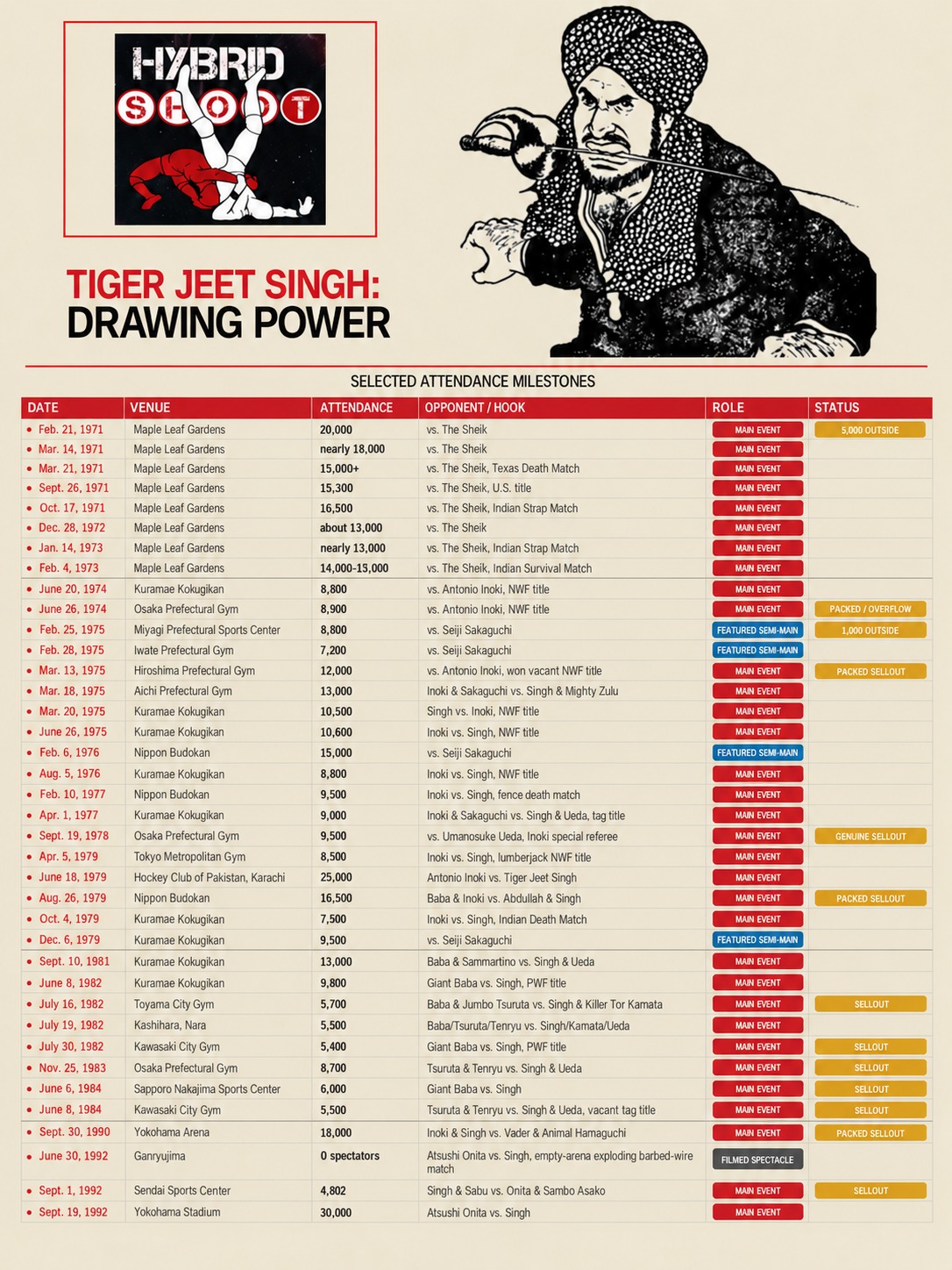
Twenty thousand people came to Maple Leaf Gardens to see him try. Promoter Frank Tunney told the Globe and Mail that it was one of the largest wrestling crowds the building had ever seen.33
“There were another 5,000 people milling about outside that didn’t get in,” Tunney said, citing a police estimate.
The Sheik attacked Singh before he could even remove his robe. Blood poured into Singh’s eyes, temporarily blinding him. Reaching for his opponent, he accidentally grabbed referee Tiger Tasker instead and applied his cobra hold. Tasker went unconscious, a second referee entered the ring, and Singh was disqualified.
The match lasted two minutes and fifty-nine seconds.34
Twenty thousand people had paid to see The Sheik lose. Instead, he’d beaten another opponent without really winning.
So they came back.
On March 14, some 18,000 people watched the two men beat each other bloody. Jerry Gladman, covering the match for the Toronto Telegram, was enjoying himself.
“Jeet chopped. Sheik bopped. Sheik zapped. Jeet zopped.”35
The referees finally stopped the contest, unable to determine a winner and apparently concerned that one of the wrestlers might actually die.
Neither man had won. Neither man had lost.
“Until next week, same time, same place . . . same massacre,” Gladman concluded.36
He wasn’t kidding.
Seven days later, more than 15,000 people returned for a Texas Death Match. Singh attacked The Sheik while the latter was conducting his pre-match prayers, a breach of etiquette the villain took personally. He produced his pencil and began carving up Singh’s forehead.
Both men eventually crashed to the canvas. The Sheik rose before the count of ten. Singh didn’t.37
Another victory for The Sheik. Another Sunday night’s business for Frank Tunney, profiting more than anyone from the lawlessness.
By October, they were trying to settle matters with an Indian Strap Match. The rules were simple enough. The wrestlers would be tied together at the wrists by a leather strap, preventing The Sheik from fleeing whenever Singh started getting the better of him.
Sixteen thousand five hundred people came to watch.
The strap worked, after a fashion. Neither man could get away from the other. But they soon discovered another use for it.
They began strangling each other.
Allan Ryan, writing in the next day’s Toronto Star, described the wrestlers lying “head-to-head, motionless and slightly blue in the face.” Both had choked the other into unconsciousness.
Ryan called it an “air match.”38
Nobody won. But at least no one died.
Two weeks later, with another crowd exceeding 15,000 in attendance, they tried the strap match again. Singh had The Sheik inside the ring, the leather wrapped around his throat, and was leaning backward from the floor to tighten it.
At which point Abdullah Farouk slipped The Sheik something sharp.
The Sheik cut the strap.
Singh went flying backward onto the floor and was counted out.39
It was becoming difficult to imagine what these men might do next, or how they would find another way to avoid settling the matter. But the audiences were willing to find out. In January 1973, nearly 13,000 people came to see yet another strap match. Both wrestlers again ended up strangling each other into a draw.
The following month brought another 14,000 spectators and an Indian Survival Match. This time, the winner was whoever could leave the ring and walk down the runway while his opponent lay incapacitated. After a disagreement involving the timekeeper’s table, The Sheik managed the journey. Singh remained on the mat.40
The Sheik had survived again.
What Singh learned from all this was worth a great deal more than the money he earned in Toronto. The crowds had come to see violence, to see blood, to see the most hated man in wrestling finally get what was coming to him. And every time The Sheik managed to escape, they bought another ticket.
That was the business.
In Canada, Tiger Jeet Singh was given the unenviable task of trying to stop the madman. In Japan, he’d soon discover how profitable it could be to play the madman himself.
The Rivalry Expands
By the summer of 1974, Inoki was getting his money’s worth, earning dividends on the Isetan attack.
In June, Singh burned him with fire during a heavyweight championship match at Tokyo’s Kuramae Kokugikan. Six days later, the two met again before a reported 8,900 people at Osaka Prefectural Gymnasium, an impressive crowd in the days before the giant stadium spectacles we see these days.
This time Inoki was the dangerous one.
He caught Singh in an arm breaker and kept wrenching. Singh’s right arm was left hanging uselessly. The incident entered Japanese wrestling history as the day Inoki broke Singh’s arm. Journalist Yoshihiro Inoue, who covered the rivalry, later clarified that no bone had actually been broken. The arm had nevertheless suffered serious damage.41
“Yamamoto came in and pulled Inoki off me,” he later recalled, according to Inoue. “That saved me. If Yamamoto hadn’t come in, I don’t know what would have happened to me.”
He had reached a new understanding of his opponent.
“Inoki is a scary man. If you really make him angry, he’s even crazier than I am.”
Inoue believed Singh had discovered something about Inoki that the Japanese star himself hadn’t fully understood.
“Inoki already had that madness in him,” he said, “but I think Singh deserves a lot of credit for setting it on fire.”42
For the man who had built New Japan around the scientific wrestling of Karl Gotch and Lou Thesz, it was an interesting development. He was now beating foreign villains at their own game, and the audiences were paying to see him do it.
Japan had major venues like Nippon Budokan and Kuramae Kokugikan, but much of professional wrestling’s regular touring business took place in prefectural gymnasiums, municipal arenas and civic halls. Filling those buildings repeatedly was the job description. And in Singh’s case, that matters more than any single spectacular attendance figure. He was an attraction promoters could bring back again and again, often to the same building, and still do strong business.
But before things could feel too rote, Singh had another trick he was waiting to unveil to fans who thought they understood exactly what to expect.
On March 13, 1975, he challenged Inoki for the vacant NWF heavyweight championship in Hiroshima. Twelve thousand people packed the prefectural gymnasium. After nineteen minutes, Singh pinned Inoki and became champion.43
That was remarkable enough. Inoki’s losses were the rarest of relics. Three months later, Singh did something stranger.
He wrestled a clean match.
On June 26, exactly one year after the notorious arm-breaking incident, Singh defended the championship at Tokyo’s Kuramae Kokugikan. More than ten thousand people came to see what new outrage the Mad Tiger had planned for their hero.
Singh arrived with his familiar saber, but surrendered it at ringside. He didn’t use weapons. He didn’t resort to the usual fouls. Instead, he spent three falls wrestling the kind of match Inoki had supposedly founded New Japan to promote.44
Inoki took the first fall. Singh answered with an Argentine backbreaker, forcing him to submit. Inoki finally regained the championship in the deciding fall.
When it was over, Singh accepted the defeat and raised Inoki’s hand.
No sneak attack. No wounded referee. No fire.
Tadao Monma, the wrestling historian, called it the Mad Tiger’s performance of a lifetime.45
The feat was possible because Singh was a much better wrestler than his reputation suggested. He had the amateur background, the conditioning Fred Atkins had beaten into him, and a perfectly respectable command of professional wrestling technique. He simply understood that there was usually more money in doing something else entirely. When he finally gave audiences a clean wrestling match, the surprise was as effective as any spectacular high spot.
Always keep them guessing. Whenever the opportunity arose, he said, he could fight Inoki with technique.
“I had a background in amateur wrestling,” Singh explained in a 2010 interview. “And I had gone through very hard training.”46
Yoshihiro Inoue believed the rivalry lasted because both men understood how to make the familiar seem exciting.
“Inoki vs. Singh was different,” he recalled, comparing it with other successful rivalries. “They kept repeating the same general patterns, yet every time we watched, we found ourselves impressed all over again.”47
Inoki, it turned out, understood exactly what he had in Singh.
“Singh is misunderstood by everyone,” he told Inoue. “There isn’t another wrestler who thinks more seriously about professional wrestling, trains as desperately, and, even after tonight’s match is finished, keeps thinking about tomorrow’s match.”48
The returns justified the effort. New Japan’s television ratings climbed. Major arenas filled. Singh and Inoki fought in nearly every conceivable variation of a professional wrestling match, often before thousands who had already seen them fight before.
In February 1976, a televised tag match featuring Singh helped World Pro Wrestling reach a 26.8 percent rating, one of the highest in the program’s history. In February 1977, Inoki and Singh met in a fence death match at Nippon Budokan.49
And the act kept going.
Singh’s success wasn’t confined to his rivalry with Inoki. In 1977, he found a partner almost as troublesome as himself.
Umanosuke Ueda was a Japanese wrestler with bleached-blond hair, a nasty disposition, and little interest in playing the hometown hero. Known as the Spotted Wolf, he had adopted the tactics of the hated foreign villains, making himself one of Japanese wrestling’s most despised figures.
Together, they became the Wolf Pack.50
On February 2, 1977, Singh and Ueda defeated Seiji Sakaguchi and Strong Kobayashi for the NWA North American Tag Team Championship. They became an enormous attraction, drawing crowds across Japan and giving New Japan another reliable main event.51
Television producer Mitsuo Kuriyama recalled that management initially doubted Ueda’s drawing power. Those doubts disappeared when the partnership proved successful.52
The act was so popular that New Japan executive Hisashi Shinma once asked Weekly Fight editor Yoshihiro Inoue what kind of match might produce an extraordinary crowd in Osaka.
Inoue had an idea.
Have Singh and Ueda fight each other.
On September 19, 1978, they did, with Antonio Inoki serving as special referee.
The match drew an announced 9,500 spectators to Osaka Prefectural Gymnasium. More importantly, the building was genuinely sold out. According to New Japan personnel, it was the first time the promotion had filled the arena without giving away complimentary tickets.
“Normally we give out complimentary tickets, but today it’s all cash,” wrestler Hoshino told Inoue.53
The match was less impressive than the business. Singh beat his former partner bloody, and Ueda escaped with a disqualification victory.
Inoki, who had expected a tremendous fight, was furious at the disappointing performance.
But the customers had already paid.54
Whatever their differences, Singh and Ueda eventually reunited. Their partnership continued for years, surviving the move to Giant Baba’s All Japan in 1981, where they remained a major attraction.
For Singh, the relationship meant more than successful business.
“Ueda-san was a wrestler I could genuinely respect,” he recalled in a 2010 interview. “I met many foreign wrestlers on tours. We would greet one another casually, but there were very few people I ever truly connected with from the heart.”55
That, he said, was why they made such a good team.
By 1979, Giant Baba and Antonio Inoki had spent seven years competing for control of Japanese professional wrestling. Inoki had repeatedly challenged his former partner to a match, and Baba had repeatedly declined. Getting the two men into the same ring had become one of the industry’s great impossible dreams.
Tokyo Sports, celebrating its twentieth anniversary, decided to make it happen.
The newspaper persuaded New Japan, All Japan and International Wrestling Enterprise to participate in a joint show at Nippon Budokan. Baba still wouldn’t wrestle Inoki, but he finally agreed to reunite their once-famous tag team. The next question was whom they should wrestle.
Tokyo Sports put it to the fans.
The newspaper received 68,448 ballots, with readers choosing three potential opposing teams apiece. The Funk brothers, Dory and Terry, were enormously popular. So were young Japanese stars Jumbo Tsuruta and Tatsumi Fujinami. Fans could choose from combinations featuring world champions, celebrated technicians and international attractions.56
The winners?
Abdullah the Butcher and Tiger Jeet Singh.
They received 41,193 votes, edging the Funks by just 317. Tsuruta and Fujinami finished a distant third with 34,405.57
It was an extraordinary endorsement of two men whose professional identities revolved around making people hate them.
Wrestling historian Fumi Saito thought the result made perfect sense. Butcher was All Japan’s marquee foreign villain. Singh occupied the same position in New Japan. Putting them together against the country’s two greatest wrestling heroes was an almost perfect piece of matchmaking.
It was also, according to New Japan executive Hisashi Shinma, exactly what the promoters had wanted all along.
“The main-event card was what Tokyo Sports wanted from the start,” he recalled. “But if you decide it immediately, you can’t build anticipation, right?”58
So they held the vote. And the fans obliged.
The result was a financial bonanza.
Tickets went on sale August 3, and the expensive seats began disappearing immediately. All 528 of the ¥20,000 special seats sold. Those tickets alone accounted for more than ¥10 million. By the time the show arrived, nearly everything had been purchased in advance.
About fifty fans began camping outside Budokan at eight o’clock the previous evening. By the morning of August 26, nearly a thousand people were waiting for the remaining general-admission tickets. Later, the line to enter the building stretched roughly a kilometer.59
The announced attendance was 16,500, described in contemporary coverage as a record for an indoor professional wrestling show in Japan.
The gate was reportedly the largest the business had produced. Advance estimates had suggested revenue might approach ¥100 million, an almost unthinkable figure for professional wrestling at the time. 60
Ticket money was pouring in. The television networks, meanwhile, couldn’t even agree on how to show the thing. Their competing exclusive contracts prevented a conventional live broadcast. Fans at home would have to settle for brief news highlights, although TV Asahi recorded the major matches.61
The politics extended to the finish.
According to Shinma, Inoki approached Baba the night before the show with a proposal. The obvious outcome was a disqualification, protecting everybody’s stars. Inoki thought that would disappoint the audience.
He wanted a decisive victory.
“But Butcher is All Japan’s marquee foreigner,” Inoki reportedly reasoned, “so I’ll finish Singh.”
Baba was less enthusiastic. They had a carefully constructed plan. He didn’t like surprises. Shinma remembered Baba’s reaction to Inoki’s attempt to change the agreement at the last possible moment as essentially “Kanji being Kanji.” Baba sighed. The two promoters had spent years distrusting one another, and apparently weren’t about to stop now.62
The next evening, Singh and Butcher entered Budokan looking determined to justify every vote.
Singh marched toward the ring with his saber and attacked ring announcer Tetsuo Baisho. Butcher smashed a framed commemorative certificate, breaking the glass and cutting his own hand in the process.
The match hadn’t even started.
On the surviving television recording, announcer Ichiro Furutachi proclaimed the arrival of the most vicious team in wrestling history.63
The villains did their best to live up to the introduction.
For thirteen minutes, they brawled with Baba and Inoki, drew blood, produced concealed weapons, and generally behaved as though they had wandered into the wrong kind of sporting event.
Singh nearly won it with a brainbuster on Inoki. When he tried a second, Inoki slipped behind him and caught him in a reverse cradle.
One, two, three.64
The most famous tag team in Japanese wrestling had reunited and won. Singh, whose Japanese career had been built around making Inoki’s life miserable, had provided the final victim.
Then Inoki grabbed the microphone.
“The next time the two of us meet in the ring,” he told Baba, “it will be to fight!”
Baba, smiling before 16,500 excited fans, agreed.
They never did wrestle each other.65
Backstage, Baba was still shaking his head at the behavior of their opponents.
“Butcher and Singh were completely outrageous,” he complained. “That wasn’t professional wrestling.”
Singh had his own assessment.
“You say I’m crazy? You’re the crazy ones.”66
Singh remained one of New Japan’s principal attractions throughout the 1970s, always there between Inoki’s forays into the martial arts and his occasional battles with fellow Japanese stars.
He was also setting an example for the next generation of foreign wrestlers.
Stan Hansen arrived in New Japan in 1977, a hard-hitting Texan who would become one of the most successful foreign wrestlers in Japanese history. And he was paying close attention to Tiger Jeet Singh.
Hansen had toured All Japan with Abdullah the Butcher and New Japan with Singh. Both men, he remembered, could take an ordinarily quiet Japanese audience and whip it into a frenzy. But Singh’s entrance, swinging his saber and charging into the crowd, particularly impressed him. Hansen had never seen anything quite like it, even in America.
“There’s no question that my bullrope entrance and wild wrestling style were heavily influenced by Singh,” Hansen told Japanese journalist Gantz Horie.67
Hansen eventually became one of Japan’s biggest attractions himself, charging toward the ring with his cowbell and bullrope, scattering spectators just as Singh had done with his saber. Bruiser Brody followed a similar template. Singh was the original.
His final New Japan match of the eighties came on June 4 at Kuramae Kokugikan, against Inoki in the Fourth MSG Series. There was something different about him that night.
For much of the match, he wrestled straight.
“Singh wrestling strong style threw me off,” Inoki reportedly said afterward.68
Then Singh reverted to form. He kicked Inoki squarely in the groin and was disqualified.
It was no ordinary low blow. Inoue remembered Inoki being carried backstage, his face completely white, unable to speak. Somehow, Inoki recovered sufficiently to return for the tournament final against Stan Hansen.
Singh, meanwhile, did something even more extraordinary than wrestling a clean match. Walking toward the dressing room, he reached out and shook hands with spectators, including women and young boys.
Inoue had never seen him behave that way before.
Only later did he understand what he believed had happened. Singh knew he was leaving New Japan. He had gone into the match wanting to fight Inoki the way Inoki preferred, but also wanting to give him one last taste of the Mad Tiger.
“Both were farewell gifts to Inoki,” Inoue concluded.69
Perhaps.
By 1981, Japan’s two major wrestling companies were competing for those attractions with open checkbooks. New Japan struck first, luring Abdullah the Butcher away from Giant Baba’s All Japan. Butcher had been Baba’s premier foreign villain for years, and losing him was no small matter.
Baba retaliated by going after Inoki’s longtime tormentor.
“When I heard rumors that Butcher was coming to New Japan, I asked them about it. They told me, ‘Don’t worry.’ But when I went to Japan, Butcher was there in New Japan,” Singh remembered. “I thought, ‘Then what did all those words mean?’ I had given so much of my life to this company, and now they were lying to me.”70
When New Japan executive Hisashi Shinma heard that Singh was considering an offer, he tried to keep him with a $500-a-week raise. Baba had considerably more money in mind.
According to a July 1981 report in Weekly Fight, Singh signed a three-year agreement with All Japan calling for eighteen weeks of work annually at $8,000 a week, reportedly twice his previous salary.71
The man who had arrived in Canada with six dollars in his pocket could now earn $8,000 for a week’s work.
And the bidding wasn’t finished.
In December, Baba landed an even bigger prize, convincing Hansen to abandon New Japan for All Japan. Within months, the two companies had traded three of their most valuable foreign stars. The wrestling war was becoming a financial war, with the wrestlers themselves among its biggest beneficiaries.72
Singh certainly wasn’t complaining about his new arrangement.
“Why not use my strength to rebuild Papa’s place?” he said of joining Baba.73
There was one particularly appropriate detail about Singh’s move. The man who helped broker his new contract, bringing his Japanese career full circle, was none other than The Sheik.74
After all those years, the old bastard was still helping him make money.
Inoki wasn’t convinced that Singh would have quite the same success working for Giant Baba.
“I don’t chase people who leave,” he said. “But I wonder whether Singh can wrestle in an All Japan ring the same way he wrestled in ours. Their basic wrestling style is different from ours.”75
It was a reasonable question. All Japan was a very different operation from New Japan. Baba built his cards around the international elite: the Funk brothers, Harley Race, Mil Máscaras, Nick Bockwinkel and other accomplished wrestlers whose reputations rested on what they could do inside the ring.
Singh’s reputation rested largely on what he might do outside it.
But that was precisely what Baba had purchased.
Contemporary wrestling coverage described the arrival of Singh and his longtime partner, Umanosuke Ueda, as a dose of “shock therapy” for All Japan, introducing some dangerous poison into a promotion whose polished wrestling had begun to show its age.
On October 9, 1981, All Japan celebrated its tenth anniversary at Kuramae Kokugikan. The card featured Ric Flair defending the NWA world championship against Jumbo Tsuruta, Bruiser Brody against Dory Funk Jr., and Mil Máscaras defending his title against Mighty Inoue.
The main event?
Giant Baba and Bruno Sammartino against Tiger Jeet Singh and Umanosuke Ueda.
Thirteen thousand spectators were announced for the show. The main event degenerated into a brawl and ended in a double countout after less than twelve minutes.76
Apparently, Singh was fitting in just fine.
Singh never occupied quite the same position in All Japan that he had in New Japan. He worked further down some cards—but he continued to headline major shows when called upon, an ace that was always up Baba’s sleeve.
In 1982, he challenged Baba for the PWF heavyweight championship, including a sold-out show in Kawasaki. In July 1983, Singh and Ueda defeated Baba and Tsuruta for the NWA International Tag Team Championship in Fukuoka. In November, they faced Tsuruta and Genichiro Tenryu before a reported sellout of 8,700 at Osaka Prefectural Gymnasium.77
Five years after leaving Inoki, Singh was still doing important business.
Perhaps the clearest indication of Baba’s confidence came in November 1986, when former sumo grand champion Hiroshi Wajima made his professional wrestling debut.
Wajima was no ordinary rookie. A former yokozuna, he was one of Japan’s most recognizable athletes. His move into professional wrestling attracted coverage from the national newspapers, television networks and even NHK.
Baba chose Singh as his first opponent.
“As an opponent, I couldn’t ask for more,” Wajima said.78
On November 1, before a packed house in Wajima’s home prefecture of Ishikawa, Singh attacked the former sumo champion before the bell, waving his saber while Wajima was still wearing his entrance gown.
Wajima fought back with tackles, chops and kicks, but the match soon descended into the sort of chaos Singh had spent his career perfecting. The referee disqualified both men after five minutes and fifty-five seconds.
Even that wasn’t the end of it.
As Singh retreated toward the dressing room, Baba shoved Wajima after him, encouraging his new star to continue the fight.79
It was a carefully chosen introduction. Rather than ask Wajima to demonstrate an unfamiliar repertoire of professional wrestling holds, Baba had given him a man who could make a fight out of practically anything. He knew Japan was watching. He trusted Singh to deliver.
After all, Singh had been doing that for more than twenty years.
By 1990, Antonio Inoki had entered Japanese politics and was spending considerably less time in the ring. But for his thirtieth anniversary in professional wrestling, New Japan had an idea that would have seemed unthinkable during the 1970s.
Inoki and Tiger Jeet Singh would become tag team partners.
On September 30, the old enemies faced Big Van Vader and Animal Hamaguchi at Yokohama Arena. A typhoon battered the Tokyo area, but an announced sellout crowd of 18,000 filled the building.80
For Singh, it was an occasion worth remembering.
“It was the first time Inoki and I had ever teamed together, but I think we understood each other very well and had very good teamwork,” he recalled in a 2010 interview. “It was a great success.”81
He was particularly impressed by Inoki’s physical condition, considering how little he had wrestled since entering politics.
Not everybody appreciated the reunion. Wrestling historian Tadao Monma thought the sight of Singh and Inoki cooperating exposed too much of the wrestling business. After all those years of bloody battles, seeing them suddenly become partners seemed to drain the old rivalry of its meaning.82
But there was a reason New Japan had brought Singh back. He was an indispensable part of Inoki’s history.
Two years later, another Japanese promoter found a very different use for him.
Atsushi Onita had built Frontier Martial-Arts Wrestling, or FMW, into an unlikely sensation through increasingly violent matches involving barbed wire, fire, and explosives. His audiences expected mayhem, and he was forever searching for new ways to provide it.
In the summer of 1992, Onita’s nemesis, The Sheik, promised to bring two mystery allies into FMW. One of them turned out to be his old enemy from Toronto.
On June 25, at Sapporo’s Nakajima Sports Center, 6,548 spectators watched as the lights dimmed for The Sheik’s entrance. Suddenly, Singh appeared from the opposite side of the arena, saber in hand.
He charged into the barbed-wire cage and attacked Onita before the match could begin, leaving him bleeding. Then he disappeared, climbing into a waiting taxi while The Sheik entered the ring to finish the job.
For years, writers had wondered whether Singh had lost some of the terrifying presence that once made him Inoki’s greatest enemy. Now his “wild fangs” had completely returned.
Five days later, Onita and Singh met in one of the strangest matches in wrestling history.
FMW erected a ring on a muddy field at Sekigahara, the site of the famous battle that helped determine control of Japan in 1600. There were no spectators. Instead of ropes, the ring was surrounded by barbed wire rigged with explosives.
It was raining.
Singh had spent nearly thirty years frightening wrestling audiences, but electrically triggered explosions were something new. When he first stumbled into the wire and a charge detonated, he rolled in the mud. Then he retrieved his saber and began driving Onita into the explosives.
At 7:03, Singh pinned him.
The Sheik and his protégé Sabu appeared afterward, with The Sheik throwing a fireball into Onita’s face. The old men had won another battle.
Singh became a centerpiece of FMW’s summer tours. Before one Korakuen Hall show, ring announcer Shoichi Arai issued an unusual warning:
“We have a number of vicious and brutal foreign wrestlers appearing on this tour. If you are injured, FMW cannot accept responsibility.”
The crowd laughed.
Then Singh appeared, swinging his saber and charging through the spectators.
The laughter stopped.
FMW was selling a new generation of Japanese fans the same dangerous Indian madman who had helped make New Japan famous twenty years earlier.
The feud culminated on September 19, 1992, at Yokohama Stadium. An announced crowd of 30,000 attended FMW’s third-anniversary show, with Singh defending the World Martial Arts Heavyweight Championship against Onita in a No-Rope Barbed-Wire Electric-Current Landmine Explosion Deathmatch.
The stipulations were practically a parody of themselves, but the spectacle was enormous. Whenever a wrestler struck the wire, an explosive charge could trigger a second, larger blast from a landmine positioned around the ring.
After nearly fourteen minutes, Singh stumbled backward onto one of the mines. A column of fire erupted around him.
Onita seized the opportunity, lifting the forty-eight-year-old Singh for his Thunder Fire Powerbomb. At 13:57, he scored the pin.
The crowd got its happy ending.
In 1973, Singh had helped Inoki build New Japan by making himself the man everyone wanted to see beaten. In 1992, he did the same for Onita.
New wrestlers, new promoters, new explosives.
Tiger Jeet Singh was still selling tickets.83
Life Beyond the Ring
Tiger Jeet Singh had no intention of ending up like the old wrestlers who stayed in the ring long after their bodies had given out.
In August 1973, newspaper reporter John Davidson accompanied Singh to a wrestling match in Brantford, Ontario, riding in his big, air-conditioned Cadillac. Away from the ring, the terrifying wrestler was friendly, articulate and remarkably candid about money.
“Lots of guys live really high when they’re on top,” Singh told him. “But as soon as they get hurt they go broke awful fast. Many of them die poor, poor men.”84
Singh intended to avoid their fate. He already owned property in India and had opened an imported-handicrafts store in Toronto with his brother-in-law. He wrestled only part of the year, dividing his time between the ring, his family and his business interests.
As the years passed, those investments grew. Japanese television producer Mitsuo Kuriyama, visiting Singh’s Canadian home, was astonished by its scale and by the discovery that his guest owned tens of thousands of chickens. Poultry farming was only one of several businesses Singh pursued, alongside importing and real estate.85
The Mad Tiger had become a prosperous Canadian businessman.
Wrestling historian Tadao Monma thought the two occupations were closely related. Singh, he wrote, was an “Indian merchant” selling villainy. He understood that his frightening reputation was something he could sell, and he worked tirelessly to preserve its value.86
But accumulating money was only part of Singh’s story.
In Milton, Ontario, where he made his home, Singh became a prominent community leader and philanthropist. He and his son, former WWF wrestler Tiger Ali Singh, established the Tiger Jeet Singh Foundation to support children’s hospitals, schools, and families in need.
Their annual Miracle on Main Street campaign grew into a major charitable undertaking. In 2023, the foundation reported more than $1.1 million in combined donations and sponsorships, benefiting hospitals, food banks, schools, and dozens of community organizations.87
In 2010, Tiger Jeet Singh Public School opened in Milton, Ontario, recognizing his contributions to the community. It was the first Canadian school named in honor of a person of South Asian descent.88
His affection for Japan had hardly diminished either.
After the devastating earthquake and tsunami of March 2011, Singh and his foundation organized relief efforts for Japanese children. They sold red-and-white wristbands for five dollars apiece, raising money and encouraging Canadian students to send messages of support to children whose lives had been upended by the disaster.89
The Japanese government subsequently recognized the foundation’s relief work. Then, in April 2024, came an even greater honor.90
Singh, then eighty, was awarded the Order of the Rising Sun, Gold and Silver Rays, for his contributions to friendship and mutual understanding between Japan and Canada through sports.91
At the September presentation ceremony in Toronto, he was joined by his son and congratulated by Canadian and Japanese dignitaries. Prime Minister Justin Trudeau sent a video message.
Singh called Japan his second home. He said the decoration belonged to professional wrestling fans as much as it belonged to him.92
The announcement also produced an extraordinary little moment on Japanese morning radio.
On Ohayo Terachan, a news and current affairs program on Nippon Cultural Broadcasting, economic commentator Tsukasa Jonen interrupted a discussion of the government’s spring honors to imitate Singh’s entrance music.
“Dun-da-da-dun-da-da-dun…”
Host Naomasa Terashima immediately knew whom he meant. They began reminiscing about the saber, the terrifying entrances and the wrestler who had once seemed genuinely dangerous.
Jonen remembered being frightened of Singh as a boy. Terashima remembered something else about him.
“Once you saw him as a kid,” he said, “you never forgot him.”93
In the West, Tiger Jeet Singh has largely faded from wrestling’s collective memory. In Japan, as that anecdote illustrates, he’s still part of the cultural landscape. Half a century after he first terrorized Antonio Inoki, two men discussing the news on a mainstream morning radio program remembered him well. Singh had become part of the country’s popular culture, a figure whose fame extended far beyond wrestling fans. He helped build New Japan into a national powerhouse, drew enormous crowds in two countries, influenced a generation of foreign wrestlers, and remained a valuable attraction across three decades of Japanese wrestling.
No serious discussion of Japanese professional wrestling’s greatest foreign stars can leave out Tiger Jeet Singh. His Hall of Fame case doesn’t rest on nostalgia. It rests on the money he drew, the television audiences he attracted, the rivalries he helped create, and the extraordinary cultural impression he left behind. The evidence has been there all along, even if much of it has been overlooked by Western historians and voters.
Tiger Jeet Singh belongs in the Hall of Fame.
Jonathan Snowden is an author covering professional wrestling, mixed martial arts, and boxing for Hybrid Shoot. His next book, The Era of the Hitman: How Bret Hart Conquered Pro Wrestling, is scheduled for release in April 2027 through ECW Press
Endnotes
- MIYA TERU, ‘Antonio Inoki vs. Tiger Jeet Singh, Part 1: The Shinjuku Isetan Attack and Osaka Arm-Breaking Incident,’ 1970年生まれ 男のロマンBlog, June 19, 2018; Tokyo Sports, November 7, 1973.
- Tokyo Sports, November 7, 1973, interviews with Antonio Inoki and Keisuke Inoki, reproduced in MIYA TERU, ‘Antonio Inoki vs. Tiger Jeet Singh,’ Part 2 (2018).
- Tiger Jeet Singh, interview in Antonio Inoki 50 Years, vol. 1 (May 2010), reprinted in Weekly Pro Wrestling/BBM, ‘Tiger Jeet Singh on Antonio Inoki,’ Part 1.
- Mitsuko Baisho, interview in Tokyo Sports, November 7, 1973; reproduced in MIYA TERU, ‘Antonio Inoki vs. Tiger Jeet Singh,’ Part 2 (2018).
- Tiger Jeet Singh, interview in Antonio Inoki 50 Years, vol. 1 (2010); MIYA TERU, ‘Antonio Inoki vs. Tiger Jeet Singh,’ Parts 1–2 (2018).
- Fumi Saito, 猪木と馬場 (Inoki and Baba) (Tokyo: Shueisha, 2022), 74; Tokyo Sports, November 7, 1973.
- Yasuo Sakurai, recollections of the Isetan incident, G-Spirits, Antonio Inoki special issue; excerpted in MIYA TERU, ‘Antonio Inoki vs. Tiger Jeet Singh,’ Part 1 (2018).
- Gantz Horie, 闘魂と王道―昭和プロレスの16年戦争― (Wani Books, 2022), 1973 section; Tadao Monma, Antonio Inoki: The Genes of Fighting Spirit, chap. 10.
- Tadao Monma, Antonio Inoki: The Genes of Fighting Spirit, chap. 10.
- Mr. Takahashi, 流血の魔術 最強の演技―すべてのプロレスはショーである (The Magic of Bloodshed: The Ultimate Performance) (Tokyo: Kodansha, 2001); Keisuke Inoki, 兄 私だけが知るアントニオ猪木 (My Brother: The Antonio Inoki Only I Knew) (Tokyo: Kodansha, 2025).
- Bill White, interview, Weekly Gong, June 9, 2004; reproduced in MIYA TERU, “Antonio Inoki vs. Tiger Jeet Singh,” Part 3, 1970年生まれ 男のロマンBlog, June 21, 2018.
- Tadao Monma, Antonio Inoki: The Genes of Fighting Spirit, chap. 10.
- MIYA TERU, ‘Antonio Inoki vs. Tiger Jeet Singh,’ Part 1 (2018), on New Japan’s November 8, 1973 Numazu show.
- Tiger Jeet Singh, interview in Antonio Inoki 50 Years, vol. 1 (May 2010), reprinted in Weekly Pro Wrestling/BBM, ‘Tiger Jeet Singh on Antonio Inoki,’ Part 1.
- Fumi Saito, 猪木と馬場 (Inoki and Baba) (Shueisha, 2022), 74.
- ‘好漢・猪木に直言する—あまりにも違いすぎる口にする理想と現実’ (‘Speaking Frankly to Inoki: His Ideals and Reality Are Far Too Different’), プロレス (Pro Wrestling), Baseball Magazine Sha, January 1974, 100–102.
- Gantz Horie, 闘魂と王道―昭和プロレスの16年戦争― (Wani Books, 2022), 1973 section; Tadao Monma, Antonio Inoki: The Genes of Fighting Spirit, chap. 10.
- Hisashi Shinma, interview in Gantz Horie, 闘魂と王道―昭和プロレスの16年戦争― (Wani Books, 2022), 1973 section.
- Hisashi Shinma, interview in Gantz Horie, 闘魂と王道―昭和プロレスの16年戦争― (Wani Books, 2022), 1973 section.
- Hisashi Shinma, interview in Gantz Horie, 闘魂と王道―昭和プロレスの16年戦争― (Wani Books, 2022), section on Singh’s 1973 arrival.
- Mitsuo Kuriyama, ‘救世主タイガー・ジェット・シン’ (‘Savior Tiger Jeet Singh’), in 『ワー・プロ』を創った男 (The Man Who Created World Pro Wrestling), Weekly Fight, February 16, 2017, https://miruhon.net/60650.
- “好漢・猪木に直言する―あまりにも違いすぎる口にする理想と現実” (“Speaking Frankly to Inoki: His Ideals and Reality Are Far Too Different”), Pro Wrestling (プロレス), Baseball Magazine Sha, January 1974, p. 101; citing the November 25, 1973, morning edition of the Yomiuri Shimbun.
- Rediff Sports, ‘Tiger Singh: Most Feared Man in Japan,’ May 5, 2005, https://www.rediff.com/sports/special/sspec/20050505.htm.
- John Davidson, ‘Good Guys, Bad Guys—It’s a Tough, Rich Life,’ The Financial Post, August 18, 1973.
- ‘Tiger Jeet Singh (Jagjit Singh Hans): Among Top 25 Canadian Immigrants 2012,’ SikhChic, June 12, 2012, https://www.sikhchic.com/article-detail.php?cat=5&id=3407.
- Tiger Jeet Singh, recollections of Fred Atkins’s training, interview with Yoshihiro Inoue, Weekly Fight, ‘Fight Documentary Theater 11’; see also Davidson, ‘Good Guys, Bad Guys,’ The Financial Post, August 18, 1973.
- Tiger Jeet Singh, interview with Yoshihiro Inoue on Fred Atkins’s training, reproduced in Weekly Fight, ‘Fight Documentary Theater 11,’ September 22, 2021.
- Tiger Jeet Singh, recollections of Hans Schmidt and Fred Atkins, as reported in Yoshihiro Inoue’s interviews and Weekly Fight’s Singh retrospective material.
- Maple Leaf Gardens wrestling card, September 1965; Toronto wrestling newspaper results and match listings.
- Noel Bates, Toronto Star, June 12, 1967.
- Toronto Star and Toronto Telegram reports and wrestling results, June–August 1967, Singh–Johnny Valentine series.
- Toronto wrestling newspaper listings and results, summer and autumn 1967, Singh’s matches against Gene Kiniski and Bruno Sammartino.
- Globe and Mail, February 22, 1971, Frank Tunney’s account of the Singh–Sheik crowd at Maple Leaf Gardens.
- Globe and Mail, February 22, 1971, report on Singh versus the Sheik, February 21, 1971.
- Jerry Gladman, Toronto Telegram, March 15, 1971, report on Singh versus the Sheik.
- Gladman, Toronto Telegram, March 15, 1971.
- Toronto wrestling reports, March 22, 1971, Singh–Sheik Texas Death Match.
- Allan Ryan, Toronto Star, October 18, 1971, report on the Indian Strap Match.
- Toronto Star and Toronto Telegram coverage of Singh–Sheik strap matches, October–November 1971.
- Globe and Mail, ‘Rotten Table Manners Bring Win for Sheik,’ February 5, 1973; Toronto wrestling coverage, January–February 1973.
- Yoshihiro Inoue, ‘Fight Documentary Theater 7: The Legendary Arm-Breaking Incident,’ Weekly Fight, August 27, 2021.
- Yoshihiro Inoue, ‘Fight Documentary Theater 7: The Legendary Arm-Breaking Incident,’ Weekly Fight, August 27, 2021.
- Tadao Monma, Antonio Inoki: The Genes of Fighting Spirit, chap. 10; Tokyo Sports retrospective on Singh’s NWF championship victory, March 13, 1975.
- ‘“Cold-Blooded Fighter” Tiger Jeet Singh Shows Sportsmanship Against Antonio Inoki,’ Weekly Pro Wrestling / BBM Sports, May 10, 2024, https://www.bbm-japan.com/article/detail/51422; match recording, June 26, 1975.
- Tadao Monma, Antonio Inoki: The Genes of Fighting Spirit, chap. 10.
- Tiger Jeet Singh, interview in Antonio Inoki 50 Years, vol. 1 (May 2010), reprinted by Weekly Pro Wrestling / BBM.
- Yoshihiro Inoue, recollections of the Inoki–Singh rivalry, Weekly Fight, ‘Fight Documentary Theater’ series.
- Antonio Inoki, comments on Singh as recalled by Yoshihiro Inoue, Weekly Fight, ‘Fight Documentary Theater’ series.
- Tadao Monma, Antonio Inoki: The Genes of Fighting Spirit, chap. 10, ‘Ratings Soar’ (on the February 5, 1976 World Pro Wrestling broadcast).
- Tadao Monma, Antonio Inoki: The Genes of Fighting Spirit, chap. 10; Gantz Horie, 闘魂と王道―昭和プロレスの16年戦争― (Wani Books, 2022), 1977 section.
- Mitsuo Kuriyama, ‘Savior Tiger Jeet Singh,’ Weekly Fight, February 16, 2017, https://miruhon.net/60650, ‘The Professional Side of Umanosuke Ueda.’
- Kuriyama, ‘Savior Tiger Jeet Singh,’ Weekly Fight, February 16, 2017, ‘The Professional Side of Umanosuke Ueda.’
- Yoshihiro Inoue, ‘Fight Documentary Theater 39: Singh vs. Ueda,’ Weekly Fight; Weekly Pro Wrestling, retrospective on the September 19, 1978 Osaka sellout, January 2023.
- Inoue, ‘Fight Documentary Theater 39: Singh vs. Ueda,’ Weekly Fight.
- Tiger Jeet Singh, interview in Antonio Inoki 50 Years, vol. 1 (2010), reprinted by Weekly Pro Wrestling / BBM, Part 3.
- ‘Dream All-Star Show Spectator Special,’ Monthly Pro Wrestling, September 1979; Fumi Saito, 猪木と馬場 (Inoki and Baba) (Shueisha, 2022), 88.
- ‘Dream All-Star Show Spectator Special,’ Monthly Pro Wrestling, September 1979, fan-vote totals and ballot results.
- Hisashi Shinma, interview in Gantz Horie, 闘魂と王道―昭和プロレスの16年戦争― (Wani Books, 2022), 1979 section.
- ‘Dream All-Star Show Spectator Special,’ Monthly Pro Wrestling, September 1979, ticket prices and advance sales.
- Contemporary coverage of the Pro Wrestling Dream All-Star Show, Nippon Budokan, August 26, 1979; Gantz Horie, ‘“Baba-san Was Furious…” Why Did the All-Star Show Happen Only Once?,’ Number Web, June 14, 2023, https://number.bunshun.jp/articles/-/857774.
- ‘Dream All-Star Show Spectator Special,’ Monthly Pro Wrestling, September 1979; Gantz Horie, ‘“Baba-san Was Furious…”’, Number Web, June 14, 2023, https://number.bunshun.jp/articles/-/857774.
- Hisashi Shinma, interview in Gantz Horie, 闘魂と王道―昭和プロレスの16年戦争― (Wani Books, 2022), 1979 section.
- Contemporary match-night coverage and television recording of Baba and Inoki versus Singh and Abdullah the Butcher, August 26, 1979.
- Pro Wrestling Dream All-Star Show broadcast recording and match report, August 26, 1979.
- Pro Wrestling Dream All-Star Show broadcast recording and match report, August 26, 1979; Horie, ‘“Baba-san Was Furious…”’, Number Web, June 14, 2023.
- ‘The Thirty Chosen Men: Thus We Fought,’ post-match interviews with Giant Baba and Tiger Jeet Singh, contemporary coverage of the Pro Wrestling Dream All-Star Show, August 26, 1979.
- Gantz Horie, ‘「アントニオ猪木と闘うことで有名になれた」—スタン・ハンセンを覚醒させた猪木の手腕,’ Number Web, October 6, 2022, https://number.bunshun.jp/articles/-/854866?page=2.
- Yoshihiro Inoue, ‘I Can Never Forget How White Inoki’s Face Was—The Brutal Final Inoki vs. Singh Match,’ Fight Wonderland, episode 104, April 29, 1997; reproduced in Weekly Fight, ‘Fight Documentary Theater 43,’ October 13, 2022.
- Inoue, ‘I Can Never Forget How White Inoki’s Face Was,’ Fight Wonderland, episode 104, April 29, 1997; Weekly Fight, ‘Fight Documentary Theater 43,’ October 13, 2022.
- Tiger Jeet Singh, interview in Antonio Inoki 50 Years, vol. 1 (2010); Weekly Fight, ‘Singh to Appear for All Japan—The Sheik Served as Intermediary,’ July 7, 1981.
- ‘シン、全日に出場 仲介役はシーク’ (‘Singh to Appear for All Japan—The Sheik Served as Intermediary’), Weekly Fight, July 7, 1981.
- Gantz Horie, 闘魂と王道―昭和プロレスの16年戦争― (Wani Books, 2022), 1981 section; Fumi Saito, 猪木と馬場 (Shueisha, 2022), 92.
- ‘シン、全日に出場 仲介役はシーク,’ Weekly Fight, July 7, 1981, interview with Singh in Toronto.
- ‘シン、全日に出場 仲介役はシーク,’ Weekly Fight, July 7, 1981.
- Antonio Inoki, comments on Singh’s move to All Japan, in ‘Turbulent Mat World—Japan Edition,’ Japanese wrestling press, 1981.
- All Japan Pro Wrestling, tenth-anniversary show, Kuramae Kokugikan, Tokyo, October 9, 1981, contemporary results and attendance report.
- All Japan Pro Wrestling match records: Baba–Singh PWF title bouts (1982); Singh and Ueda’s International Tag Team title victory (July 1983); and Osaka Prefectural Gymnasium card (November 25, 1983).
- ‘かくて輪島狂奏曲は終わった!’ (‘And So the Wajima Rhapsody Ends!’), Weekly Pro Wrestling, no. 173, November 18, 1986, report on Wajima’s November 1 prematch remarks.
- Weekly Pro Wrestling, no. 173, November 18, 1986, illustrated reports of Wajima’s November 1 debut against Tiger Jeet Singh at Nanao General Civic Gymnasium.
- Tadao Monma, Antonio Inoki: The Genes of Fighting Spirit, chap. 10; Tiger Jeet Singh, interview in Antonio Inoki 50 Years, vol. 1 (2010).
- Tiger Jeet Singh, interview in Antonio Inoki 50 Years, vol. 1 (May 2010), reprinted by Weekly Pro Wrestling / BBM.
- Tadao Monma, Antonio Inoki: The Genes of Fighting Spirit, chap. 10.
- Weekly Pro Wrestling, contemporary coverage of Tiger Jeet Singh’s FMW appearances, June–September 1992.
- John Davidson, ‘Good Guys, Bad Guys—It’s a Tough, Rich Life,’ The Financial Post, August 18, 1973.
- Mitsuo Kuriyama, ‘Savior Tiger Jeet Singh,’ in The Man Who Created World Pro Wrestling, Weekly Fight, February 16, 2017, https://miruhon.net/60650.
- Tadao Monma, Antonio Inoki: The Genes of Fighting Spirit, chap. 10, ‘The Calculating Businessman.’
- Tiger Jeet Singh Foundation, ‘Over $1.1 Million Raised at Miracle on Main!,’ February 21, 2024, https://tigerjeetsinghfoundation.com/2024/02/21/over_1_million_raised_at_miracle_on_main/.
- Halton District School Board, ‘Tiger Jeet Singh—About TJS,’ https://tjs.hdsb.ca/about-tjs.
- Tiger Jeet Singh Foundation, ‘Launch of Japan Relief Campaign a Huge Success,’ April 25, 2011, https://tigerjeetsinghfoundation.com/2011/04/25/launch-of-japan-relief-campaign-a-huge-success/.
- Ministry of Foreign Affairs of Japan and Consulate-General of Japan in Toronto, ‘2024 Spring Conferment of Decorations on Foreign Nationals,’ April 29, 2024, https://www.toronto.ca.emb-japan.go.jp/itpr_en/11_000001_00531.html.
- Consulate-General of Japan in Toronto, ‘2024 Spring Conferment of Decorations on Foreign Nationals,’ April 29, 2024, https://www.toronto.ca.emb-japan.go.jp/itpr_en/11_000001_00531.html.
- Consulate-General of Japan in Toronto, ‘Conferment Ceremony of the Order of the Rising Sun, Gold and Silver Rays, for Mr. Jagjit Singh Hans,’ September 26, 2024, https://www.toronto.ca.emb-japan.go.jp/itpr_en/11_000001_00652.html.
- Nippon Cultural Broadcasting, ‘“Once You See Him as a Child, You Never Forget Him”: The Mad Tiger of India, Tiger Jeet Singh, Receives Decoration,’ Ohayo Terachan program report, April 29, 2024, https://www.joqr.co.jp/qr/article/123556/.