
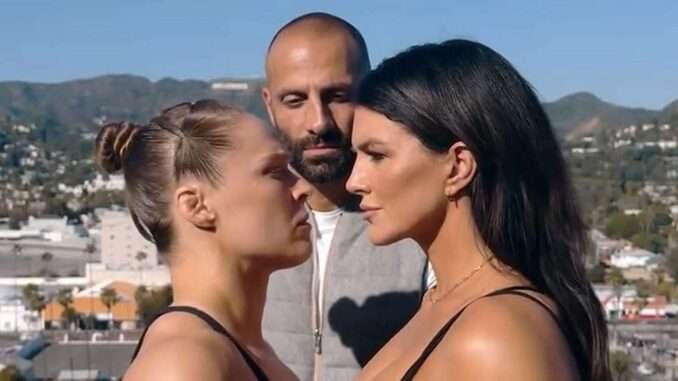
It’s hard to argue against the fact that Most Valuable Promotions delivered a smash hit with its first-ever MMA event last weekend.
I’m willing to admit that I was a skeptic. Heading into Saturday night’s show, I wasn’t sure if a large-scale viewership could be attracted for the broadcast.
North American MMA fans haven’t really shown much of an appetite for non-UFC cards in recent years. Whether it be because promoters don’t know how to get that mainstream appeal, or fans simply couldn’t care to try out a new option, that’s been a large part of UFC’s success story as of late. UFC is so synonymous with MMA that the most casual viewer might conflate the two. Even when Francis Ngannou made his first-ever post-UFC appearance in 2023, it didn’t feel like a massive deal.
Carano and Rousey’s returns, while big for many sections of the lapsed fanbase, might not have been appealing to the Gen-Z crowd, many of whom latched onto UFC when it had a boom of popularity in the COVID-19 pandemic, long after either fighter previously stepped into a cage.
But the numbers argue that Saturday’s show, despite any reason to be skeptical, won the night. On Tuesday, Netflix reported that the broadcast of Ronda Rousey’s 17-second submission win against Gina Carano peaked at nearly 17 million viewers globally, staggering (albeit not unprecedented) numbers for a competitor brand in MMA. An average of 12 million was reported for the three-hour broadcast.
Before last weekend’s main event, MVP head Nakisa Bidarian called the card a “test.” And, by my standards, they passed that assessment with flying colors.
The event was a testament to the drawing power of Carano and Rousey, both over a decade removed from their last fights, and the ability of MVP to quickly make an impact in a sport they had not touched before.
The event went head-to-head with a low-key UFC card, which generated little chatter online. Saturday proved that, when done right, MVP can challenge UFC’s spot as the top promotion. There doesn’t have to be just one company running the sport.
But can they do it right again? That’s a much more complicated problem to solve.
It might be hard for MVP to replicate the situation they found themselves in last weekend: On the streaming goliath that is Netflix, earning a multi-million dollar gate inside an NBA team’s state-of-the-art building, attracting more eyeballs than a head-to-head UFC broadcast.
The question going forward is, with the limited talent pool they can access, is MVP able to once again make a “big” fight?
We have long known that Netflix is in the business of big events. They want MLB’s Opening Day and Home Run Derby, not Friday Night Baseball. They’d like the NFL’s Christmas games, not their Thursday night slate. They want Alex Honnold to tempt death with a climb of the Taipei 101 on a live broadcast, not the annual rock climbing championships.
Netflix has been notoriously selective regarding its sports programming. I mean, we’re talking about the same Netflix that wasn’t interested in taking UFC’s entire fight schedule, instead going after the brand’s numbered events.
For MVP to make MMA return to the platform, they’d have to make another big fight. Live MMA, or even MMA with some recognizable names in action, probably wouldn’t cut it. If you came to them and said, “We can give you a Francis Ngannou fight,” they’d reply, “Yeah, but against who?”
Because of UFC’s long-standing dominance in MMA, there isn’t exactly the greatest talent pool for MVP to go after.
Don’t get me wrong: There is an impressive roster of world-class fighters around the world who aren’t competing under the UFC banner. But how many of them can attract eyeballs in the seven figures? Just a handful, honestly. And of those few, they are spread out across weight classes and hard to match up. Finding big names is not an issue for MVP. Big matchups? Significantly harder.
If you can’t make a big fight, you can likely count Netflix out. And if Netflix is out, who is in? That’s a big question that we don’t know the answer to. What’s the appetite of an ESPN that lost its UFC rights in late 2025? The same ESPN that, it’s worth noting, already has a working relationship with MVP through its women’s boxing series.
What other options are out there? Would a streamer like DAZN care? At the end of the day, if MVP wants to get its MMA division rolling, it needs a big partner who can help bankroll the type of high-budget showcase we saw just recently. Because if MVP doesn’t have the money to challenge the UFC, they’ll just become another B-League.
There is a hunger from MVP to not have Saturday’s show be remembered as a one-off. Much like how they slowly but methodically massaged their way into the boxing world, I’m sure they’d like to gain some footing in the much more homogenized MMA scene.
Anyone who follows MMA should be hoping that this is the case. UFC has such dominance over the sport, and without real opposition, they have become complacent. MMA could use some massive change, and MVP might be the ones to bring that. But how? It’ll be interesting to see what their answer might be.
