
Over the past week, there has been a lot of debate about the state of the independent wrestling scene. The latest discussion stems from announcements by AIW and Orange Crush’s PRODUCE of hiatuses they are entering.
Independent wrestler and AIW trainer Dominic Garrini has submitted the following article to POST Wrestling outlining his thoughts as an active member of the independent scene over the last decade. Garrini has a combat sports background and began his career in 2016 with experience across the United States & Canada.
Guest column from Dominic Garrini
To say that independent wrestling looks a whole lot different than it did when I started training to be a wrestler in 2015 would be a hell of an understatement.
For those of you who don’t know me or my story, I’m Dominic Garrini. In August 2015, I decided to pursue a lifelong passion and train to be a professional wrestler. You see, I was coming off a mildly successful career in another “hobby” combat sport, Brazilian Jiu-Jitsu, and had spent the last five years of my life grinding out weekend trips around the Midwest and Northeast to compete, with a couple of trips to California to compete in the World and Pan-Am Championships. I felt that I was never going to accomplish the end goal I set out for myself, so I decided to go back to my first love and rekindle it by becoming a professional wrestler.
Through my time in BJJ, I had largely fallen out of the Independent scene. When I was at my peak of fandom in 2006, I was tape trading for every ROH DVD, buying VHS and DVDs from Smart Mark Video and frequenting online Indie message boards like CZW Fans and the ROH Board. To say that I was obsessed with Indie Wrestling at that time would be an understatement, though I hit what a lot of people call “formative teenage years” and girls didn’t want to talk about the ROH CZW Cage of Death or Weekend of Champions at Gray’s Armory, so I followed wrestling but turned my obsessive nature into Jiu Jitsu and MMA. I bring this up because even while not being fully engulfed in Indie Wrestling, I kept tabs on my favorites like Samoa Joe, Bryan Danielson, and Kevin Steen. I saw all these guys have success, and arguably, it was what assisted me in a decision to transfer from BJJ into pro wrestling in 2015.
I feel that my traveling the world doing this art, mixed with how closely tied I am to seeing how a promotion and wrestling school are run, gives me the “insiders” edge on Independent Wrestling. I bring all of this up because now in 2026, there’s a very large online discussion of whether “Independent Wrestling” is dead. I decided to write this piece to discuss this question and give a very simple answer.
Independent Wrestling is not dead, and it will never die, but the “Indies” we once knew, at least for the current time, are.
Now what do I mean by this?
It’s honestly somewhat simple.
In my opinion, Independent Wrestling itself will never die. There will always be some version of it somewhere, in some county, or random city in the United States. As long as there is a ring to be set up, chairs to be filled, and people who are willing to work, there will continue to be wrestling shows. In my time assisting and working at Absolute Intense Wrestling (AIW) out of Cleveland, Ohio, I have seen what a normal person simply seeing a wrestling ring or poster that says “Live Professional Wrestling,” does, and that is they sit down if it’s free or inquire about the show if they see a poster. Wrestling is one of the longest-standing forms of entertainment in America and is always an easily recognizable thing that carries an interest for people.
In addition, I have served as one of the trainers for the AIW Academy in Cleveland since 2017, and I can tell you people are always looking to begin a journey (for better or worse) in professional wrestling. Thus, it is always giving local independent wrestling an influx of new individuals to work and draw fans to shows. It is for reasons like this that Independent Wrestling itself will never die as it can always self-sustain itself on a local level and a big reason as to why due to several factors you see most Independent promotions going to this model. It’s about survival and sustainability.
What do I mean by the “Indies” are dead at the current moment?
I mean the state of the Indie scene when I started training and debuted in 2016. That form of the indies is gone, at least for the time being. In 2016, the independent scene would arguably have had one of the highest talent levels of all time, too many up-and-coming talents to name, along with seasoned veterans of the past that were still absolutely kicking ass. It was very easy to build cards based on all this talent, and (talent) rates were much lower at this time, but we live in a different world now, and it’s that way for a couple of reasons.
Reason one: our current economic state as a country. I will not entertain the idea of politics here, but there is no denying that the U.S. economy is not in a good state, and that hurts an ancillary thing like professional wrestling. It is extra entertainment not only for fans, but often for promoters who are doing this on the side. Due to costs like travel and fair rates for talent, it causes promoters to have to price tickets in a fashion that fans of 2016 indie wrestling aren’t accustomed to. Fans have much less money to dedicate to shows, purchasing a ticket, paying for food and beverage before or at a show, and more, while the economy struggles. In addition, promoters feel the burden of covering rising transportation costs for talent and a changed landscape of rising rates for talent.
Reason number two: AEW.
This is not a “Hey, AEW is a bad thing” type of statement. It’s just being honest as to what they are. AEW in 2026 is more of an active competitor to the WWE and professional wrestling than any company in history, excluding WCW. This has been amazing for talent to get signed and make life-changing money, but for the “Indies” or the “Super Indie” that people saw from 2012-2019, it changed the game. I say this mainly because, at its core, that’s what AEW is: a super indie. It is taking all the best talent from the wrestling world and allowing them to work on a twice-per-week basis on a global platform.
If you look at the AEW roster, it is largely made up of talent you would’ve seen on any AIW, AAW, Chikara, or PWG show in 2015. This makes the “Super Indie” very hard to exist because why is anyone going to pay $50 for a ticket when they can watch it on HBO Max and save gas, parking, food and beverage, souvenirs, and more? It’s a conundrum that will tell you why promoters on the current scene are cycling back to shows that cater more locally. In addition, AEW’s success has essentially created an arms race between them and WWE to scoop up all of the up-and-coming hottest talent. Thus, long-tenured veterans who could fill out a “Super Indie” card or that hot name who just needed a break get signed very early on in their development.
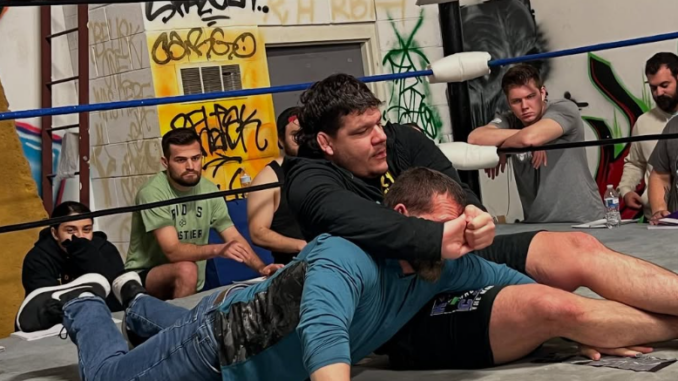
In the early 2000’s there weren’t nearly as many training schools, and talent needed to work on the road to get proper seasoning, but now we have many reputable training schools in any area, thus placing talent on similar or equal levels. Again, this is great for wrestlers to have the opportunity to make life-changing money early in their careers, but it’s also a big part of why the “Super Indie” companies of the 2010s are either gone or have reformatted their brand to focus on more local talent. John Thorne, who has run AIW since 2005 and assisted in training me, saw the shift coming many years ago. In 2018, he told me that we needed to focus on training our students to be ready to take spots that would be left by roster members who we wouldn’t be able to use as much, and if you look at the current AIW roster, it is largely that. We have had over twenty-five students complete our training school. It has helped us with what our core roster is, and it’s what you’re seeing other former “Super Indies” do.
In the end, it’s totally fine to pine for what was and what we had in 2016, but as it currently stands, that’s not coming back. I think the important thing for fans to do is stop yelling into echo chambers that Independent Wrestling is dead, because it’s not. What you used to know about independent wrestling is dead, and you have to get ready to support what it’s going to be as we move forward